The Complete Guide to Renting a Trailer from a Neighbor: Everything Renters Need to Know
 Neighbors Trailer
Apr 21, 2026 516 15 min read Renting from a neighbo
Peer-to-Peer Trailer Rental: The Complete Guide
For decades, renting a trailer in the United States meant exactly three things: driving to a U-Haul lot, calling a Penske branch, or visiting a Budget counter. If the closest location did not have what you needed, you waited, paid more, or made a second trip. That was the system.
Peer-to-peer trailer rental changed that. On a marketplace like Neighbors Trailer, the trailer you need is often parked three blocks away in a neighbor's driveway, owned by someone who uses it on weekends and would happily earn a few hundred dollars renting it to you during the week. You search, book, pick up, use it, and return it, all through the platform.
This guide is a complete reference for renters. It covers what peer-to-peer trailer rental actually is, when it is the right choice and when it is not, what the real costs look like, which trailer types exist and how to choose one, whether your vehicle can tow the trailer you want, how insurance and protection work, the basic safety rules every first-time renter should know, and what happens if something goes wrong along the way.
Read it top to bottom if you have never rented this way before, or skip to the section you need if you are already partway into your decision.

1. What Peer-to-Peer Trailer Rental Actually Is
Peer-to-peer trailer rental is a marketplace model. Instead of a company owning a fleet of trailers and renting them out from centralized lots, individual trailer owners list their personal trailers for rent, and renters book those trailers through a platform that handles discovery, payment, identity verification, and protection. Think Airbnb, but for the trailer you would otherwise drive across town to rent from a corporate yard.
The difference matters more than it sounds. On a peer-to-peer platform, inventory is distributed across every neighborhood instead of concentrated at a few branches. Pricing is set by individual owners, which means it tends to reflect local demand rather than national corporate rates. Trailer selection is wider because owners list the specific trailers they actually use, including dump trailers, gooseneck trailers, enclosed car haulers, landscaping trailers, and equipment trailers that corporate rental fleets rarely stock.
The exchange is also more human. You message the owner before pickup, you inspect the trailer together, and you return it the same way. For most renters, that turns out to be a feature rather than friction. For a smaller group, who want the anonymity and 24-hour counter of a corporate rental, it is a reason to go a different route. Both responses are fair.
2. Who Should (and Shouldn't) Rent Peer-to-Peer
Peer-to-peer is a strong fit for most renters, but not all. Being direct about the not-a-fit cases up front saves everyone time.
It is a strong fit if you have a local job, a weekend project, or a short multi-day haul. It is a strong fit if you know what type of trailer you need and want something specific, like a 16-foot tandem utility, a dump trailer, or an enclosed car hauler, rather than whatever happens to be on the corporate lot that morning. It is a strong fit if you want to save money, since peer-to-peer rates typically come in below corporate rates for the same trailer type. It is a strong fit if you are comfortable coordinating pickup and return times with another person by text or in-app message.
It is not the right fit for every situation. If you are doing a one-way interstate move and need to drop the trailer 800 miles from where you picked it up, a traditional rental company with nationwide locations is still the better answer. If you need a trailer within the next two hours in a low-density zip code where there is little listed inventory, corporate rental yards with walk-up counters will beat the marketplace. If you strongly prefer zero interaction with the owner and want a purely transactional counter experience, peer-to-peer will feel different than what you are used to.
Most renters fall into the first group. But if you fall into the second, that is good to know before you spend time searching.
3. The Real Cost of Renting Peer-to-Peer vs Traditional
Cost is the first question most renters ask, so it is worth answering clearly. On a peer-to-peer platform, the total you pay is the daily rate set by the owner, plus a small platform fee, plus optional protection. On a corporate rental, you pay a daily rate, a per-mile charge, a mandatory coverage fee, and often an environmental fee, a location fee, and a fuel surcharge. The pricing model is different, and the corporate model is usually where the hidden costs accumulate.
Here is a representative comparison for a two-day local rental of a utility trailer:
| Cost Component | Corporate Rental | Peer-to-Peer |
|---|---|---|
| Daily rate (2 days) | $60 to $90 | $40 to $70 |
| Mileage charge | $0.40 to $0.99 per mile | Usually none |
| Mandatory coverage | $10 to $20 per day | Optional, a few dollars per day |
| Environmental & location fees | $5 to $15 | None |
| Platform/service fee | Built into rate | 10% renter fee |
| Typical total for 2-day local | $140 to $220 | $70 to $120 |
The delta widens for multi-day rentals and specialty trailers. For a detailed breakdown with specific scenarios, read our guide on how much it costs to rent a trailer or the deeper pricing analysis in trailer rental prices explained.
There is also a 10% renter fee on Neighbors Trailer, which funds the platform, the identity verification system, the support team, and the technology that keeps the marketplace running safely. Most renters find it worth the cost because the underlying trailer is priced well below corporate rates to begin with.
NeighborsTrailer.com
4. Trailer Types and When to Use Each
One of the biggest advantages of peer-to-peer is selection. Corporate fleets standardize around a handful of trailer types because they have to. A marketplace of individual owners naturally offers a wider variety. Here is a quick reference for the main types you will see.

Utility Trailers
Open trailers with sides, typically four to seven feet wide and eight to sixteen feet long. Best for yard work, small furniture moves, landscaping debris, ATVs, and general-purpose hauling when weather is not a factor.
Enclosed Cargo Trailers
Boxed trailers with a rear ramp or double doors. Best for long-distance moves, protecting valuables from weather, and anything that cannot get wet. Also the most common trailer type for small business use.
Car Haulers
Open trailers with loading ramps, typically 16 to 20 feet long, designed to carry one vehicle. Used for transporting a non-running car, delivering a project vehicle, or moving a classic that you do not want to put miles on.
Dump Trailers
Trailers with hydraulic lift beds that tip to dump contents. Used for landscaping debris, gravel, mulch, demolition material, and anything heavy that you do not want to unload by hand. Usually require a larger tow vehicle.
Gooseneck and Flatbed Trailers
Heavy-duty trailers used for large equipment, tractors, hay, lumber, and industrial loads. Gooseneck trailers attach in the bed of a pickup rather than at a standard hitch receiver. These are niche but widely available on peer-to-peer platforms where corporate rental fleets rarely stock them.
Motorcycle and Specialty Trailers
Smaller trailers purpose-built for motorcycles, jet skis, snowmobiles, and similar equipment. These are almost never available at corporate rental counters but common in driveways across the country.
Not sure what type you need? Browse active listings on the platform, or read our utility trailer guide for the most common everyday use case.
5. Can Your Vehicle Actually Tow It?
This is the question most first-time renters skip, and it is the single most important one. Every vehicle has a towing capacity rating, usually found in the owner's manual or on a sticker inside the driver-side door jamb. Every trailer has a loaded weight. The first must exceed the second, with meaningful margin.

Three numbers matter. GVWR, or gross vehicle weight rating, is the maximum the trailer can weigh fully loaded. Tongue weight is what the trailer presses down on your hitch, typically 10% to 15% of loaded trailer weight. Payload is how much weight your vehicle can carry, which includes passengers, cargo, and the tongue weight of whatever you are towing.
A half-ton pickup can typically tow 7,000 to 10,000 pounds, which covers most utility, enclosed, and car hauler rentals comfortably. A midsize SUV can usually tow 3,500 to 5,000 pounds, which is fine for smaller utility trailers and some enclosed cargo trailers but not dump trailers or fully loaded car haulers. A sedan or crossover is typically limited to 1,500 pounds or less and should only be used for the smallest utility trailers.
For a full walkthrough of what your specific vehicle can handle, read can your vehicle safely tow a trailer and our technical breakdown of trailer towing capacity, GVWR, GCWR, and payload.
You may also need a brake controller. Trailers above a certain weight threshold (varies by state, typically 3,000 pounds) are required by law to have functioning trailer brakes, and those brakes must be controlled by a device installed in the tow vehicle. Our guide on whether you need a brake controller walks through the rules by trailer type.
6. How a Peer-to-Peer Booking Actually Works
Here is the full flow, step by step, so nothing about the experience is a surprise.

You search the platform by location, dates, and trailer type. You review listings, which include photos, specs, daily rate, pickup address, and owner reviews from previous renters. You pick a trailer that fits and submit a booking request. You complete identity verification, which confirms you are over 21 and have a valid driver's license. You pay for the rental through the platform. The owner approves the booking.
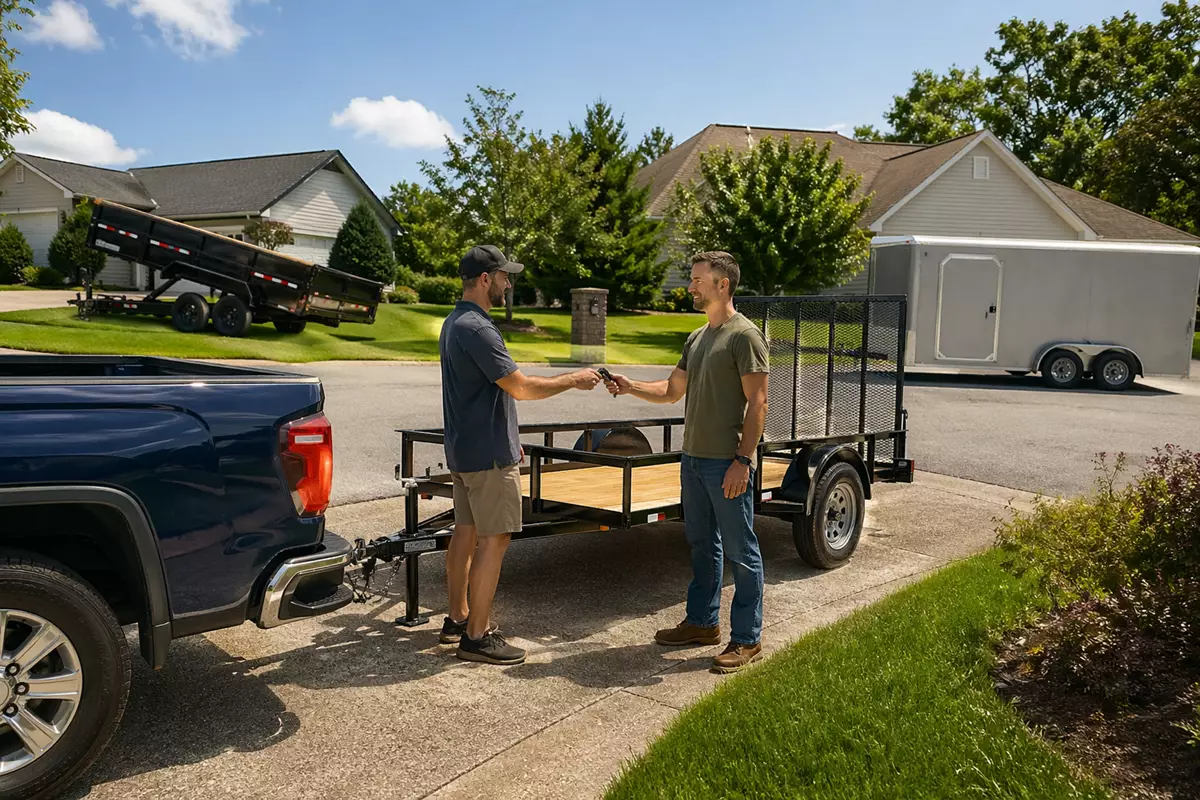
On pickup day, you meet the owner at the agreed location, inspect the trailer together, and walk through the hitch connection and the light check. You connect the trailer to your tow vehicle, snap a few photos documenting condition, and head out. During the rental, you can message the owner through the platform if anything comes up.
On return day, you bring the trailer back at the agreed time, do a brief joint inspection, and you are done. The platform releases payment to the owner. Both of you leave reviews. That is the full experience.
No paperwork mountain, no lot line, no surprise fees, and no negotiation over whether the scratch was there when you picked it up, because you documented the trailer's condition with timestamped photos at pickup.
7. Insurance and Protection: What Is Actually Covered
This is the single biggest question most first-time renters have, and for good reason. Understanding how protection works before you book is worth the five minutes it takes.
Your personal auto insurance policy almost certainly covers your liability for property damage and bodily injury caused by an accident while towing, because it covers you as a driver regardless of whether the trailer is yours. What it typically does not cover is physical damage to the rented trailer itself. That is the gap protection products are designed to fill.
Neighbors Trailer offers a protection product called NT Protect that costs a few dollars per day. It covers physical damage to the trailer up to its actual cash value, with a $500 renter deductible.
For a full explanation of how coverage works on peer-to-peer platforms and how NT Protect compares to corporate rental CDW, read peer-to-peer trailer rental insurance explained and our overview of NT Protect.
8. Safety Basics Every First-Time Renter Should Know
You do not need to be a professional hauler to tow a trailer safely. You do need to get a few things right. Here is the minimum.

Confirm the hitch ball size matches the trailer coupler. Most trailers use a 2-inch or 2 5/16-inch ball. Mixing sizes is the single most common first-timer mistake and will cause the trailer to disconnect while driving. Snap the coupler latch closed and pin it. Cross your safety chains under the tongue so they form a cradle if the coupler fails. Connect the electrical plug and verify that the turn signals, brake lights, and running lights all work before you leave the driveway.
Once you are on the road, drive slower than you think you need to. Leave more stopping distance than you normally would, because a loaded trailer roughly doubles your stopping distance. Turn wider than you would in your car alone, because the trailer wheels track inside your vehicle wheels through a turn. Never back up without a spotter if you can avoid it, and always back up slowly.
Our trailer safety 101 guide covers the full pre-trip and road checklist in more detail.
9. State Laws You Need to Know Before Towing
Towing laws vary by state. The specifics that change from state to state include the weight threshold that requires trailer brakes, speed limits for vehicles towing trailers, the GVWR at which a commercial driver's license becomes required, and the rules for safety chains, breakaway switches, and trailer lighting.
If you are renting in Texas, our guide on the top 10 essential trailer towing laws in Texas covers the specifics. If you are renting elsewhere, check your state's department of transportation or department of motor vehicles site before your first long tow. Most of the rules are common sense, but the weight thresholds that trigger additional requirements vary meaningfully, and it is worth knowing them up front.
10. What to Do If Something Goes Wrong
Most rentals go smoothly. Occasionally they do not. Here is how to think about the edge cases.
If the trailer has a flat, a light goes out, or a bearing fails during the rental, message the owner first. Most owners will help you troubleshoot or point you toward a nearby tire shop. If something more serious happens, contact Neighbors Trailer support through the platform.
If you accidentally damage the trailer, document what happened with photos and message the owner as soon as possible. If you have NT Protect, file a claim through the platform and pay your $500 deductible. If you declined NT Protect, you are responsible for the full cost of the damage up to the trailer's actual cash value.
If you have a dispute with the owner (for example, the trailer was not as described, or there is disagreement about damage that already existed at pickup), the platform support team handles mediation. The pickup-time photos you took will be the single most valuable piece of evidence, which is why every rental should include them.
11. How to Be a Renter Owners Want to Book
Peer-to-peer works because both sides of the marketplace trust each other. That trust is built one booking at a time through reviews. Being a good renter is not complicated: communicate clearly, arrive on time for pickup and return, return the trailer clean and in the condition you received it, and leave an honest review.
Good renters get better booking acceptance rates, sometimes get small favors from owners (flexible pickup times, help hitching up for first-time renters), and build a review history that makes their next booking easier. Over time, you become someone owners want to say yes to.
12. Frequently Asked Questions
What is the minimum age to rent on Neighbors Trailer?
21 years old with a valid driver's license.
Do I need to show insurance to rent?
Your personal auto insurance typically covers your liability while towing. NT Protect is an optional add-on that covers physical damage to the trailer itself.
Can I rent a trailer without a truck?
You need a vehicle capable of towing the specific trailer you rent. A small utility trailer can often be towed by a midsize SUV or crossover. A dump trailer or car hauler typically requires a full-size pickup.
What happens if I return the trailer late?
Late return fees are set by the owner and disclosed in the listing. Message the owner as early as possible if you are running behind; most will accommodate if you communicate in advance.
How do I cancel a booking?
Cancellation policies are listed on each trailer. Most owners offer a full refund if you cancel more than 24 or 48 hours in advance. Last-minute cancellations may incur a fee.
What if the trailer is not as described when I arrive?
Do not accept the trailer. Contact Neighbors Trailer support through the platform. You will not be charged for a rental you do not accept.
Is peer-to-peer really cheaper than U-Haul?
For most local rentals, yes, meaningfully so. For one-way interstate moves, corporate rental can still be more convenient because of nationwide drop-off locations. Our blog on peer-to-peer savings walks through specific scenarios.
Closing: Your First Booking
Peer-to-peer trailer rental is how most people will rent trailers in the next five years, the same way peer-to-peer car rental and peer-to-peer home rental became normal over the last decade. It is cheaper, the selection is wider, and the experience is more human. For most local rentals, it is already the better answer.
The best way to learn the model is to try it once. Search trailers in your zip code, pick one that fits your project, and book it. Your first booking will teach you more than any guide can. If you want tips on how to get the most value out of that first booking, our list of top 10 tips to save money on your trailer rental is a good place to start.