

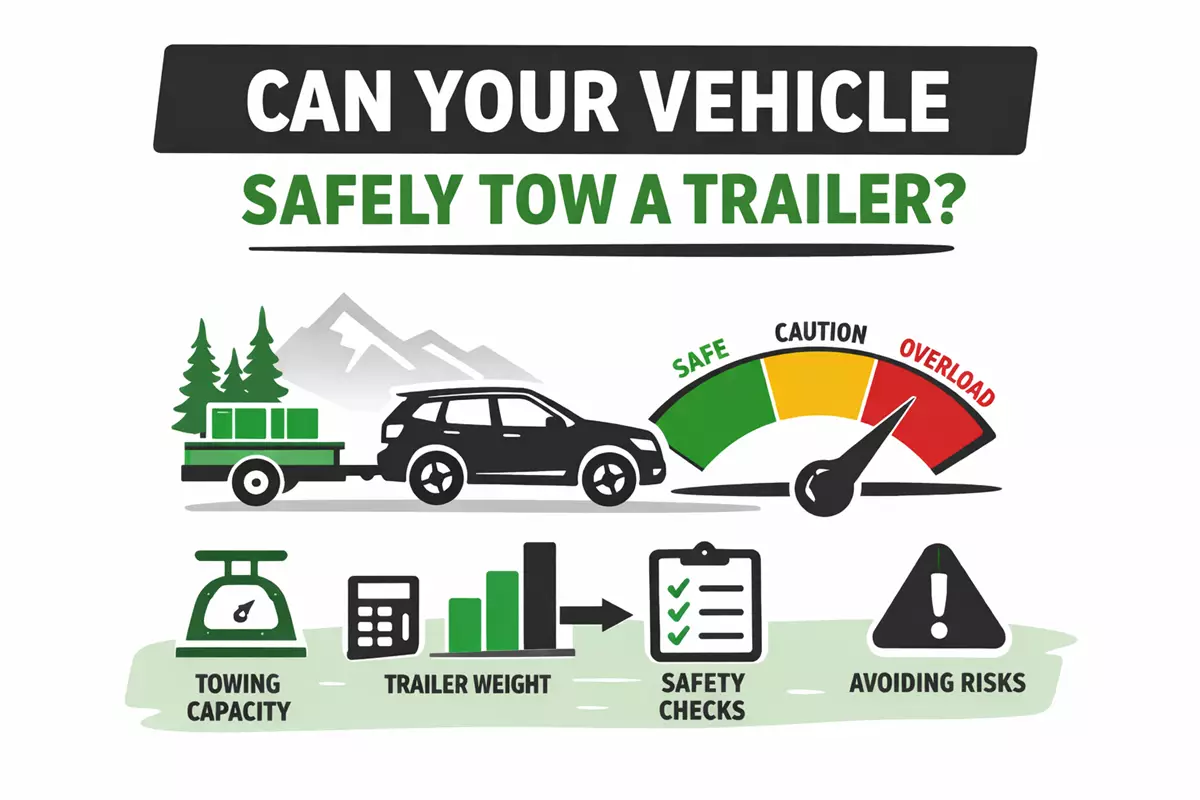
Can Your Vehicle Safely Tow a Trailer?
 Neighbors Trailer
Feb 10, 2026 591 10 min read can your vehicle tow a trailer
The Complete, Safety-First Guide for Renters
If you’re thinking about renting a trailer, there’s one question that matters more than price, size, or availability:
Can my vehicle tow a trailer safely?
This guide answers that question clearly, without jargon or guesswork. Whether you drive a car, SUV, truck, or electric vehicle, you’ll learn how towing capacity really works, how trailer weight is calculated, and how to avoid the most common (and costly) towing mistakes.
Quick Answer: Can My Vehicle Tow a Trailer?
Maybe — it depends on three key factors:
- Your vehicle’s towing capacity
- The actual loaded weight of the trailer
- How the trailer is set up (tongue weight, brakes, hitch, and load balance)
Two vehicles that look identical can have very different towing limits depending on engine, drivetrain, axle ratio, and trim level.
Many towing problems don’t happen because a vehicle can’t tow — they happen because the trailer weighs more than the driver realizes.
Need a quick way to calculate your numbers?
Download our Towing Capacity Quick Calculator Card (PDF) to quickly check trailer weight, tongue weight, and payload before towing.
Checking towing capacity alone isn’t enough.
You also need to consider:
- Payload limits
- Tongue weight
- Braking requirements
- Hitch setup
- Overall vehicle configuration
Many unsafe towing situations happen when drivers exceed one rating without understanding how the numbers work together.
Let’s break it down
In this guide, you’ll learn:
- How to find your vehicle’s true towing capacity
- The difference between towing and payload ratings
- How tongue weight affects your truck
- Common mistakes that lead to unsafe towing
- How to confirm your vehicle is properly equipped
By the end, you’ll know whether your vehicle can safely handle the trailer you plan to tow — and what to check before you hit the road.
How to Find Your True Towing Capacity
Your vehicle’s towing capacity is not a guess — it’s a manufacturer-rated limit based on engineering specifications.
But finding the correct number requires more than just typing your vehicle into Google.
Step 1: Identify Your Exact Vehicle Configuration
Towing capacity can vary significantly based on:
- Engine size
- Drivetrain (2WD vs 4WD)
- Axle ratio
- Cab size
- Bed length
- Factory towing package
Two trucks with the same model year and trim can have very different ratings.
For example:
A 2022 Ford F-150 with a 3.3L V6 may tow far less than the same model with a 3.5L EcoBoost and Max Tow Package.
Always verify your exact configuration.
Step 2: Check Reliable Sources
The most accurate places to confirm towing capacity are:
- Your owner’s manual
- The manufacturer’s official towing guide (available online)
- The manufacturer’s website
- A dealership with your VIN
You may also find helpful information by searching:
“Year + Make + Model + Engine + towing capacity”
But confirm the engine and drivetrain match your vehicle exactly.
Step 3: Understand What the Rating Actually Means
Your maximum towing capacity assumes:
- Properly functioning brakes
- Proper hitch setup
- Proper load distribution
- No overloaded payload
It is not a target — it is a limit.
Staying slightly below your maximum rating provides a safety buffer and improves braking and stability.
Towing Capacity vs. Payload: What Most Drivers Miss
Most towing problems don’t happen because a vehicle can’t tow.
They happen because the driver stayed under towing capacity — but exceeded payload.
Understanding the difference is critical.

Towing Capacity (What You Can Pull)
Towing capacity is the maximum weight your vehicle can pull behind it.
This includes:
- The trailer’s empty weight
- Everything loaded inside the trailer
If your truck is rated to tow 7,500 lbs, the fully loaded trailer must not exceed 7,500 lbs.
But that number assumes ideal conditions.
Real-World Example

Your Truck Ratings
- Towing Capacity: 7,500 lbs
- Payload Capacity: 1,500 lbs
Your Trailer & Load
- Loaded trailer weight: 6,000 lbs
- Estimated tongue weight (10%): 600 lbs
You also have:
- 400 lbs of passengers
- 200 lbs of gear in the bed
Payload Calculation
600 (tongue weight)
- 400 (passengers)
- 200 (bed cargo)
= 1,200 lbs total payload used
What This Means
- You are within towing capacity (6,000 lbs < 7,500 lbs)
- You are within payload capacity (1,200 lbs < 1,500 lbs)
You still have:
- 1,500 − 1,200 = 300 lbs of remaining payload capacity
- 7,500 − 6,000 = 1,500 lbs of remaining towing capacity
You’re under towing capacity.
But you’re much closer to your payload limit than you may realize.
The Most Common Mistake
Drivers focus on towing capacity and ignore payload.
This can lead to:
- Rear suspension sag
- Reduced steering control
- Longer stopping distances
- Increased sway
- Accelerated wear on suspension and brakes
Staying within both limits is essential.
The Safe Towing Rule
For safe towing:
- Total trailer weight must be at or below towing capacity
- Total vehicle load (passengers + cargo + tongue weight) must be at or below payload capacity
Both limits matter. Not just one.

Important Reminder
Towing capacity alone does not determine whether your vehicle can safely tow a trailer.
You must also consider:
- Payload capacity
- Tongue weight
- Passenger weight
- Cargo in the truck bed
We’ll cover how those numbers work together next.
For a complete breakdown of safe towing practices — including braking distance, tongue weight calculations, and real-world examples — review our Ultimate Trailer Towing Safety Guide.
Payload Capacity (What Your Vehicle Can Carry)
Payload capacity is the maximum weight your vehicle can carry on itself.
This includes:
- Passengers
- Cargo in the truck bed
- Aftermarket accessories
- Tongue weight from the trailer
Payload capacity is often listed on a sticker inside the driver-side door.
This is where many drivers unknowingly exceed safe limits.
Tongue Weight: The Stability Factor Most Drivers Ignore
Tongue weight doesn’t just affect your payload rating — it directly affects how your vehicle handles on the road.
Even if you’re within towing capacity, improper tongue weight can make towing unstable.
What Happens If Tongue Weight Is Too Low?
When there isn’t enough weight pressing down on the hitch:
- The trailer may sway at highway speeds
- Steering can feel light or “floaty”
- Crosswinds and passing trucks can push the trailer
- Sudden lane changes become more dangerous
Low tongue weight is one of the leading causes of trailer sway.
What Happens If Tongue Weight Is Too High?
When too much weight presses down on the hitch:
- Rear suspension may sag
- Front steering traction can be reduced
- Headlights may aim upward
- Braking distance can increase
- Suspension and tires experience added strain
Excess tongue weight doesn’t just feel heavy — it reduces control.
The Safe Target Range
For most trailers:
Aim for 10–15% of the trailer’s fully loaded weight on the hitch.
Proper load placement helps maintain this balance:
- Place heavier items slightly forward of the trailer axle
- Avoid stacking weight too far toward the rear
- Secure the load to prevent shifting
Even small adjustments in load placement can significantly improve stability.
Why This Matters
You can be under your towing capacity and still tow unsafely if tongue weight isn’t balanced.
Safe towing isn’t just about numbers — it’s about control.
Vehicle Type Breakdown: What Can Tow What
Cars & Sedans
Most cars are not designed for towing or are limited to very light loads.
- Typical towing range: 0–1,500 lbs
- Best for: Small utility trailers, very light loads
- Not recommended for: Enclosed trailers, long-distance towing
SUVs & Crossovers
SUVs vary widely depending on size and drivetrain.
| SUV Type | Typical Towing Range |
| Compact crossover | 1,500–2,000 lbs |
| Mid-size SUV | 3,500–5,000 lbs |
| Full-size SUV | 7,000–9,000+ lbs |

Pickup Trucks
Trucks are built for towing, but payload still matters.
| Truck Class | Typical Towing Range |
| Mid-size | 5,000–7,000 lbs |
| Half-ton (150/1500) | 8,000–13,000 lbs |
| ¾-ton & 1-ton | 12,000–20,000+ lbs |
Electric Vehicles (EVs)
EVs can tow — but with important caveats.
- Range reduction of 30–50% is common
- Heat and braking demand increase
- Weight limits still apply
EV towing works best for short trips and lighter trailers, especially utility trailers.
Trailer Weight Explained (Where Most People Get It Wrong)
One of the biggest towing mistakes is relying on empty trailer weight.
The difference that matters
- Empty (dry) weight: Trailer with no cargo
- Loaded weight: Trailer + everything inside it
A “light” utility trailer can gain hundreds of pounds once loaded.
Real-world example
A 5×8 utility trailer:
- Empty weight: ~900 lbs
- Lawn equipment + tools: 800 lbs
- Tie-downs + ramps: 100 lbs
Total towed weight: ~1,800 lbs
This is why guessing is risky — and why understanding loaded weight is critical.

Tongue Weight: The Most Ignored Safety Factor
Tongue weight is how much downward force the trailer puts on the hitch.
Ideal tongue weight
- 10–15% of total trailer weight
| Trailer Weight | Ideal Tongue Weight |
| 1,500 lbs | 150–225 lbs |
| 3,000 lbs | 300–450 lbs |
| 5,000 lbs | 500–750 lbs |
Why it matters
- Too little → trailer sway
- Too much → rear suspension sag, steering loss
Even if your vehicle can tow the weight, poor tongue weight can make towing dangerous.
Common Trailer Types & Typical Weights
| Trailer Type | Empty Weight | Common Loaded Range |
| Utility trailer | 600–1,200 lbs | 1,200–3,000 lbs |
| Enclosed trailer | 1,200–2,500 lbs | 2,500–6,000 lbs |
| Dump trailer | 2,000–4,000 lbs | 5,000–10,000+ lbs |
| Car hauler | 1,800–2,500 lbs | 4,000–7,000 lbs |
Pro tip: Always base your towing decision on the trailer’s fully loaded weight—not the empty weight—because gear, tools, and tie-downs can easily double what you’re actually towing.
Real-World Towing Scenarios
Can a mid-size SUV tow a 5×8 utility trailer?
Usually yes — if:
- The trailer is lightly loaded
- Tongue weight stays within limits
- No additional heavy cargo is in the vehicle
Can a crossover tow an enclosed trailer?
Usually not recommended, even if towing capacity looks sufficient on paper.
Can a truck tow safely but still stop?
Braking matters as much as pulling power. That’s why trailer brakes are critical at higher weights.
What Else You Need (Beyond the Vehicle)
Hitch classes
| Hitch Class | Max Trailer Weight |
| Class I | 2,000 lbs |
| Class II | 3,500 lbs |
| Class III | 8,000 lbs |
| Class IV/V | 10,000+ lbs |
Pro tip: Your hitch class limits how much you can tow just as much as your vehicle does, so always confirm the hitch rating matches—or exceeds—your trailer’s loaded weight, not just its empty weight.
Other essentials
- Correct ball size
- Safety chains
- Working lights
- Brake controller (when required)
Safety Checklist Before You Tow
Before you rent or haul, confirm:
✔ Vehicle towing capacity verified
✔ Trailer loaded weight estimated
✔ Tongue weight within range
✔ Hitch and ball properly matched
✔ Lights and brakes tested
✔ Load secured and balanced
✔ Tires inflated correctly
This checklist alone prevents most towing issues.
What Happens If You Tow More Than You Should
Towing beyond safe limits can lead to:
- Poor handling and sway
- Longer stopping distances
- Transmission and brake damage
- Increased accident risk
- Insurance and liability issues
Safe towing protects you, your vehicle, and the people around you.
How Neighbors Trailer Helps Reduce Risk
Neighbors Trailer encourages safer rentals by:
- Providing clear trailer details
- Promoting proper trailer-vehicle matching
- Educating renters before they tow
- Supporting responsible owners
The goal isn’t to tow more — it’s to tow smart.
Frequently Asked Questions
Can I tow a trailer with an SUV?
Yes, many SUVs can — as long as weight limits and setup are correct.
Do I need trailer brakes?
Often required above certain weights and recommended for safety even when not legally required.
Is towing dangerous for beginners?
Not when done correctly and conservatively.
Can I tow without a brake controller?
Only if the trailer does not have brakes and is within safe limits.
Final Takeaway
If you remember one thing, remember this:
Safe towing isn’t about what your vehicle can do — it’s about what it should do.
Understanding towing capacity, trailer weight, and setup turns towing from stressful guesswork into a confident, safe experience.
This article has been revised on 2/15/26 to improve accuracy.