

Do I Need a Brake Controller to Tow a Trailer? (2026)
 Neighbors Trailer
Mar 20, 2026 1308 12 min read towing, trailer, brake, safety, trailer renta
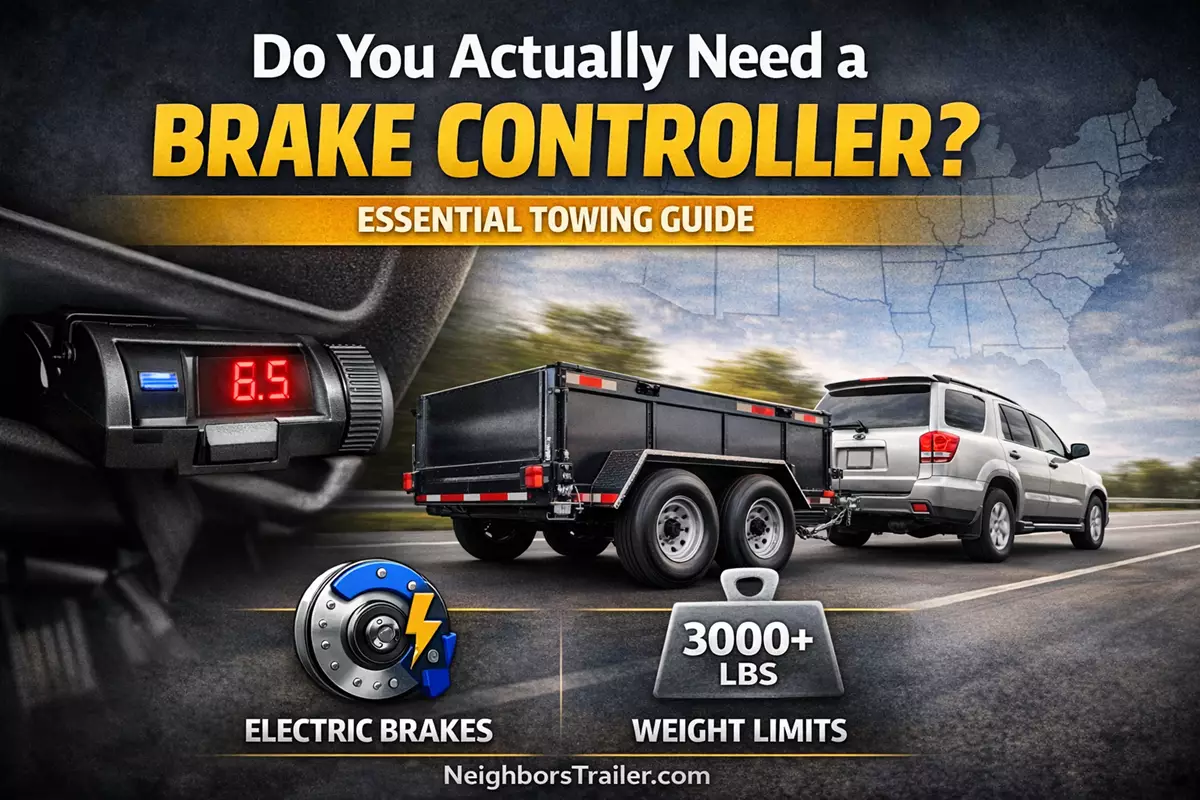
Do You Actually Need a Brake Controller? Here's the Short Answer
You're about to rent a trailer for a move, a landscaping haul, or a weekend project. You've matched the hitch, checked your tow vehicle's capacity, and you're almost ready to go. Then a question stops you: does this trailer need a brake controller?
Short answer:
• If the trailer has electric brakes → you need a brake controller
• If it has surge brakes → you don’t
• If your trailer exceeds your state’s weight limit → brakes are legally required
No controller = no trailer braking.
Think of it like this: without a brake controller, your trailer is just a heavy object being pushed forward with no ability to slow itself down.
The short answer depends on two things: whether the trailer has electric brakes, and what your state law requires based on the trailer's weight. If the trailer has electric brakes, you absolutely need a brake controller in your tow vehicle to activate them. Without one, those brakes are dead weight, and your vehicle is doing all the stopping alone, pushing stopping distances to dangerous levels. See how much your stopping distance grows with trailer weight using the Stopping Distance Calculator.
But the deeper question, the one most first-time renters get wrong, is whether the trailer even requires brakes at all. That answer changes depending on what state you're towing in. This guide breaks down the weight thresholds state by state, explains how brake controllers work, and helps you choose the right setup so your next Neighbors Trailer rental is safe, legal, and stress-free.
What a Brake Controller Does and Why It Matters
How Electric Trailer Brakes Work
Most rental trailers over 3,000 pounds come equipped with electric brakes. These brakes use electromagnets inside each brake drum that activate when electrical current flows through the trailer's blue brake wire. The more current that flows, the stronger the magnets pull, and the harder the brakes clamp down. But here's the catch: that current has to come from somewhere. Your tow vehicle's brake pedal doesn't automatically send power to the trailer. That's the brake controller's job.
A brake controller is a small device, either built into your tow vehicle's dash or plugged into the trailer wiring harness, that detects when you press the brake pedal and sends a proportional electrical signal to the trailer's brakes. Press lightly, and it sends a small amount of current. Brake hard, and it sends the maximum. The result is coordinated stopping power between your vehicle and the trailer, which dramatically shortens stopping distances and reduces strain on your tow vehicle's brakes.
What Happens Without a Brake Controller
If your trailer has electric brakes but you tow without a controller, those brakes never engage. Your tow vehicle's brakes are handling the stopping force for both the vehicle and the fully loaded trailer. On a 6,000-pound trailer, that means your brakes are working nearly twice as hard as they were designed to. Stopping distances increase dramatically, brake fade sets in faster (especially on long downhill grades), and the risk of rear-ending the vehicle ahead of you goes up significantly.
For a full breakdown of towing capacity, GVWR, and how weight affects your vehicle's performance, check out our guide to trailer towing capacity and payload.
When Does Your State Require Trailer Brakes?
Every state sets its own weight threshold for when a trailer must be equipped with brakes. If you're towing across state lines, you need to comply with the law in whichever state you're currently driving through, not just your home state. The table below covers the threshold for every U.S. state so you can check your route before you tow.
| State | Brakes Required Above (lbs) | State | Brakes Required Above (lbs) |
|---|---|---|---|
| Alabama | 3,000 | Montana | 3,000 |
| Alaska | All trailers | Nebraska | 3,000 |
| Arizona | 3,000 | Nevada | 1,500 |
| Arkansas | 3,000 | New Hampshire | 3,000 |
| California | 1,500 | New Jersey | 3,000 |
| Colorado | 3,000 | New Mexico | 3,000 |
| Connecticut | 3,000 | New York | 1,000 |
| Delaware | 4,000 | North Carolina | 4,000 |
| Florida | 3,000 | North Dakota | 3,000 |
| Georgia | 3,000 | Ohio | 2,000 |
| Hawaii | 3,000 | Oklahoma | 3,000 |
| Idaho | 1,500 | Oregon | 1,500 |
| Illinois | 3,000 | Pennsylvania | 3,000 |
| Indiana | 3,000 | Rhode Island | 4,000 |
| Iowa | 3,000 | South Carolina | 3,000 |
| Kansas | 3,000 | South Dakota | 3,000 |
| Kentucky | 4,000 | Tennessee | 3,000 |
| Louisiana | 3,000 | Texas | 4,500 |
| Maine | 3,000 | Utah | 2,000 |
| Maryland | 3,000 | Vermont | 3,000 |
| Massachusetts | 10,000 | Virginia | 3,000 |
| Michigan | 3,000 | Washington | 3,000 |
| Minnesota | 3,000 | West Virginia | 3,000 |
| Mississippi | 2,000 | Wisconsin | 3,000 |
| Missouri | 3,000 | Wyoming | 3,000 |
Weight thresholds shown reflect gross trailer weight (GTW) or GVWR depending on the state's specific statute. Some states have additional requirements for brakes on all wheels above higher weight thresholds. Always verify current requirements with your state's DMV or department of transportation before towing, as laws can change.
For a broader look at speed limits, licensing rules, and other towing regulations, read our full trailer towing laws by state guide for 2026.
How States Break Down by Weight Threshold
Looking at the full map of state requirements, a clear pattern emerges. The vast majority of states cluster around the 3,000-pound mark, but there are notable outliers on both ends. Here's how the 50 states distribute across the most common weight thresholds:

Number of U.S. states at each trailer brake weight threshold. Includes Alaska, which requires brakes on all trailers regardless of weight, grouped with the strictest category.
The takeaway? If your loaded trailer weighs more than 3,000 pounds, you need brakes in the overwhelming majority of states. If it's over 1,500 pounds, you need brakes in California, Nevada, Idaho, and Oregon. And if you're towing in New York, brakes kick in at just 1,000 pounds.
Types of Brake Controllers and How to Choose
Not all brake controllers are created equal. There are three main types, and the right choice depends on your tow vehicle, how often you tow, and your budget.
Proportional (Inertia-Based) Controllers
Proportional controllers use an internal accelerometer to sense how quickly your tow vehicle is decelerating. They then send a matching level of braking force to the trailer in real time. Press the brakes gently, and the trailer brakes gently. Stomp the pedal in an emergency, and the trailer brakes lock up right alongside your vehicle. This creates the smoothest, most natural braking feel and reduces wear on both your vehicle's and the trailer's brake components. Popular models include the Tekonsha Prodigy P3 and the Curt Spectrum. Proportional controllers typically cost between $80 and $200.
Time-Delayed Controllers
Time-delayed controllers apply a preset amount of braking force to the trailer after a short delay when you press the brake pedal. You set the maximum braking intensity and the ramp-up time manually. These are simpler, less expensive (usually $30 to $80), and work fine for occasional towing. The trade-off is less smooth braking, because the controller doesn't adapt to how hard you're pressing the pedal. You may notice a slight lurch or uneven deceleration, especially at lower speeds.
Trailer-Mounted Wireless Controllers
A newer category, trailer-mounted controllers attach directly to the trailer and communicate with your smartphone via Bluetooth. These are ideal for renters because they don't require any permanent wiring in your tow vehicle. The controller mounts near the trailer's brake wiring and includes its own inertia sensor. You adjust settings through an app on your phone. These typically run $250 to $400 but eliminate the need for a plug-in controller in your vehicle's cab. Brands like Elecbrakes and AutowBrake are the most established in this space.
Does Your Tow Vehicle Already Have One?
Many newer trucks and SUVs come with a factory-installed brake controller, especially if the vehicle was ordered with a towing package. Check your owner's manual or look at your vehicle's dash for a brake controller display or manual override slider. Common vehicles with factory-installed controllers include most Ram, Ford, Chevrolet, and GMC trucks from 2015 onward (with the towing package), as well as some Toyota Tundra and Nissan Titan models.
If your vehicle has a factory controller, all you need to do is plug in the trailer's 7-pin connector and the controller will detect the trailer's brakes automatically. You may need to adjust the gain (braking intensity) setting for the specific trailer you're towing, but the hardware is already in place.
If your vehicle doesn't have a factory controller, you can install an aftermarket plug-in unit yourself in about 15 minutes. Most aftermarket controllers plug directly into the vehicle's existing trailer wiring harness under the dash. No cutting or splicing required.
What If Your Rental Trailer Has Surge Brakes Instead?
Not all trailer brakes are electric. Some trailers, especially boat trailers and certain enclosed cargo trailers, use surge brakes (also called hydraulic brakes). Surge brakes work mechanically: when you slow down, the trailer pushes forward against the hitch coupler, compressing a master cylinder in the trailer's tongue that activates hydraulic brakes on the wheels.
The key advantage of surge brakes for renters is that they don't require a brake controller at all. They activate automatically based on the physics of deceleration. If the trailer you're renting on Neighbors Trailer has surge brakes, you can tow it with any vehicle that has the right hitch and towing capacity, with no additional equipment needed.
When browsing trailer listings, check whether the owner mentions electric brakes or surge brakes. If the listing doesn't specify, message the owner before booking to confirm. Knowing the brake type before you pick up the trailer saves you from scrambling to find a controller at the last minute.
Protect Your Rental with the Right Coverage
Whether your trailer uses electric brakes, surge brakes, or no brakes at all, things can go wrong on the road. A sudden stop, an unexpected obstacle, or a mechanical issue can lead to trailer damage that isn't covered by your personal auto policy. NT Protect, available on every Neighbors Trailer booking, provides coverage for accidental damage during your rental for just a few dollars per day. With a $500 deductible, it keeps you from shouldering the full repair cost if something happens. Adding it takes seconds at checkout and is especially smart when you're towing heavier loads where braking dynamics are more demanding.
For a complete breakdown of how rental trailer insurance works, see our post on peer-to-peer trailer rental insurance in 2026.
Quick Decision Guide: Do You Need a Brake Controller?
Here's how to figure it out in under a minute:
First, check the trailer listing for brake type. If the trailer has electric brakes, you need a brake controller. If it has surge brakes or no brakes, you don't. Second, check the trailer's GVWR against your state's weight threshold using the table above. If the trailer's loaded weight exceeds your state's brake requirement, the trailer must have working brakes (and if those are electric, you need the controller to activate them). Third, if you're crossing state lines, check every state on your route, because you need to comply with the strictest threshold you'll encounter.
If you're ever unsure, reach out to the trailer owner through the Neighbors Trailer messaging system. Owners can tell you the brake type, the trailer's GVWR, and whether you'll need any additional equipment.
For our complete towing safety resource, read the ultimate trailer towing safety guide.
How to Adjust Your Brake Controller Gain Setting
Once you have a brake controller installed and the trailer plugged in, you'll need to adjust the gain setting before you drive. The gain controls how much braking force is sent to the trailer. Set it too low and the trailer won't brake hard enough; set it too high and the trailer's brakes will lock up and skid.
Start with the gain at a medium setting, usually around 5 or 6 on a 1-to-10 scale. Drive to an empty stretch of road at about 25 mph, then brake firmly. If the trailer's wheels lock and skid, reduce the gain. If the trailer pushes the back of your vehicle forward (you'll feel the hitch compress), increase the gain. The ideal setting is the point where the trailer decelerates at the same rate as your tow vehicle with no lurching, no skidding, and no push from behind.
Keep in mind that the correct gain setting changes based on how much weight you're carrying. A fully loaded trailer needs a higher gain than an empty one. If you load or unload a significant amount of cargo mid-trip, readjust the gain before you get back on the road.
The Bottom Line: When in Doubt, Use a Controller
Even if your state's law technically doesn't require brakes on a lighter trailer, having a brake controller and functional trailer brakes is always safer. The difference in stopping distance between a trailer with working brakes and one without is dramatic, especially at highway speed or on wet roads. A 5,000-pound trailer without brakes can significantly increase your stopping distance at highway speeds, because your tow vehicle is handling all braking force alone. Federal regulations require vehicle-and-trailer combinations to meet specific stopping performance standards, which is why trailer brakes are required above certain weight thresholds. That's the difference between a close call and a collision. A brake controller costs less than a single fender-bender repair—and it’s the difference between controlled stopping and being pushed through an intersection.
Neighbors Trailer makes it easy to find the right trailer for your project. Every listing includes trailer specs, and owners are available to answer questions about brake types and equipment requirements before you book. Browse trailers near you on NeighborsTrailer.com and check brake type before booking so you know exactly what equipment you’ll need.