

Towing Capacity Explained: GVWR, GCWR & Payload
 Neighbors Trailer
Feb 20, 2026 4087 10 min read Trailer Towing Capacity
If you’re trying to understand towing capacity, you’re probably asking one of these questions:
How much can my truck safely tow?
What’s the difference between GVWR and GCWR?
Does payload affect towing capacity?
Why does my vehicle’s tow rating not tell the whole story?
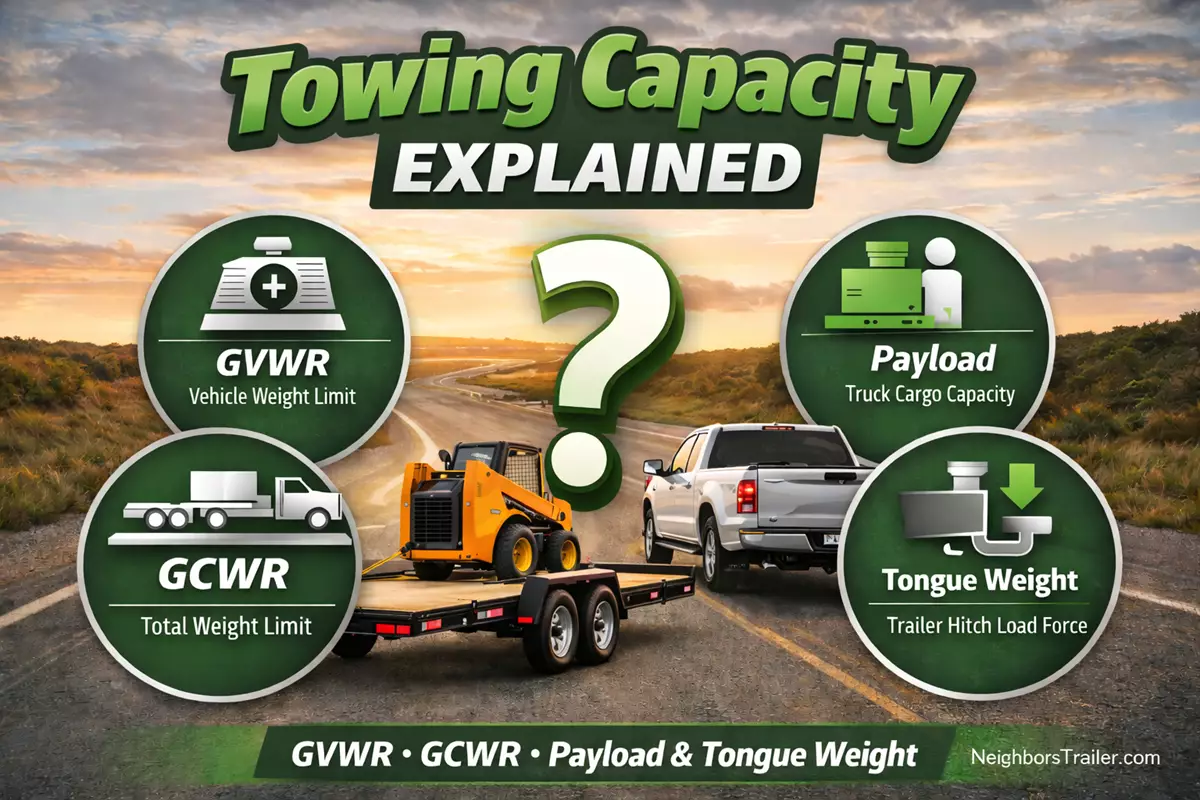
Towing capacity isn’t just a single number on a brochure. It’s a system of weight ratings — including GVWR, GCWR, payload capacity, axle ratings, and tongue weight — that work together to determine whether your vehicle and trailer combination is actually safe.
As a result, many drivers rely only on the advertised maximum tow rating — overlooking limits like payload or rear axle ratings that often reduce real-world towing capacity long before you reach it.
According to long-term analysis of National Highway Traffic Safety Administration (NHTSA) crash data, trailer-related accidents in the United States account for an average of 445 deaths and more than 21,800 injuries each year. These statistics underscore the importance of proper vehicle matching, load management, and safe towing practices.
In this guide, we’ll break down how towing capacity really works, explain the difference between GVWR and GCWR, show how payload and tongue weight affect your limits, and walk through a real-world example calculation.
If you’re unsure whether your vehicle is properly matched to your trailer, you may also want to review:
Can Your Vehicle Safely Tow a Trailer?
For a broader safety checklist beyond weight ratings, see our complete trailer towing safety guide for step-by-step setup, loading, and driving best practices.
What Is Towing Capacity?
Towing capacity is the maximum trailer weight your vehicle is rated to pull under ideal conditions.
Most modern manufacturer tow ratings are established using standardized testing protocols such as the SAE J2807 towing standard, which evaluates acceleration, braking, cooling performance, and handling under controlled conditions.
That number assumes a lightly loaded vehicle, minimal passengers, and properly distributed weight. It does not automatically mean you can tow that weight safely in every situation.
Your actual safe towing limit depends on payload capacity, tongue weight, combined vehicle + trailer weight, axle ratings, braking capacity, and hitch rating. That’s why understanding the supporting ratings matters more than memorizing one number. This is why understanding towing capacity in context — not just the advertised number — is critical for safe trailer operation.
What Determines Towing Capacity?
Towing capacity is determined by several vehicle weight ratings working together:
- GVWR (Gross Vehicle Weight Rating) – the maximum your vehicle can weigh when fully loaded
- GCWR (Gross Combined Weight Rating) – the maximum combined weight of vehicle and trailer
- Payload capacity – how much weight your vehicle can carry, including tongue weight
- Tongue weight – the downward force the trailer applies to the hitch (typically 10–15%)
- GAWR (Axle Ratings) – the maximum weight allowed on each axle
- Hitch rating – the maximum trailer and tongue weight your hitch can support
Exceeding any one of these limits can reduce your safe towing capacity — even if you are under the advertised tow rating.
What Limits Towing Capacity First?
Your real-world towing capacity is often lower than the advertised maximum because it depends on how your vehicle is loaded.
In most real-world scenarios, payload capacity or rear axle ratings limit towing before maximum tow rating does.
To understand why these limits matter, let’s break down the core weight ratings in detail.
Understanding the Core Weight Ratings
GVWR (Gross Vehicle Weight Rating)
GVWR is the maximum allowable weight of your vehicle itself. This includes the vehicle, driver and passengers, fuel, cargo, and trailer tongue weight.
GVWR does not include the trailer’s full weight—only the portion pressing down on your hitch (tongue weight). If your loaded vehicle exceeds its GVWR, you are overloaded even if you’re under your advertised tow rating.
GCWR (Gross Combined Weight Rating)
GCWR is the maximum allowable weight of your vehicle and trailer combined. This includes the fully loaded vehicle and the fully loaded trailer.
This is often the true limiting factor for heavy towing. Even if your trailer is under your tow rating, exceeding GCWR can over-stress your drivetrain, transmission, cooling system, or braking system.
Payload Capacity
Payload is how much weight your vehicle can carry — and it is often the first limit drivers hit. This visual shows how quickly passengers, gear, and tongue weight reduce your available margin.

GVWR – Curb Weight = Payload Capacity
Payload includes passengers, cargo in the vehicle, and trailer tongue weight. It does not include the trailer’s full weight — only the tongue weight pressing down on the hitch. This is where many people unknowingly overload their vehicle.
Example: If your payload is 1,500 lbs and your trailer’s tongue weight is 900 lbs, you only have 600 lbs left for passengers and cargo.
Tow Rating (Maximum Trailer Weight)
Tow rating assumes proper tongue weight and that other limits (payload, GVWR, GCWR) are not exceeded. It is just one piece of the puzzle. Tow rating is a performance ceiling — not a guarantee that every configuration under that number is safe.
Towing Ratings Comparison Table
If these ratings feel similar, this side-by-side comparison will clarify what each one controls and why it matters.
Use this table to quickly understand what each rating controls and what usually limits towing first in the real world. Below is a detailed, text-based breakdown for reference.
| Rating / Term | What It Means | What It Includes | Where to Find It | Why It Matters (Real-World) | Common Mistake |
| GVWR | Max allowed weight of the vehicle itself when loaded. | Vehicle + passengers + cargo + fuel + tongue weight. | Driver door jamb sticker; owner’s manual; manufacturer spec sheet. | Over GVWR = overloaded suspension, tires, brakes, even if “tow rating” looks fine. | Assuming GVWR includes the trailer’s full weight (it does not). |
| GCWR | Max allowed combined weight of vehicle and trailer. | Loaded vehicle + fully loaded trailer. | Owner’s manual; towing guide; manufacturer spec sheet. | Often the true mechanical limit for hills/heat; protects drivetrain & cooling. | Never checking combined weight after adding passengers, gear, water, etc. |
| Payload | How much weight the vehicle can carry. | Passengers + cargo + accessories + tongue weight. | Yellow/white payload sticker (door jamb); owner’s manual. | Common #1 limiter for SUVs and half-tons; tongue weight eats payload fast. | Loading the vehicle normally, then adding a trailer without recalculating payload. |
| Tow Rating | Max trailer weight the vehicle is rated to pull under ideal conditions. | Assumes correct tongue weight, proper hitch, and other ratings not exceeded. | Owner’s manual; towing guide; manufacturer site/spec sheet. | Good starting point, but not the full picture—real-world limits are usually lower. | Using tow rating as the only number that matters. |
| Tongue Weight | Downward force the trailer applies to the hitch. | Typically 10–15% of trailer weight (bumper-pull). | Calculated, measured; scale; tongue weight gauge. | Directly reduces payload; too low = sway risk, too high = rear axle overload. | Estimating blindly or loading heavy items behind the axle. |
| GAWR (Axle Ratings) | Max allowed weight on each axle (front/rear). | Weight carried by that axle, including cargo and tongue weight distribution. | Door jamb sticker; owner’s manual. | Rear axle can exceed limits before GVWR; affects tire safety and handling. | Ignoring axle limits when the rear “looks fine” but is overweight. |
| Hitch Rating | Max trailer/tongue weight your hitch/receiver is rated for. | Trailer weight rating + tongue weight rating (varies by hitch class). | Stamped on hitch/receiver; product label; manufacturer docs. | A low-rated hitch can be the weak link even if the vehicle can tow more. | Assuming a 2" receiver automatically means “heavy duty.” |
Tip: Your real-world safe limit is usually set by payload, rear axle rating, or GCWR before you ever reach your advertised tow rating.
Why Tongue Weight Matters So Much
Tongue weight is the downward force the trailer places on your hitch. For most bumper-pull trailers, proper tongue weight is about 10–15% of total trailer weight.
If your trailer weighs 6,000 lbs, ideal tongue weight is 600–900 lbs. That entire amount counts against your payload.
For equipment fitment details, see our Hitch Size Compatibility Chart.

Real-World Example Calculation
Vehicle Specs
- Tow rating: 7,000 lbs
- GVWR: 6,500 lbs
- Curb weight: 5,000 lbs
- Payload capacity: 1,500 lbs
- GCWR: 13,000 lbs
You Plan to Tow
- Trailer weight: 6,500 lbs
Step 1: Calculate Tongue Weight (12%)
6,500 × 0.12 = 780 lbs
Step 2: Subtract Tongue Weight from Payload
1,500 – 780 = 720 lbs remaining
Step 3: Check GCWR
Total combined weight = 12,830 lbs
Checking all three ensures your vehicle remains within manufacturer limits and maintains predictable handling and braking performance.
Towing capacity is only one part of the equation — our complete trailer towing safety guide walks through inspection, hitch setup, braking systems, and real-world safety checks.
Common Towing Capacity Mistakes
Mistake 1: Using “Dry Trailer Weight”
Dry weight does not include water, propane, gear, or accessories.
Mistake 2: Ignoring Payload
Many vehicles run out of payload before hitting tow rating.
Mistake 3: Overlooking Weight Distribution
Improper weight balance can reduce steering control and increase sway.
Mistake 4: Ignoring Brake Requirements
Review: Trailer Towing Laws by State (2026 Guide)
What Actually Limits You First?
In real-world towing, the limiting factor is usually payload capacity or rear axle rating first, then GCWR — and only lastly the advertised tow rating. Even if your vehicle advertises a high tow rating, real-world limits usually reduce that number. Here’s how that works:

This is why checking multiple ratings—not just tow rating—is critical before towing.
Not sure whether your vehicle-trailer combination is within safe limits?
Start with our guide: Can Your Vehicle Safely Tow a Trailer?
A Simple 3-Step Safe Towing Check
If any one of these limits is exceeded, your setup may be unsafe — even if the tow rating appears sufficient.
- Verify your tow rating.
- Check payload.
- Confirm combined weight.
Do You Need a Safety Margin?
Yes. Staying 10–15% under maximum ratings improves stability, braking performance, drivetrain longevity, and driver confidence — especially in wind, hills, or high temperatures.
Final Thoughts: Towing Capacity Is a System
Safe towing requires understanding how GVWR, GCWR, payload, tongue weight, and total trailer weight interact as a system — not as isolated numbers.
FAQ
What limits towing capacity the most?
Payload capacity and tongue weight often limit towing first.
Is GCWR more important than tow rating?
GCWR often represents the true mechanical limit because it governs the total weight your engine, transmission, cooling system, and brakes must handle together.
Does tongue weight count against payload?
Yes.
Can exceeding GVWR damage my vehicle?
Yes, it can overload suspension and braking systems.
Is towing at maximum capacity safe?
Towing at maximum rated capacity leaves little margin for wind, hills, heat, or emergency braking. Many experienced towers recommend staying 10–15% under maximum ratings when possible.
Does cargo in the trailer affect GCWR?
Yes. GCWR includes the fully loaded trailer, not just its dry weight.