

What Size Trailer Do I Need? A Practical Guide
 Neighbors Trailer
Jul 22, 2026 651 15 min read
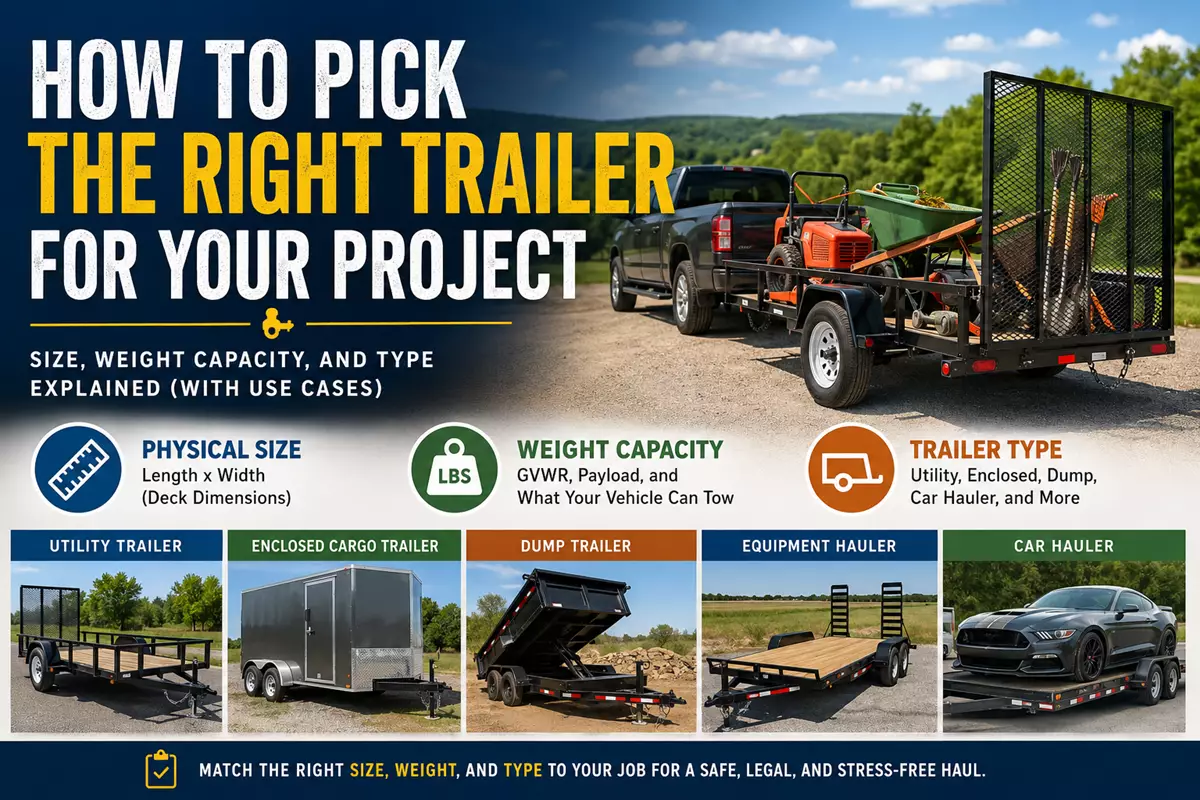
Every first-time trailer renter runs into the same question early in the booking process: what size trailer do I actually need? The answer is not obvious, because "size" is really three questions in one. There is physical size (length and width of the deck), weight capacity (how much the trailer can carry), and trailer type (utility, enclosed cargo, dump, car hauler, or something else). All three need to match the job. Get physical size right but the type wrong, and the trailer is not fit for purpose. Get type right but weight capacity wrong, and the trailer is not legal or safe to tow loaded. Most sizing mistakes come from renters focusing on just one dimension and missing the other two. This guide walks through how to pick the right trailer for your specific project, with concrete recommendations for the most common use cases and a master reference table you can bookmark.
If you want an instant recommendation rather than working through the tables below, our What Trailer Do I Need? calculator asks a few project questions and returns a matched trailer type and size in about a minute.
Why "Size" Is Really Three Questions
Before picking a specific trailer, it helps to understand what you are actually deciding. Every trailer rental involves three simultaneous choices, and treating them as one question is where most sizing errors start.
Physical Size: The Deck Dimensions
The most visible dimension is the deck footprint, usually expressed as length by width in feet. A 5x8 trailer has a deck five feet wide and eight feet long. A 6x12 trailer has a deck six feet wide and twelve feet long. Common consumer sizes range from small 4x6 utility trailers up to 8.5x20 enclosed cargo trailers, with several standard sizes in between. Physical size determines whether your cargo will fit; it does not tell you whether the trailer can safely carry your cargo's weight.
Weight Capacity: The Hidden Constraint
Every trailer has a Gross Vehicle Weight Rating (GVWR) that includes the weight of the trailer itself plus its maximum allowed cargo. Payload capacity is GVWR minus the empty trailer weight. A trailer with a 3,500-pound GVWR that weighs 1,200 pounds empty has 2,300 pounds of payload. Match this to your cargo weight, not just its dimensions. Our vehicle payload capacity guide covers the related tow-vehicle side of the weight equation, which sets an upper limit on what trailer you can pull regardless of what the trailer can carry.
Trailer Type: The One That Actually Matters Most
Type is the choice most often made incorrectly by first-time renters, usually because it is the least visible from a listing search filter. A 6x12 utility trailer, 6x12 enclosed cargo trailer, 6x12 dump trailer, and 6x12 flatbed are all the same physical size but suited to completely different jobs. Picking the wrong type is the mistake that ruins trips even when the size and weight capacity are technically fine.
Standard Physical Sizes
A handful of standard sizes cover the vast majority of consumer rentals. Knowing them by name shortcuts a lot of decision-making.
| Trailer Size | Deck Area | Typical Uses |
|---|---|---|
| 4x6 or 4x8 | 24-32 sq ft | Small landscaping loads, single-motorcycle transport, weekend errands |
| 5x8 or 5x10 | 40-50 sq ft | Studio apartment moves, single appliance haul, one ATV or two motorcycles |
| 6x10 or 6x12 | 60-72 sq ft | 1-2 bedroom moves, multiple appliances, landscape debris, small boat |
| 7x14 or 7x16 | 98-112 sq ft | 2-3 bedroom moves, full kitchen replacement, compact vehicle transport |
| 8.5x16 or 8.5x20 | 136-170 sq ft | Full house moves, multiple vehicles, contractor equipment, business hauls |
| 8.5x24 or larger | 200+ sq ft | Commercial jobs, multi-vehicle transport, heavy equipment |
Interior height matters as much as deck footprint for enclosed trailers. Standard enclosed trailer interior heights range from 5.5 feet (economical models) to 6.5 feet or more (V-nose or extra-tall models). A full-size refrigerator or a mounted motorcycle on a chock can push interior clearance requirements that a smaller trailer cannot meet regardless of length and width.
Trailer Types and When to Pick Each
The type decision is worth its own careful walk-through, because most renters default to whatever's cheapest or closest without thinking about whether the type suits the job.
Utility Trailer (Open Deck)
The most common and least expensive rental option. Open flat deck with low side rails, sometimes with removable ramp gates. Good for: landscaping debris, single appliance moves on dry days, motorcycles and small equipment, weekend errands. Not good for: anything weather-sensitive, valuable cargo you cannot afford to have exposed, tall items that would benefit from vertical wall support.
Enclosed Cargo Trailer
A fully-enclosed box on wheels with a rear ramp door or double swing doors. More expensive than utility trailers but essential for weather protection. Good for: appliances, furniture moves, valuable equipment, motorcycles you care about, anything electronic or moisture-sensitive. Not good for: bulky odd-shaped items that would not fit through the door, extremely heavy point loads that stress the deck.
Dump Trailer
An open-top trailer with hydraulic tipping. Good for: dirt, mulch, gravel, concrete debris, brush, anything you plan to dump rather than unload piece by piece. Not good for: anything you want to unload gently or intact, sensitive cargo, most non-bulk-material jobs.
Flatbed / Equipment Hauler
Deck-over-tires flatbeds and equipment haulers designed for heavier loads and drive-on cargo. Good for: skid steers, mini excavators, tractors, cars (for short distances), oversized loads. Not good for: anything weather-sensitive, jobs that would work better on a shorter deck.
Car Hauler
A specialized flatbed with ramps designed specifically for automotive transport. Wheel wells, tie-down points, and deck length are optimized for vehicles. Good for: vehicle transport (single or multiple depending on size), some equipment jobs. Not good for: cargo other than what the deck is designed for.
Gooseneck
A trailer that attaches in the bed of a pickup truck rather than at a rear receiver hitch. Bed-mounted attachment dramatically increases stability and weight capacity. Good for: heavy loads (usually 10,000+ lbs), long trailers where sway is a concern, professional or commercial hauling. Not good for: renters without gooseneck-equipped tow vehicles (most non-professional trucks).
Sizing by Use Case: The Master Reference
Use the table below as a starting point. Weight ranges are approximate; verify against your specific cargo and the specific trailer's capacity before booking.
| Project | Recommended Type | Recommended Size | Approximate Cargo Weight |
|---|---|---|---|
| Studio or small 1BR move | Enclosed cargo | 6x12 | 1,500-2,500 lbs |
| 2-bedroom apartment move | Enclosed cargo | 7x14 to 7x16 | 2,500-4,000 lbs |
| 3+ bedroom house move | Enclosed cargo | 8.5x20 (or two trips with a 7x16) | 4,000-6,000+ lbs |
| Single major appliance (fridge, washer) | Enclosed cargo | 5x10 to 6x12 | 200-350 lbs |
| Full kitchen replacement | Enclosed cargo | 6x12 to 7x14 | 500-800 lbs |
| Landscaping debris or mulch | Dump trailer | 6x10 or 6x12 | 1,000-3,000 lbs |
| Dirt, gravel, or concrete | Dump trailer | Match to trailer GVWR carefully | 2,000-6,000 lbs (dense material) |
| Single motorcycle | Utility with chock or small enclosed | 5x8 or 5x10 | 400-900 lbs |
| Two motorcycles | Utility with chocks or 6x12 enclosed | 6x12 | 800-1,800 lbs |
| Single ATV or side-by-side | Utility or enclosed | 5x10 to 6x12 | 700-2,000 lbs |
| Small fishing boat or jet ski | Utility (or the dedicated boat trailer that came with it) | 5x10 to 6x12 | 500-1,500 lbs |
| Compact car (sedan under 3,500 lbs) | Car hauler | 18-20 ft | 3,000-3,500 lbs |
| Full-size vehicle or SUV | Car hauler or flatbed | 20-22 ft | 4,000-6,000 lbs |
| Skid steer or mini excavator | Equipment hauler | 18-20 ft (verify weight rating) | 5,000-10,000 lbs |
| Small tractor or riding mower | Utility or equipment hauler | 5x10 to 6x12 | 500-2,500 lbs |
| Weekend general hauling | Utility open | 5x8 or 5x10 | Under 1,500 lbs |
Real-World Examples: How the Decision Works
Reading a table is one thing. Walking through actual sizing decisions is another. Below are the thought processes for the five most common rental scenarios.
Moving a Studio Apartment
A studio typically contains a bed, dresser, small couch or loveseat, a small table with a few chairs, a TV, and 15 to 25 boxes. Total weight usually falls between 1,500 and 2,500 pounds. Physical volume is the constraint more than weight. A 6x12 enclosed cargo trailer handles this comfortably with room for proper strapping. A 5x10 works too but requires more careful stacking and leaves less room for oversized items. Enclosed is the right choice because you cannot risk furniture getting wet if the trip crosses weather.
Hauling a Single Refrigerator
A full-size refrigerator weighs 250 to 350 pounds and stands roughly 70 inches tall. Any 5x10 or 6x12 enclosed trailer with adequate interior height (verify 6-foot or greater interior height before booking) handles the load easily. Weight is not the constraint; interior clearance and door access are. Our appliance hauling guide covers the specific handling techniques after you have the right trailer.
Landscaping Debris Haul
Yard debris, brush, and small tree limbs are bulky but not particularly heavy. A 6x10 or 6x12 dump trailer with 3,000 to 5,000 pounds GVWR handles most residential landscape jobs. Dump capability is worth prioritizing because unloading brush by hand from a utility trailer is significantly slower than tipping it into a designated debris pile. Match the sides to the load type: tall side walls or removable stakes if you are hauling loose brush; short walls or gates for compacted material. For bulk material projects (mulch, gravel, topsoil), our Landscape Material calculator converts area and depth into yards, weight, and trailer loads. For end-to-end project planning with budget and timeline, the Weekend Project Planner walks through the whole job.
Transporting One Motorcycle
A cruiser or standard motorcycle weighs 400 to 700 pounds and needs a stable chock to hold the front wheel upright during transport. A 5x8 or 5x10 utility trailer with a wheel chock works for dry-weather trips. An enclosed 5x10 or 6x12 is worth the premium for any trip involving rain, road grime, or an expensive bike. The trailer's ramp gate matters: a full-width ramp is easier to load than a narrow one, and a ramp with the correct load rating is essential for the bike's weight plus your weight during loading.
Moving a Small Car
A compact sedan weighs 2,800 to 3,500 pounds. Standard 18 to 20-foot car haulers with ratings of 7,000 pounds or more handle these easily. Do not attempt to move a car on a general-purpose flatbed unless the flatbed is specifically rated for automotive transport with proper tie-down points; car haulers have engineered wheel chocks and D-ring anchors in specific positions that a general flatbed lacks.
The Weight Check Everyone Should Do
Physical fit is easy to estimate visually. Weight is harder because most renters underestimate how heavy their cargo actually is. Before booking, do a rough estimation and verify against the trailer's payload capacity (not just its GVWR).
Rough Weight References
A queen mattress and box spring: 60-100 lbs. A full couch: 150-350 lbs depending on size. A refrigerator: 250-350 lbs. A washer or dryer: 150-250 lbs. A pallet of bricks: 3,000+ lbs. A yard of gravel: 2,700 lbs. A yard of topsoil: 2,000 lbs. A 55-gallon drum of liquid: about 460 lbs. An adult motorcycle: 400-700 lbs. A cruiser motorcycle: 700-900 lbs. An ATV: 500-800 lbs. A side-by-side UTV: 1,500-2,000 lbs. Compact car: 2,800-3,500 lbs. Full-size sedan: 3,500-4,500 lbs.
Once you have a total estimated cargo weight, verify the trailer's payload capacity covers it with margin. A 20 percent safety margin is a reasonable buffer for the underestimation that happens with most first-time cargo assessments.
Do Not Forget the Tow Vehicle
The trailer's capacity is only half of the weight equation. Your tow vehicle also has a maximum trailer weight rating (found in the owner's manual or on a door jamb sticker) and a tongue weight limit. Match all three: trailer's GVWR, your tow vehicle's max trailer weight, and the loaded tongue weight against the tow vehicle's hitch rating. The lowest of the three sets your real ceiling.
When to Upsize
The temptation with first-time rentals is to book the smallest trailer that will technically fit the cargo. This saves rental cost but usually creates problems on the trip. Several situations argue for going one size larger than the bare minimum.
You Need Room for Straps and Padding
Cargo strapped tight against the sides of a trailer with no room for padding gets scratched, dented, or scuffed during transport. A trailer that leaves 12 to 18 inches of clearance around the load is much more forgiving to work with than one packed tight.
You Are Loading Anything Awkward
A single measurement of length and width does not capture the challenge of loading a couch through a narrow ramp, threading a motorcycle around a corner, or shifting appliances during positioning. Extra deck space makes all of this easier.
You Underestimated the Cargo Volume
Real cargo volume almost always exceeds initial estimates. The bookshelf you forgot about, the tool box you did not measure, the odd-shaped items that do not stack neatly. Booking one size larger than the visible cargo assumes protects against these misses.
You Are Combining Multiple Loads
A rental that combines a couple of appliances, some furniture, and boxes will exceed the sum of the parts because of loading inefficiency. The full 500 pounds of cargo may occupy 700 pounds of trailer space by the time it is arranged and secured. Our loading guide covers the space budgeting that comes with proper weight distribution.
When Bigger Is Worse
Occasionally, oversizing creates its own problems. A few situations argue against the reflexive upsize.
Your Tow Vehicle Is Marginal
A larger trailer weighs more empty, has more air resistance, and puts more stress on the tow vehicle. If your tow vehicle is already close to its maximum tow rating, the extra headroom of a bigger trailer disappears against the trailer's own weight.
You Are Maneuvering in Tight Spaces
Longer trailers are harder to back up, harder to fit in tight parking spots, and harder to navigate around suburban driveways. A 7x14 might be technically larger than a 5x10, but if you cannot get it into the driveway at your destination, the extra space is worthless.
The Rental Cost Difference Actually Matters
For a one-off short trip with a small load, the price gap between a 5x8 and a 6x12 can be meaningful. If you are certain the cargo will fit in the smaller trailer, the smaller trailer is the right pick.
Common Sizing Mistakes
The pattern of what goes wrong is consistent, and each one is preventable.
Sizing by Fit Alone Without Checking Weight
A trailer that fits the cargo dimensionally but cannot carry the weight is not a solution. Always verify both dimensions and payload capacity, not just deck footprint.
Choosing the Wrong Trailer Type
Renting a utility trailer for cargo that should be in an enclosed trailer (weather sensitive), or a flatbed for cargo that should be in a dump trailer (bulk material), or an enclosed trailer for cargo that should be on a car hauler (a vehicle). Type first, then size within the type.
Ignoring Interior Height on Enclosed Trailers
Interior height is often the constraint for tall cargo (refrigerators, appliances, mounted motorcycles) and is not visible in the deck-size-in-feet convention. Always verify interior clearance before booking anything tall.
Assuming Two Small Trailers Equal One Larger
Two 5x8 trailers do not equal one 5x16. Two trips are usually significantly more expensive, time-consuming, and stressful than one trip with a properly-sized trailer. Unless your tow vehicle actually cannot pull the larger trailer, one trip in the right size wins almost every time.
Not Confirming Tow Vehicle Compatibility
A trailer perfectly sized for your cargo is still the wrong choice if your tow vehicle cannot safely pull it. Check the vehicle's owner manual for max trailer weight and confirm before booking. Our ultimate towing safety guide covers the broader set of tow-vehicle compatibility checks worth doing before any rental.
The Bottom Line
The right trailer size is not one number; it is the intersection of three questions: how big does the deck need to be, how much weight does it need to carry, and what type of trailer suits the specific job? Get all three right and the trip is straightforward. Get any of the three wrong and the rental turns into a workaround at best or a canceled booking at worst. Use the reference tables above to shortcut the decision, verify weight against payload capacity every time, and lean toward one size larger than the minimum when you are unsure. The extra rental cost is almost always worth the reduced stress and better outcome.
Ready to pick the right trailer for your project? Browse trailers on Neighbors Trailer and use the filters to narrow by trailer type first, then physical size, then weight capacity. Message the host with your specific cargo details before booking; most hosts are happy to confirm their trailer is a good fit or steer you toward a better one for your specific job.