

Vehicle Payload Capacity: The Hidden Towing Number
 Neighbors Trailer
May 30, 2026 293 10 min read
Most first-time trailer renters check one number before they book: their vehicle's towing capacity. That number is on the spec sheet, it's easy to find, and it feels like the answer. The problem is that towing capacity is only half of the math. The other half is your vehicle's payload capacity, and it is the number that quietly catches more renters by surprise than any other towing rating. This guide walks through what payload capacity actually is, why it matters more than most renters realize, and how to use it to plan a safe and confident rental.
The Confusion: Why Towing Capacity Is Not the Whole Story
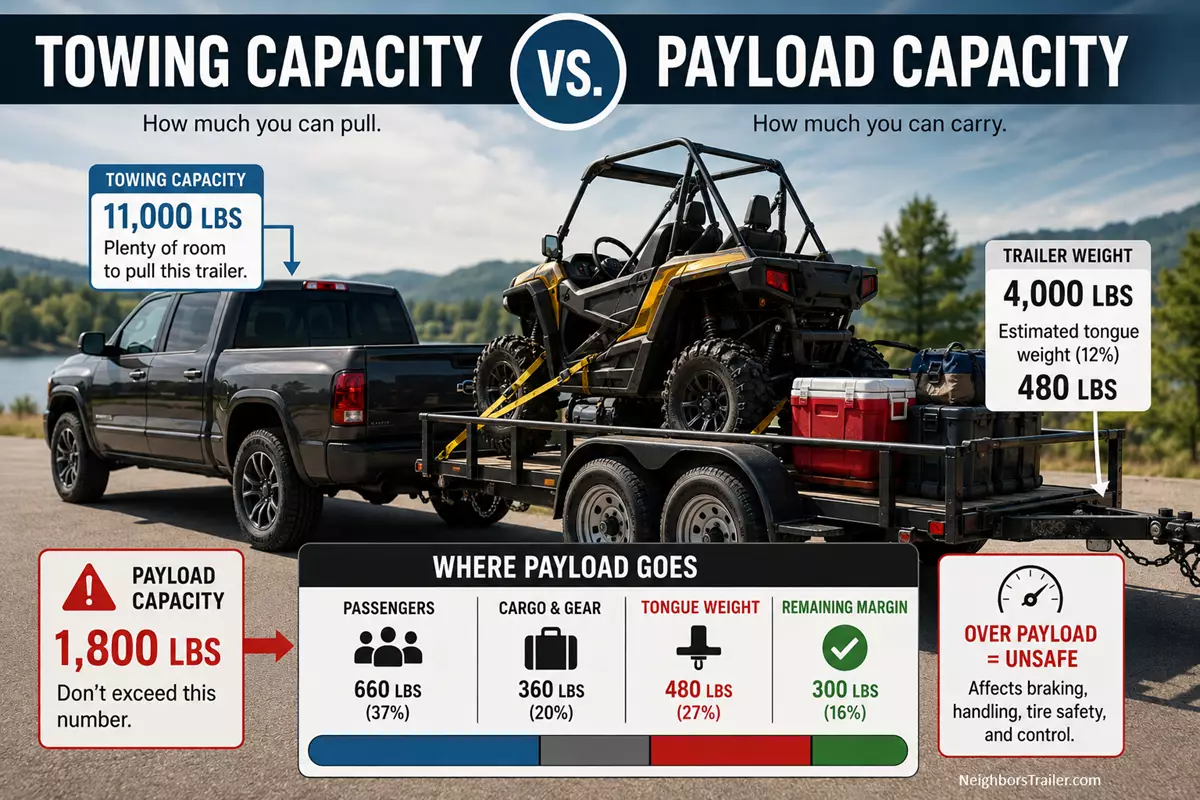
Here is the most common scenario that catches renters off guard. You drive a popular half-ton pickup, the spec sheet says it tows 11,000 pounds, and you book a trailer well under that limit. You feel safe. But by the time you load passengers, gear, a cooler, and connect the trailer, you are over your vehicle's payload limit, even though you are well under its towing limit. Your truck did not lie to you. You just looked at one number when you needed to look at two.
Towing capacity tells you the maximum weight your vehicle can pull behind it. Payload capacity tells you the maximum weight your vehicle can carry inside and on it, which includes passengers, cargo, and the tongue weight that the trailer pushes down on your hitch. Both numbers have separate limits, and exceeding either one is unsafe. The difference between them is what most people miss. To match your specific vehicle to a factory tow rating, use the Towing Capacity calculator.
Three Numbers That Matter on Your Vehicle
To work out your payload capacity, you only need to understand three numbers. Once you have them, the math is simple addition and subtraction.
GVWR (Gross Vehicle Weight Rating)
GVWR is the maximum total weight your vehicle is rated to carry, fully loaded. It is set by the manufacturer based on engineering limits for the frame, suspension, axles, brakes, and tires. GVWR is not the weight of your vehicle. It is the absolute ceiling for what the loaded vehicle can weigh, including the vehicle itself, all passengers, all cargo, and any tongue weight from a trailer.
Curb Weight
Curb weight is what your vehicle weighs empty, with a full tank of fuel and standard equipment, but no passengers and no cargo. Manufacturers publish curb weight as a baseline. Two trucks of the same model can have different curb weights depending on options like cab configuration, drivetrain, and bed length, so it is worth checking your specific vehicle rather than relying on a generic figure.
Payload Capacity
Payload capacity is the simple subtraction: GVWR minus curb weight. Whatever is left over is what you have available to carry passengers, cargo, and tongue weight. If your truck has a GVWR of 7,100 pounds and a curb weight of 5,300 pounds, your payload capacity is 1,800 pounds. That 1,800 pounds is everything you can put on or in the vehicle without exceeding its rating.
The Hidden Math: Tongue Weight Eats Your Payload
This is the part renters miss most often. When you hook up a trailer, the trailer's tongue pushes down on your hitch with a certain amount of force, called tongue weight. Tongue weight is typically 10 to 15 percent of the loaded trailer weight. A loaded trailer that weighs 4,000 pounds will push down on your hitch with roughly 400 to 600 pounds of tongue weight.
That tongue weight counts against your payload capacity, not your towing capacity. So if you have 1,800 pounds of payload available, and your trailer puts 500 pounds of tongue weight on your hitch, you have 1,300 pounds of payload left for passengers and cargo before you exceed the rating. Four adult passengers and a load of camping gear can easily eat up that remaining number, especially in a cab with a family.
This is the exact mechanism that creates the surprise. You are well under the towing capacity, so towing feels safe. But your payload is maxed out, and the suspension, brakes, and tires are now operating right at their engineering limit. Sway, soft braking, and steering wander are the warning signs.
Where to Find Your Numbers
You do not need a manufacturer's spec sheet to find your GVWR. Every vehicle in the United States has a federally required label inside the driver's door jamb, usually on the B-pillar, that lists the vehicle's GVWR and the GAWR for each axle. That sticker is the authoritative source for your specific vehicle. The curb weight is in the owner's manual, on the manufacturer's website by VIN, or printed on a separate label in the door jamb for some models. Once you have GVWR and curb weight, you have payload capacity.
Some newer vehicles also print payload capacity directly on a yellow tire and loading information label inside the door jamb, which saves you the subtraction. If you see a line that reads "the combined weight of occupants and cargo should never exceed XXX pounds," that is your factory payload capacity.
A Worked Example
Numbers in the abstract are easy to nod along to and hard to use. Here is a realistic worked example using a common half-ton pickup loaded for a weekend trip.
| Item | Weight | Running Total |
|---|---|---|
| Payload capacity (GVWR minus curb weight) | 1,800 lbs | 1,800 lbs available |
| Driver and front passenger | 340 lbs | 1,460 lbs left |
| Two rear passengers | 320 lbs | 1,140 lbs left |
| Cooler, gear, and luggage in the bed | 250 lbs | 890 lbs left |
| Bike rack and two bikes | 110 lbs | 780 lbs left |
| Tongue weight from 4,000 lb loaded trailer (12 percent) | 480 lbs | 300 lbs left |
| Final margin | 300 lbs | Within limit |
This is a perfectly reasonable trip. Four people, normal weekend gear, a moderately loaded trailer. The math works, but it works with only 300 pounds of margin. If the trailer were heavier, or there were more cargo, or a fifth passenger joined, the same setup would push the vehicle over its rating, even though the trailer is well under the truck's 11,000 pound towing capacity. That is the exact gap this post exists to close.
Quick Visual: How Payload Gets Used Up
Here is how a typical loaded scenario stacks up against the payload limit. The bars represent the proportion of payload capacity used by each category for the example above.
Payload Usage in a Typical Weekend Tow
Passengers 660 lbs (37%)
Cargo and gear 360 lbs (20%)
Tongue weight 480 lbs (27%)
Remaining margin 300 lbs (16%)
Tongue weight alone consumes more payload than most renters realize. Plan for it deliberately.
The yellow bar is the one worth staring at. Tongue weight, the thing most renters never think about when they choose a trailer, consumes roughly a quarter of the payload in a typical setup. That number scales up the heavier the trailer is loaded, which means a bigger or heavier-loaded trailer cuts into your passenger and cargo allowance even faster.
When You Are Close to the Limit
If your math leaves you with thin margin, you have a few options before you change vehicles or cancel the trip.
The simplest fix is to shed cargo. Pack lighter, leave the heavier items at home, or split the load across two trips. Many weekend trips are carrying more than they need to. The next option is to redistribute. Heavy items moved from the bed to the trailer change where the weight lives, but watch the trailer's loaded weight and tongue weight as you do this. The third option is to rent a different trailer, ideally a smaller or lighter one that puts less tongue weight on your hitch.
If your math is genuinely over the limit, do not tow it. Vehicles are not graded on a curve, and exceeding a payload rating affects braking, steering, and tire safety even if you cannot feel the difference at low speeds. The right move is to choose a different trailer, a different load, or a different vehicle.
Common Mistakes Renters Make With Payload
A few patterns show up over and over. Knowing them in advance is the easiest way to avoid them.
Treating Towing Capacity as the Only Limit
The most common mistake is checking only the towing capacity and assuming the rest of the math takes care of itself. It does not. A modern half-ton can tow far more than its payload can support once passengers and tongue weight are factored in.
Forgetting Passengers Count
Passenger weight is part of payload, full stop. Four adult passengers can add 700 pounds or more, which is a significant chunk of a typical pickup's payload capacity before any cargo or tongue weight is even considered.
Ignoring Tongue Weight Until Pickup
Tongue weight is not something you can estimate well by eye. Ten to fifteen percent of the loaded trailer is a reasonable rule of thumb, but the specific number depends on how the trailer is loaded. Loading too much weight at the front of the trailer drives tongue weight up. Loading too much at the rear can cause sway. The owner of the trailer will often know roughly what their trailer's tongue weight is loaded; ask.
Trusting an Old or Mismatched Spec Sheet
Generic spec sheets are averages across many configurations of a vehicle. Your specific truck, with its specific cab, bed, drivetrain, and options, has its own GVWR and curb weight printed on its own door jamb. Trust the sticker on your vehicle, not a number you found on a forum.
How to Plan a Rental Around Your Vehicle's Payload
Once you know your payload number, the process for planning a rental is straightforward. Start with your payload capacity, subtract the typical weight of the people who will be in the vehicle, subtract a realistic estimate of cargo, and what you have left is your maximum allowable tongue weight. Divide that number by 0.10 to 0.15 to get a rough ceiling on the loaded trailer weight you can safely tow. That is the trailer you should be shopping for.
This is also the moment where the trailer-side math becomes relevant. Once you know how much trailer you can safely pull from your vehicle's side, our companion post on trailer towing capacity, including GVWR, GCWR, and payload from the trailer's perspective covers what the trailer itself can carry and how to read its ratings. If you want a broader pre-trip check on whether your vehicle is set up properly, our guide on whether your vehicle can safely tow a trailer walks through the full pre-rental confirmation. Our Payload calculator calculates real cargo capacity from a trailer's GVWR and empty weight.
You Have the Number That Matters
Most renters arrive at the trailer with a towing capacity in their head and a fuzzy sense of payload. The renters who tow safely arrive with both numbers in their head, and they know exactly how much payload they have left after passengers, cargo, and tongue weight. The math takes five minutes the first time and one minute every time after that. Once you have done it, you will pick the right trailer for your vehicle every time, and the unpleasant surprises that happen on the road to other people will not happen to you.
Ready to book a rental that fits your vehicle's actual capacity? Browse trailers on Neighbors Trailer and use the loaded weight figures on each listing to match the right trailer to your payload math. Owners list the loaded and empty weights for their trailers precisely so that renters can do this calculation in advance and pick the right size on the first try.