Trailer Tire Pressure: The Number Most People Get Wrong
 Neighbors Trailer
Jun 5, 2026 1110 11 min read
If you ask most renters what they check before towing a trailer, they will mention the hitch, the lights, and the brakes. Tire pressure rarely makes the list. That is the problem. Underinflated trailer tires are the single most common cause of blowouts on the road, and a blowout under load is the kind of incident that turns a smooth trip into a stranded one. The good news is that getting trailer tire pressure right is one of the simplest, lowest-cost things a renter can do. It takes two minutes and a $15 gauge. This guide walks through why trailer tire pressure is different from your vehicle's, where to find the right number, and the routine that prevents almost every preventable tire failure on the road.
Why Trailer Tires Are Not the Same as Vehicle Tires
The most common tire pressure mistake renters make is assuming the same number that works for their truck will work for the trailer. It will not. Vehicle tires and trailer tires are engineered for different jobs, carry different loads at different speeds, and run at different pressures. Treating them the same way is what produces the blowouts.
Trailer tires are typically marked with the prefix ST, which stands for Special Trailer. Vehicle tires are usually marked P for passenger or LT for light truck. ST tires have stiffer sidewalls, a different rubber compound, and a much lower speed rating than passenger tires. They are built to carry heavy static loads and to be towed, not driven. Because of these differences, ST tires generally need to be inflated to the maximum pressure printed on the sidewall, not the pressure recommended for the vehicle pulling them.
This is the core insight: your truck's tire pressure sticker has nothing to do with the trailer's tires. The trailer's correct pressure comes from the trailer tire sidewall and the trailer's loading capacity, both of which are independent of the tow vehicle.
Where to Find the Right PSI
There are two places to look for the correct tire pressure for a trailer.
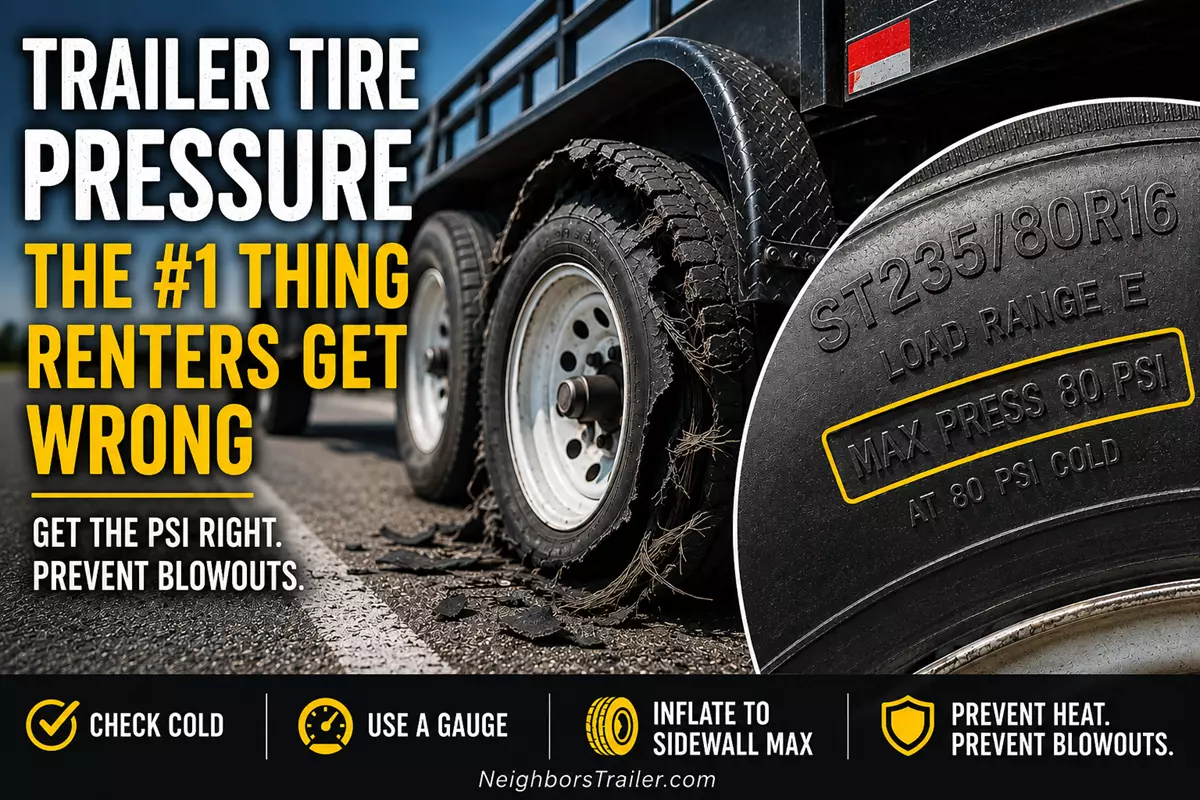
The first is the tire sidewall itself. Every tire is required to display the maximum cold inflation pressure on the sidewall, usually printed in raised lettering near the size markings. A typical ST trailer tire will show something like "Max Press 65 PSI" or "Max Press 80 PSI." Common ranges for trailer tires are 50 PSI for small utility trailers, 65 PSI for medium cargo and utility trailers, and 80 to 110 PSI for heavy-duty trailers, gooseneck flatbeds, and equipment trailers. The exact number depends on the tire size and load rating, and the only authoritative source is the actual tire on your trailer. If you're near the trailer's payload limit and want to verify the tires are rated for the load, the Tire Load calculator works out the required rating per tire from your loaded weight and axle count.
The second place to look is the trailer's own tire information label, usually located on the tongue or near the door for enclosed trailers. This label lists the manufacturer-recommended inflation pressure and load rating for the trailer's stock tires. If your trailer still has its original tires, the label and the sidewall should agree. If the tires have been replaced with a different brand or load rating, trust the sidewall number on the actual tires.
For most trailer use, you inflate ST tires to the maximum cold pressure printed on the sidewall. This is different from your vehicle, where you would typically inflate below the maximum. The reason is that trailer tires are built to operate near their maximum, not below it, and underinflation rapidly destroys them.
The Number Most People Get Wrong
Here is the specific mistake that catches renters most often. You hitch up the trailer, glance at the tires, see that they look round and full, and assume they are at proper pressure. They probably are not. Tires can look perfectly normal while being 10 to 20 PSI below their proper inflation level, and that gap is what causes blowouts.
There is no reliable way to estimate tire pressure by eye. The sidewall stiffness of an ST tire hides the kind of bulging you would see in a soft passenger tire. A trailer tire 15 PSI low can still look round and ready to go, but it is running hot, flexing more than it was designed to flex, and accumulating heat damage with every mile. Eventually, the heat damage exceeds what the tire can tolerate, and the tire fails. Usually at highway speed. Usually when the trailer is loaded.
The fix is to check pressure with a gauge, not with your eyes, and to do it cold (before the tires have been driven on). A $15 dial gauge or digital gauge is more accurate than any visual inspection. Pencil-style gauges are inexpensive but vary in accuracy and are worth replacing with a dial or digital model.
How Underinflation Causes Blowouts
The mechanism that turns underinflation into a blowout is mechanical and predictable. Here is what happens inside the tire and why specific pressure ranges matter.
| Pressure Status | What Happens Inside the Tire | Risk Level |
|---|---|---|
| At maximum sidewall pressure | Tire operates as designed, minimal flex, normal heat | Safe |
| 5 PSI below max | Slightly more flex, slightly more heat, accelerated wear | Low |
| 10 PSI below max | Significant sidewall flex, heat buildup begins to compound | Moderate |
| 15 PSI below max | Heavy flex, tire runs hot enough to soften rubber compound | High |
| 20+ PSI below max | Tire is in active failure mode, blowout likely on first long trip | Severe |
| Visibly low | By the time it looks low, the tire is already badly underinflated | Critical |
The pattern that matters here is that heat is the killer. Underinflated tires flex more than they should, and that flex generates heat. The hotter the tire gets, the softer the rubber becomes. The softer the rubber, the more it flexes. The cycle compounds until the tire structure fails. This is why most trailer tire blowouts happen on long, hot highway trips rather than around town. The trip just gives the heat cycle time to complete.
Cold Pressure Versus Hot Pressure
One more critical detail: always check tire pressure when the tires are cold, meaning the trailer has not been driven for at least three hours, or has been driven less than a mile at slow speed. Tires heat up during driving, and hot tires read 4 to 8 PSI higher than the same tire cold. If you check a hot tire and see what looks like proper pressure, the cold pressure underneath is probably 4 to 8 PSI too low.
Tire Pressure Reading: Cold vs Hot (Example: 65 PSI Target)
Cold reading 65 PSI (actual pressure, correct)
Warm (10 min drive) 69 PSI gauge (still 65 PSI cold)
Hot (highway) 73 PSI gauge (still 65 PSI cold)
Never release air from hot tires. The gauge reading is high because the tire is hot, not because the cold pressure is high.
The corollary is just as important: never let air out of hot tires. If you check a hot tire on a long trip, see 73 PSI, and bleed air down to 65 PSI to "fix" it, you have just created an underinflated tire. When the tire cools overnight, it will be sitting at 57 or 58 PSI, well below the safe range. The hot reading was normal. The bled-down cold pressure is now dangerous.
If you must check pressure mid-trip and the tires read high, leave them alone. The temperature compensation is built into the tire design and the manufacturers expect it.
The Pre-Trip Tire Check Routine
Building this into a habit takes about two minutes and prevents the vast majority of tire-related towing incidents. Here is the routine.
The night before your trip, while the tires are cold and parked, walk around the trailer with a gauge. Remove each valve stem cap, press the gauge firmly onto the stem, and read the pressure. Inflate any tire that is more than 2 PSI below the target. Don't forget the spare. The spare is the tire that gets ignored for years and then turns out to be unusable when you actually need it. Check it like the others.
Also walk around and look at each tire for sidewall cracks, bulges, or unusual wear patterns. Trailer tires often fail from age rather than mileage. A tire that has sat outside for five years is structurally compromised even if the tread looks fine. Look for small spider-web cracks in the sidewall rubber. If you see them, mention it to the owner before you leave. Our broader pre-trip walkthrough is covered in our road ready safety tips guide if you want a complete checklist.
Common Tire Pressure Mistakes Renters Make
A few patterns show up over and over. Knowing them in advance is the easiest way to avoid them.
Inflating to Vehicle Pressure
The mistake we discussed at the top of this guide. Your truck's recommended tire pressure (often 32 to 45 PSI for passenger or light truck tires) is far below the proper trailer tire pressure (often 50 to 80 PSI or more). Inflating trailer tires to vehicle pressure puts them in active failure mode the moment you hitch up and drive away.
Skipping the Spare
An unchecked spare tire is the most common failure point of a tire emergency. You go to use it after a roadside flat, and the spare is also flat or below safe pressure. Check the spare every time you check the road tires.
Checking Pressure Hot
Reading pressure on warm or hot tires gives a misleading high number. Always check cold, ideally before the first drive of the day. If you have just driven the trailer to where you are parking, wait three hours before checking pressure.
Trusting the "Looks Fine" Test
Trailer tires can hide significant underinflation behind stiff sidewalls. There is no reliable visual indicator that replaces a gauge reading. If you do not check with a gauge, you do not actually know the pressure.
Forgetting About Temperature Drops
Tires lose roughly 1 PSI for every 10 degrees Fahrenheit drop in temperature. A trailer that was at proper pressure during summer can be 5 to 7 PSI low after the first cold snap of fall, and that is enough to begin damage on the first highway trip of the season.
What to Do If You Notice a Problem on the Road
If you feel a vibration that was not there before, hear a thumping noise from the trailer, or see a tire that looks visibly low through the side mirror, pull over in a safe location and check the tire. Do not finish the trip on a tire that has obvious problems.
If a tire is going down slowly but is still holding some pressure, you may be able to drive at reduced speed (35 mph or less) to the nearest gas station or service area to inflate or change it. If a tire is flat or severely damaged, replace it with the spare before driving further. Driving any meaningful distance on a flat trailer tire will destroy both the tire and the wheel, and possibly the fender. Our ultimate towing safety guide covers roadside problem responses in detail for renters who want to be prepared for the rare situations where things go wrong.
The Bottom Line
Trailer tire pressure is one of the few towing variables where you can dramatically reduce risk for almost no effort and no cost. Two minutes with a gauge, before every trip, prevents the vast majority of tire-related incidents that strand renters and cause damage to equipment. Inflate to the maximum cold pressure printed on the tire sidewall. Check pressure cold, never hot. Don't forget the spare. Build it into your pre-trip routine, and you will not be the renter standing on the shoulder of a highway with a shredded trailer tire.
Ready to book a rental and put a good pre-trip routine into practice? Browse trailers on Neighbors Trailer and use the listing details to confirm tire condition and recommended pressure before you hitch up. If you own a trailer and are listing it, sharing the recommended cold tire pressure in your listing is one of the most appreciated details a host can include.