

The 5-Minute Trailer Pickup Walkthrough
 Neighbors Trailer
Jun 27, 2026 117 13 min read
The five minutes between when you arrive at a trailer rental pickup and when you actually drive away are the most consequential five minutes of the entire rental. The work you do during that window catches the mechanical problems that would otherwise strand you on the highway, creates the photo baseline that protects you against unfair damage disputes, and sets a professional tone with the host that pays off in every interaction that follows. Most first-time renters skip this walkthrough or rush through it. The renters who consistently have smooth trips and zero post-trip disputes do not. This guide walks through exactly what to inspect at pickup, what to photograph, and how to handle the small handful of situations where the right call is to delay rather than tow.
Why the Pickup Walkthrough Matters
The walkthrough does three things at once. First, it catches mechanical issues before they become problems on the road. A trailer with a soft tire, a loose coupler latch, or a non-working brake light is a trailer that should not leave the host's driveway. Catching these at pickup means a five-minute conversation with the host. Catching them at 65 miles per hour on the highway means something more serious.
Second, the walkthrough creates a shared baseline of the trailer's condition. Photos taken at pickup, with the host present, are the single most useful evidence in any post-trip damage dispute. If the host later claims a scratch on the rear fender came from your trip, your pickup-time photo of that exact scratch ends the conversation. Without that photo, you are in a he-said-she-said dispute with no documentation. Almost every damage dispute that goes badly for renters traces back to a missing pickup walkthrough.
Third, the walkthrough is the moment that establishes you as a careful, professional renter. Hosts who watch a renter do a thoughtful walkthrough relax. They trust you with their equipment. That trust shows up later as five-star reviews, fast responses, and the kind of small flexibility that makes future rentals easier. The walkthrough is the audition that hosts grade you on, whether they realize they are doing it or not.
Do It With the Host, Not After They Leave
The single biggest pickup-walkthrough mistake is doing it after the host has gone back inside. A walkthrough that the host did not see does not count. The host needs to be present for two reasons: they can answer questions about features and history, and they can confirm in real time that the existing damage you are photographing was already there. Without the host present, your photos are just photos. With the host present, your photos are jointly verified evidence.
When you arrive at pickup, do not unhitch the trailer or do anything else until the walkthrough is complete. Greet the host, ask them to walk through the trailer with you, and start the inspection together. Most hosts appreciate the request because it makes their job easier too. Anyone who refuses to participate in a walkthrough is a signal worth heeding.
The Six Systems to Inspect
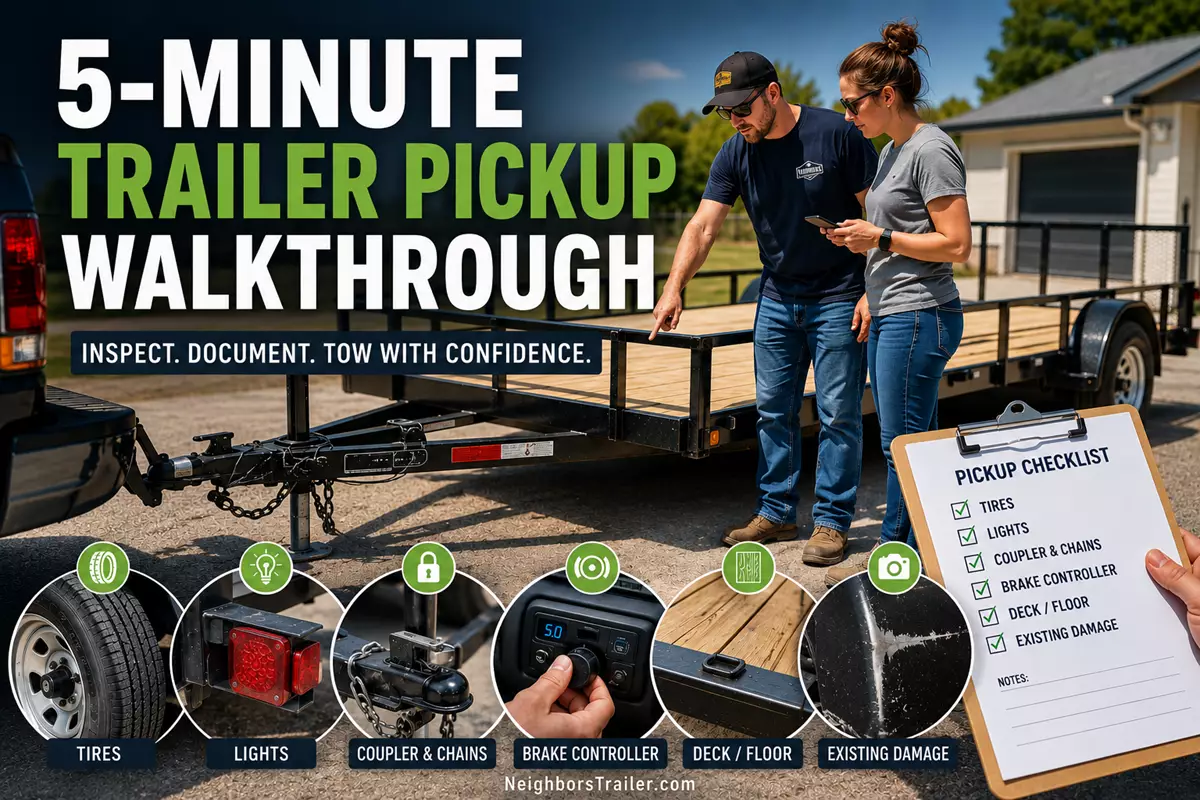
The full walkthrough covers six systems and takes about five minutes. None of the individual checks require specialized knowledge. The goal is not to perform a mechanic's inspection; it is to confirm that the trailer is in safe, ready-to-tow condition and that any pre-existing wear is documented.
| System | What to Check | Red Flag | Time |
|---|---|---|---|
| Tires | Cold pressure to sidewall max, tread, sidewall cracks, spare condition | Visible cracks, low pressure, missing spare, tires over 3 years old | 1 min |
| Lights | Running lights, both turn signals, brake lights, hazards (plug in and test) | Any non-working light or dim bulb | 1 min |
| Coupler and Chains | Latch closes fully and pins, safety chains intact, no rust or worn links | Latch does not close cleanly, frayed or kinked chains, missing pins | 1 min |
| Brake Controller | If electric brakes, test the manual override in your vehicle | No brake response when controller is engaged | 30 sec |
| Deck or Floor | Wood for rot or soft spots, metal for cracks, tie-down anchor points solid | Soft spots, visible rot, loose or missing anchor points | 30 sec |
| Existing Damage | Walk all four sides, photograph every scratch, dent, scuff | Anything that looks structural rather than cosmetic | 1 min |
The Tire Check in Detail
Tires are the single most common cause of roadside breakdowns, and most tire issues are visible at pickup. Walk around each tire (including the spare, if there is one) and look for sidewall cracks, especially small spider-web patterns in the rubber. Check that the pressure feels right by pressing on the sidewall. A properly inflated trailer tire feels firm, not squishy. The host should be able to confirm the proper cold pressure off the sidewall stamp. Our trailer tire pressure guide covers the cold-versus-hot distinction and the DOT date code reading that tells you the tire's age.
The spare tire is the check renters most often skip. The spare lives a hard life on a trailer (sun, weather, neglected pressure) and is the tire most likely to be unusable when you actually need it. Check it like the others, and if it is visibly flat or weather-damaged, ask the host whether they have a usable replacement.
The Lights Test
Connect the trailer to your tow vehicle (if you have not already) and have someone in the cab cycle through each function: running lights on, left turn signal, right turn signal, brake pedal pressed, hazards. Walk around the trailer and confirm each light responds correctly. The most common failures are at the seven-pin connector itself (corrosion) and at individual lamp grounds (also corrosion). A dim or non-working light is not legal to tow at night and is a non-starter for the trip.
If a light is non-functional, ask the host to repair it before you tow. Most light failures are quick fixes (a clean of the connector pins, a replacement bulb), and a reasonable host will sort it on the spot.
The Coupler and Safety Chain Check
Verify three things at the coupler: the ball size on your tow vehicle matches the size stamped on the trailer's coupler, the latch closes fully when you lower the coupler onto the ball, and the latch is pinned shut so it cannot vibrate open during the trip. Our guide on how to hook up a trailer covers the full hookup sequence including the lift-test that confirms the coupler is actually grabbing the ball.
Walk the safety chains end to end and look for stretched links, broken hooks, or worn spring latches. Cross the chains under the tongue when you hook them up so that if the coupler ever did fail, the chains would catch the tongue rather than letting it drop on the road. Chains are cheap to replace, and a host should be willing to swap obviously compromised ones.
The Brake Controller Test
If the trailer has electric brakes (most trailers above 3,000 pounds gross do), test them before you leave the host's driveway. Plug in the seven-pin connector, set the brake controller in your tow vehicle to a moderate gain setting, and roll the trailer forward at slow speed. Use the manual override slider or button on the controller to engage the trailer brakes only. You should feel the trailer pulling back against the truck. If you feel nothing, the brake circuit is not working, and the trip should not start until it is fixed.
The Deck or Floor Inspection
For flatbed trailers, walk the deck and look for cracked welds, separated boards (on wooden decks), or anchor points that look loose or have pulled away from the deck. Press down on suspect areas with your weight; a soft spot in a wooden deck is a renter falling through the deck waiting to happen. For enclosed trailers, open the doors and inspect the interior floor the same way.
Anchor points and tie-down rings should feel rigid when grabbed and pulled. Anything that flexes under hand pressure will fail under cargo load.
The Existing Damage Walk-Around
This is the photo step, and it is the single most important documentation in the whole pickup. Walk all four sides of the trailer with your phone in hand. Photograph every visible scratch, dent, scuff, missing reflector, faded sticker, or stained surface. Each photo should have enough context that the location is obvious (a wide shot first, then a close-up).
Verbally confirm each photo with the host: "I see this scratch on the rear fender, just noting that's there now." Most hosts will say yes without missing a beat. If a host pushes back on this kind of documentation, that itself is a flag.
The photo collection from this step is your insurance against unfair damage claims. Save the photos in a dedicated album on your phone, ideally one labeled with the rental date so you can find it later if needed. The cost of taking thirty photos at pickup is zero. The cost of not having them when a host claims you scratched something you did not is potentially significant.
Questions to Ask the Host During the Walkthrough
The walkthrough is the natural time to ask anything you need to know about the trailer that is not obvious from the listing. A few questions are worth asking every time.
What is the cold tire pressure I should run? (Confirms the sidewall reading.) Is the spare tire usable? (Catches the neglected-spare problem.) Are there any quirks I should know about the latch, the lights, or the brakes? (Catches the things the host has learned about their trailer over time.) Have you had any recent maintenance? (Tells you the trailer's recent service history.) Where is the closest place to swap a flat tire if I have a roadside issue? (Useful information you do not want to learn from scratch on the side of the highway.)
Most hosts answer all of these in under two minutes and appreciate that you asked. The questions also signal to the host that you are taking the equipment seriously, which makes the rest of the relationship smoother.
When to Delay or Decline a Pickup
The walkthrough exists in part so you can decline a trailer that is not safe to tow, before you are committed to the trip. Some situations genuinely warrant delay or cancellation.
Mechanical Issues the Host Cannot Fix on the Spot
If a tire has visible structural cracks, a brake light cannot be repaired in the driveway, or the brake circuit does not respond, the trailer is not ready to tow. A reasonable host will offer a reschedule, a partial refund, or another trailer if they have one. An unreasonable host who insists you take a compromised trailer is one to decline and report to the platform.
Existing Damage That Is Beyond Cosmetic
Cosmetic wear (scratches, faded paint, small dents) is normal and not a reason to decline. Structural damage (cracked welds, bent frame components, soft deck areas) is different. If the trailer has structural compromises, do not tow it. The risk to you, your tow vehicle, and other drivers is real, and the platform's protection programs do not cover trips you should not have started.
Host Cannot Answer Basic Questions
Most hosts know their trailers well. If the host cannot tell you the gross weight rating, the cold tire pressure, or how the brake controller is wired, the trailer is probably not maintained the way it should be. Trust your instincts in these moments. It is much better to walk away from a marginal rental at pickup than to deal with the consequences mid-trip.
Common Things Renters Miss
A few items consistently get overlooked in pickup walkthroughs, even by experienced renters. Knowing the pattern helps you avoid the same gap.
The spare tire is the single most-skipped check. Renters look at the four road tires, assume the spare is fine, and discover otherwise during a roadside emergency. Always check it.
The trailer's title or registration paperwork is another common gap. Most states require that the trailer be properly registered to be towed legally, and the host should have current paperwork either inside the trailer or available digitally. Ask where it is so you can find it during a traffic stop.
The brake controller compatibility check is sometimes missed. If your tow vehicle has a built-in controller, confirm it is set up correctly for the trailer's brake type. If it does not have a built-in controller and the trailer requires one, you may not be able to legally tow at all.
Finally, renters often skip the question about what to do if something goes wrong mid-trip. The host's phone number should be in your messages, but having a verbal agreement on how to handle a roadside issue (call first? text first? go straight to a tire shop?) saves stress when the situation actually arises.
The Mid-Trip Mini-Walkthrough
The pickup walkthrough is the big one, but a quick re-check after the first ten miles of driving is worth the time. Pull over at a safe stop, walk around the trailer, and confirm nothing has changed. Tires that were properly inflated cold may need a glance for any visible issues now that they are warm. The coupler latch should still be closed and pinned. Cargo straps (if you loaded the trailer) should still be tight. Lights should still respond.
This three-minute mid-trip check catches the small handful of problems that develop in the first few miles, usually because something settled, vibrated loose, or warmed up unexpectedly. The renters who do this consistently have the smoothest trips. Our ultimate towing safety guide covers the broader set of safety habits that round out a complete approach to safe towing.
The Bottom Line
The pickup walkthrough is the highest-leverage five minutes in the entire rental experience. It catches the mechanical issues that would strand you, creates the photo baseline that protects you in any post-trip dispute, and sets a tone with the host that makes the whole relationship work. Six systems, five minutes, every single rental. Skip it, and you are taking on risk that does not need to exist. Do it, and the rest of the trip is the easy part.
Ready to put it into practice on your next rental? Browse trailers on Neighbors Trailer and plan to arrive at pickup five minutes earlier than you otherwise would. That cushion gives you the time you need to do the walkthrough properly with the host. If you are a first-time renter, do the walkthrough consciously and slowly; by the third or fourth rental, it becomes a habit that takes the same time without the deliberate thinking.