

How to Load a Trailer Safely
 Neighbors Trailer
Jun 16, 2026 118 13 min read
Most first-time renters spend hours thinking about how to hook up their trailer and almost no time thinking about how to load it. That ratio is backwards. The hookup is a five-minute task that almost everyone gets right. Loading is a thirty-minute task that almost half of first-time renters get partly wrong, and it is the silent cause of most preventable trailer damage on the road. Improper load distribution causes blowouts, sway that destabilizes the tow vehicle, jackknifing on hills, and the kind of damage to cargo that turns a successful trip into an expensive one. The good news is that loading correctly is not difficult. A handful of rules cover almost everything, and they are easy to apply once you understand the physics behind them. This guide walks through how to load a trailer the way experienced haulers do it.
Why Trailer Loading Matters More Than You Think
Most towing-related incidents on the highway trace back to one of three causes: tire failure, brake failure, or loading. Of those three, loading is the only one that is entirely within the renter's control during the trip itself. Tires and brakes were handled by the owner before the rental started. Loading happens in the renter's driveway, and how it gets done determines whether the trailer behaves predictably for the next several hundred miles.
A properly loaded trailer feels stable behind the tow vehicle. It tracks straight, it stops smoothly, and it does not surprise the driver in corners or crosswinds. A poorly loaded trailer sways at highway speed, pulls the back of the tow vehicle around in lane changes, makes braking unpredictable on downhills, and in the worst cases, causes the kind of sway that ends up jackknifed against a guardrail. The difference between the two is almost entirely about where the weight sits on the trailer, not about how heavy the load is.
The 60/40 Rule of Load Distribution
The single most important rule for trailer loading is the 60/40 rule. Sixty percent of the cargo weight should sit in front of the trailer's axle (between the axle and the tow vehicle), and forty percent should sit behind the axle. This balance is not arbitrary. It places more weight on the tongue of the trailer than behind it, which is what keeps the trailer pulled tight against the tow vehicle and resistant to sway. To visualize how your specific load balances on the trailer deck, try the Weight Distribution calculator with its interactive load planner.
The wrong distribution causes specific, predictable problems. Too much weight behind the axle (a back-heavy load) lifts the trailer tongue, reduces the connection force between the trailer and the tow vehicle, and produces sway at highway speed. Once a back-heavy trailer starts swaying, the sway grows on its own; each swing pushes harder than the last, and recovery becomes very difficult. Too much weight in front of the axle (a front-heavy load) presses the tongue down hard against the hitch, squats the back of the tow vehicle, lifts the front wheels of the tow vehicle slightly, and reduces steering responsiveness. Front-heavy is less dangerous than back-heavy, but it ruins handling and accelerates tire wear on both the trailer and the tow vehicle.
The 60/40 Rule: Weight Distribution Around the Axle
60% (in front of axle)
40% (behind axle)
← toward tow vehicle | AXLE | toward rear →
Most cargo weight goes in the front portion of the trailer, in front of the axle.
Tongue Weight: The Critical Number
The 60/40 rule produces a specific consequence at the front of the trailer: tongue weight. Tongue weight is the downward force the trailer's coupler exerts on the tow vehicle's hitch ball. It is not the trailer's total weight; it is just the portion that presses down at the connection point. Our Tongue Weight calculator returns the target range (10-15% of loaded weight) in seconds.
The 10 to 15 Percent Rule
Tongue weight should be between ten and fifteen percent of the trailer's total loaded weight. A 3,000-pound loaded trailer should have 300 to 450 pounds of tongue weight. A 5,000-pound loaded trailer should have 500 to 750 pounds. This range is what produces stable towing behavior. Below ten percent, the trailer becomes prone to sway. Above fifteen percent, the tow vehicle squats and steering suffers.
How to Estimate Tongue Weight
The most accurate way to measure tongue weight is a dedicated tongue weight scale (available for around $100). The most practical way for a one-time rental is to use a household bathroom scale: place the scale at hitch height, lower the trailer's coupler onto a small piece of wood placed on the scale, and read the weight. For larger trailers where this would exceed the scale's capacity, take the loaded trailer to a CAT truck scale and weigh the tow vehicle with and without the trailer hitched; the difference is the tongue weight.
What Happens When Tongue Weight Is Wrong
Too little tongue weight (below 10%) is the more dangerous error. The trailer feels light at the hitch, the connection between trailer and tow vehicle becomes loose, and the trailer begins to sway at highway speed. Once sway starts, it tends to amplify on its own, and recovering from severe sway often requires the trailer to be brought to a complete stop. Too much tongue weight (above 15%) is less dangerous but still problematic. The back of the tow vehicle squats, headlights point upward, the front wheels carry less weight, and steering and braking both degrade. If you notice the tow vehicle's rear bumper sitting noticeably lower with the trailer hitched, redistribute weight toward the rear of the trailer until the squat normalizes.
Side-to-Side Balance
The 60/40 rule covers the front-back balance, but trailers also need to be balanced left-to-right. Side-to-side balance is straightforward but often overlooked. Heavy items concentrated on one side of the trailer cause the trailer to pull to that side, wear the tire on the heavy side faster, and reduce stability in crosswinds.
The principle is simple: balance the load across the trailer's centerline. If you are carrying two heavy items, place them on opposite sides of the centerline. If you are carrying one heavy item, put it on the centerline. Side-to-side balance is not as critical as front-back balance, but a noticeably unbalanced load (one side carrying significantly more than the other) is worth fixing before you leave the driveway.
Low and Centered: Center of Gravity Basics
The third rule of loading is about vertical placement. Heavy items should sit low and toward the center of the trailer; lighter items can stack on top. A low center of gravity stabilizes the trailer in corners and crosswinds; a high center of gravity makes the trailer prone to lean and, in extreme cases, tip.
The practical application is straightforward. Pallets, appliances, engines, dense building materials, and anything else heavy goes on the trailer floor first. Furniture, boxes, lighter items, and anything that can be stacked goes on top of the heavy items, not under or beside them. The goal is for the heaviest material to be as close to the axle line and as low to the trailer deck as possible. Our vehicle payload capacity guide covers the related question of how much total weight the tow vehicle can handle in the first place, which sets the upper limit on what the trailer can carry. The Payload calculator subtracts the trailer's empty weight from its GVWR so you know your real cargo capacity.
Securing the Load
Weight distribution sets up the trailer for stable towing. Tie-downs keep the load in the position you set it. A perfectly distributed load that shifts on the first sharp turn becomes a poorly distributed load very quickly.
Ratchet Straps Versus Rope
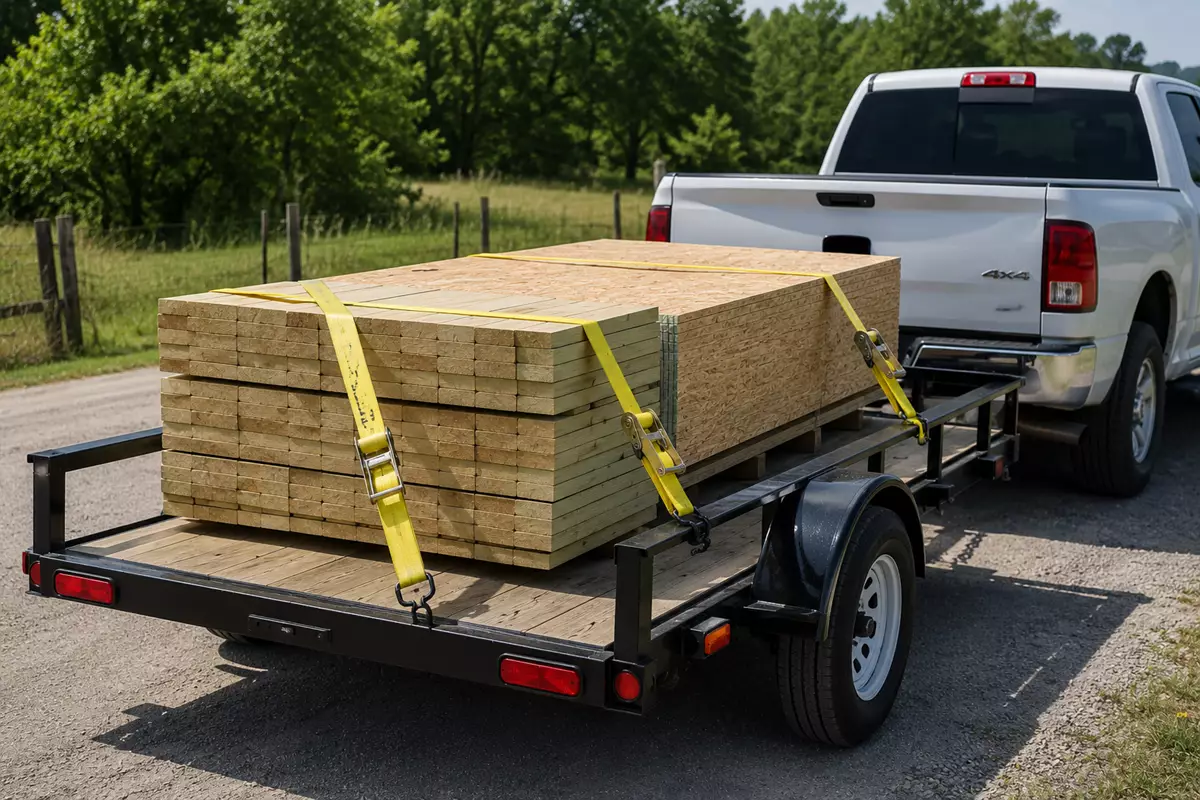
For almost all trailer loads, ratchet straps are the right tool. They are rated for specific weight capacities (printed on the strap label), they hold tension reliably, and they are easy to tighten as needed. Rope and bungee cords are not adequate substitutes. Rope stretches, slips, and loses tension; bungee cords cannot generate enough force to hold a real load in place. Two- to four-inch wide ratchet straps with rated capacities of 3,000 to 10,000 pounds cover almost any rental scenario.
Anchor Points
Most trailers have built-in anchor points: D-rings welded to the deck, stake pockets along the rails, or threaded tie-down points. Use these. Do not anchor straps to non-load-rated points (axles, suspension components, the trailer frame in random spots). Built-in anchors are designed and tested for the loads they will see; ad-hoc anchors fail under stress, often during the worst possible moment on the road.
The Cross-Tie Technique
For loads that could shift forward or backward (an engine block, a piece of furniture, a stack of pallets), use cross-ties. A cross-tie runs from an anchor point on one side of the trailer, over the top of the load, and down to an anchor point on the opposite side. Two cross-ties (one toward the front of the load, one toward the rear) hold the load from sliding in any direction. A single strap can be defeated by acceleration or braking; crossed straps cannot.
How Tight Is Tight Enough
Tighten ratchet straps until the load is compressed slightly into the trailer deck or against the trailer walls. The strap should be taut enough that you cannot easily wiggle the load by hand. Over-tightening damages soft cargo (furniture, boxes) but is rarely a real risk; under-tightening is the more common mistake. Re-check strap tension after the first few miles of driving; loads often settle, and what was tight in the driveway can be loose by the first highway exit.
Common Loading Mistakes and the Fixes
A handful of mistakes show up repeatedly in real-world rental scenarios. Knowing the patterns helps you avoid them.
| Mistake | What It Causes | The Fix |
|---|---|---|
| All weight behind the axle | Sway at highway speed, light tongue, dangerous handling | Move the heaviest items forward of the axle |
| All weight in front of the axle | Rear of tow vehicle squats, steering and braking degrade | Move some weight rearward until tongue weight is in 10-15% range |
| Heavy items stacked high | High center of gravity, lean in corners, tip risk | Put heavy items on the deck; stack light items on top |
| Items not secured at all | Load shifts during braking or turns, ruins weight distribution mid-trip | Use rated ratchet straps from anchor to anchor |
| Single strap on shiftable cargo | Load slides forward or backward despite the strap | Use cross-ties: strap from opposite corners over the load |
| Bungee cords on real loads | Bungees cannot generate holding force, load shifts or falls | Replace with ratchet straps rated for the cargo weight |
| Loading on uneven ground | Trailer leans during loading, weight distributes incorrectly | Level the trailer (with jack stands or chocks) before loading |
Special Cargo: A Few Quirks Worth Knowing
Most cargo follows the rules above, but a few common rental scenarios have specific considerations.
Vehicles and Equipment with Wheels
Vehicles loaded onto a flatbed should be positioned so the heaviest end (usually the engine) sits over or just in front of the trailer axle. Strap the vehicle from all four corners using rated wheel straps or chassis tie-downs, not by attaching to suspension components. The vehicle's parking brake alone is not enough to keep it in place; mechanical tie-downs are mandatory.
Loose Materials Like Mulch or Gravel
Bulk materials shift during transport even more readily than solid cargo. For dump-trailer loads, spread the material so the heaviest concentration sits forward of the axle, and use a tarp to prevent material from blowing out at highway speed. The 60/40 rule still applies even when you cannot precisely measure where the weight ends up.
Long Items Like Lumber or Pipe
Long items should be centered over the axle, with the bulk of the weight forward of the axle line. Use cross-ties at multiple points along the length, not just at the ends. Items that overhang the back of the trailer beyond a foot or two need a red flag and may need additional lighting depending on your state.
Tall Items
Anything that extends significantly above the height of the trailer walls becomes a center-of-gravity problem. If you must transport tall items, place them as low as possible, secure them with cross-ties to multiple anchor points, and drive slower than normal. Crosswinds affect tall loads disproportionately.
The Pre-Departure Walk-Around
Before you leave the driveway, do one final pass. Check tongue weight again (the load may have settled differently than you expected). Walk around the trailer and confirm every strap is tight and every load is where you left it. Look at the tires; an obviously squashed tire is a sign of overloading even if the gross weight seems within spec. If you have a chance, drive the trailer around the block at low speed and stop to re-check the load. Many problems become obvious only once the trailer has moved.
It is also worth confirming tire pressure on a loaded trailer; the pressure that was right empty may need a small adjustment under load. Our trailer tire pressure guide covers the cold-pressure rules that apply regardless of load, but a heavily loaded trailer should be inflated to the maximum sidewall pressure to handle the additional stress safely.
What to Do If the Trailer Starts to Sway
Even with careful loading, sway can occasionally start on the road (a strong crosswind, a fast lane change, the bow wave from a passing truck). When it does, do not steer to correct it. Steering inputs amplify sway. Instead, ease off the accelerator gradually (do not slam the brakes, which makes sway worse), keep the steering wheel pointed straight ahead, and gently apply the trailer's manual brake controller override if your tow vehicle has one. The trailer brakes pull from behind and damp the sway. Once sway stops, find a safe place to pull over and re-check the load. Sway that starts once is likely to start again, and the load distribution should be adjusted before continuing. Our ultimate towing safety guide covers sway recovery and other emergency responses in more detail.
The Bottom Line
Loading a trailer correctly is not difficult, but doing it badly causes more preventable damage than almost anything else in towing. Four rules cover the essentials: sixty percent of the weight in front of the axle, tongue weight between ten and fifteen percent of total load, heavy items low and centered, and rated ratchet straps with cross-ties on anything that could shift. Spend an extra fifteen minutes loading the right way, and the rest of the trip is forgettable. Skip those fifteen minutes, and the trip becomes a story you tell.
Ready to put the rules into practice on your next project? Browse trailers on Neighbors Trailer and pick a trailer sized for your specific load (oversized is almost always better than undersized for first-timers, because it gives you more room to position weight correctly). Whatever you are hauling, the time you spend distributing it well is the most important fifteen minutes of the whole trip.