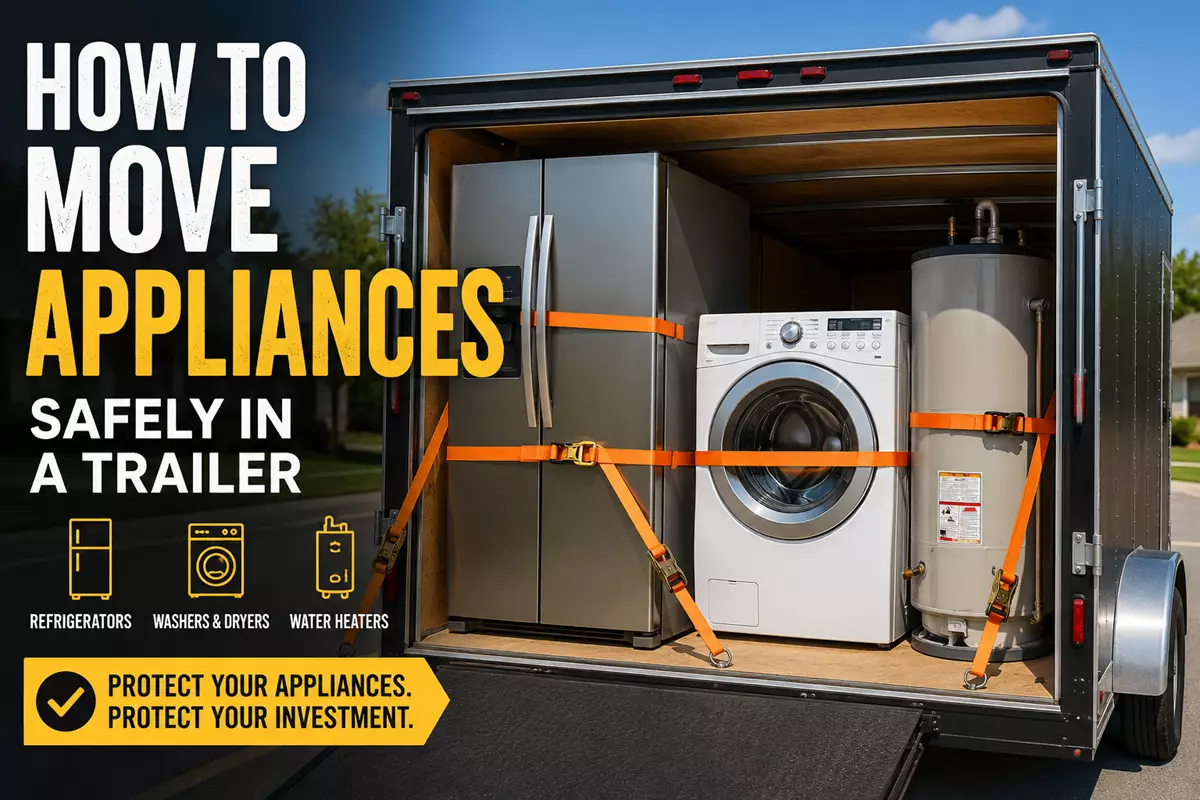
How to Move Large Appliances in a Trailer
 Neighbors Trailer
Jul 15, 2026 194 16 min read
Moving a refrigerator, washer, dryer, or water heater is one of the most common reasons people rent a trailer, and it is also one of the most common reasons appliances arrive at their destination broken. Large appliances are not like ordinary cargo. They are heavy, top-heavy, awkwardly shaped, full of vulnerable internal components, and each type has specific transport rules that damage the appliance if ignored. A refrigerator laid on its side without proper settling time can fail within days. A front-load washer transported without its shipping bolts can bounce its drum into a repair bill. A water heater moved with water still inside can crack its inner tank. None of these failures are obvious in the moment. All of them are preventable with a handful of specific practices. This guide walks through how to move each of the major household appliances safely, what the manufacturer-specific quirks are, and how to load a mixed appliance haul without damaging anything.
Why Appliances Are Their Own Category
Standard hauling advice (distribute weight, strap it down, drive carefully) is necessary but not sufficient for appliances. Each appliance has internal mechanical systems that were designed with the assumption they would sit level and stationary for most of their lives. Refrigerators have sealed compressors with oil that migrates during tipping. Washers have suspended drums that need specific shipping restraints to survive transport. Water heaters hold up to fifty gallons of water that becomes a projectile force during any sudden movement. Ignoring these specifics is what causes the majority of appliance transport damage.
Beyond the mechanical concerns, appliances are also awkward to load: they are typically five to six feet tall, narrow at the base, and heavy at the top. They tip easily during loading if not handled with a proper dolly. And because they are usually irreplaceable during the trip (few people have a spare fridge in the driveway), any damage becomes an expensive lesson rather than a minor inconvenience.
Choosing the Right Trailer
The first decision is which trailer type is appropriate for the load. All three common types can work, but each fits specific scenarios.
Enclosed Cargo Trailer
The best choice for anything valuable or weather-sensitive. Enclosed trailers protect appliances from rain, road grime, and wind pressure at highway speed. They also offer built-in anchor points on the walls and floor, and interior walls that can act as bracing for tall items. For a full kitchen remodel or a cross-town move of multiple appliances, enclosed is almost always worth the premium. Interior height matters: a full-size refrigerator with the doors on can be over 70 inches tall, so verify the trailer's interior clearance before booking.
Utility Trailer with Sides
A reasonable second choice for a single appliance being moved on a clear day. The sides provide bracing for cross-ties and give the load some wind protection. A tarp on top handles light weather. The main limitation is that side walls on utility trailers are usually only two to three feet tall. A full-size refrigerator strapped to the sides is still exposed above the sides to wind and precipitation.
Flatbed Trailer
Flatbeds work for short-distance moves in dry weather and offer the easiest loading with the widest access. The tradeoff is that the appliance is completely exposed. Even a short drive on a wet highway sprays road water onto the sides and back of the appliance, and any weather that develops mid-trip becomes a problem. Only use a flatbed for appliances you are certain will be moved short distances in good conditions.
Size Matters More Than You Think
A common mistake is renting a trailer just large enough to fit the appliance in tight. Extra space is not wasted; it is where straps go, where padding sits, and where you have room to reposition if the initial layout turns out wrong. As a rule of thumb, pick a trailer with at least two feet of clearance on each side of the appliance and enough length that the load can sit in the front third of the deck (see the weight distribution section below).
Refrigerators: The Trickiest Appliance
Of all household appliances, refrigerators have the most specific transport requirements and the most expensive failure modes. Almost every refrigerator failure attributed to "the move" traces back to violating one of the rules below.
The Upright Transport Rule
Every modern refrigerator should be transported upright whenever possible. The compressor at the base of the fridge is a sealed system with lubricating oil that stays where it belongs when the fridge is vertical. When the fridge is tipped horizontally, the oil migrates into refrigerant lines where it does not belong. Once transport is complete and the fridge is stood back up, that oil takes time to return to the compressor. Starting the fridge before the oil has fully settled runs the compressor without proper lubrication, which is what kills fridges after moves.
If You Absolutely Must Lay It Down
Some situations (low trailer height, awkward doorways at the destination) make upright transport impossible. If you must lay a fridge down, lay it on its side, not on its back. The side without the compressor cooling coils is preferred. After the move, stand the fridge upright and let it sit unplugged for the same amount of time it was on its side, with a minimum of 24 hours. Only after this settling period should the fridge be plugged in. Skipping this step is the most common reason refrigerators die after moves.
Doors, Ice Makers, and Water Lines
Before loading, secure the doors closed. Rubber bands, painter's tape, or a ratchet strap around the fridge horizontally all work. A door that swings open during transport can bend hinges, dent the door itself, or damage the trailer walls. If the fridge has an ice maker or water dispenser, disconnect the water supply line at the wall, drain any water in the internal reservoir, and secure the line so it does not dangle. If the fridge has a water filter, remove it before transport. Filters can leak into the fridge interior during movement.
Empty It Completely
Remove everything from the interior. Loose shelving, glass drawers, and door bins should be removed and transported separately (wrapped in blankets), or secured inside the fridge with tape and padding. Loose glass shelves in a moving fridge become breakage almost every time.
Washing Machines
Washing machines have different transport considerations depending on whether they are top-load or front-load.
Front-Load Washers: Reinstall the Shipping Bolts
Front-load washers ship from the factory with specific transport bolts that hold the drum in place against its shock absorbers and springs. During normal use, these bolts are removed and stored (often taped to the back of the machine or in the owner's manual pouch). Before moving a front-load washer, you must reinstall the shipping bolts. Without them, the drum bounces freely inside the cabinet during transport, damaging the suspension system and potentially breaking the drum itself. If you do not have the original bolts, most manufacturers sell replacements, and it is worth ordering them before the move rather than risking a repair bill after.
Top-Load Washers: Drum Support
Top-load washers do not have shipping bolts but do have suspension systems that can be damaged by hard bumps during transport. Wedging a folded blanket or foam pad inside the drum before moving helps limit drum movement and protects the suspension. Close the lid and tape or strap it shut so it does not fly open.
Water Hoses and Drain
Disconnect the hot and cold supply hoses from the wall (not from the washer). Drain any water that remains in the hoses into a bucket. The washer itself may hold a small amount of residual water in the pump and hoses; tilt the machine gently backward for a few seconds over a floor drain or bucket to expel most of it. Coil the hoses and either put them inside the drum or tape them to the back of the machine so they do not swing during transport.
Dryers
Dryers are generally the easiest major appliance to transport. They are heavy but their internal components are robust compared to washers and refrigerators.
Standard Preparation
Disconnect the dryer vent hose at the wall and at the machine, and dispose of it (dryer vent hoses degrade over time and are cheap to replace at the new location; do not reuse an old one). Clean out the lint trap completely. Tape the door shut so it does not swing open during transport. If the dryer has any accessories (drying racks, wool balls, sensors), remove them and transport separately.
Gas Dryers: The Gas Line
Gas dryers add one complication: the gas supply line. Before disconnecting, shut off the gas valve at the wall. Then use two wrenches (one on the valve to hold it steady, one on the fitting to unscrew) to disconnect the flexible gas line from the dryer. Cap the disconnected end of the line with an appropriate fitting or plumbing tape to prevent gas leakage from the wall side. If you are uncomfortable with any of this, have a licensed plumber or gas fitter do the disconnect. This is one of the few appliance moves where DIY is genuinely risky if you have not done it before.
Water Heaters
Water heaters are the appliance most commonly damaged in DIY moves, usually because renters underestimate how much water is still inside even after "draining."
Drain Completely Before Moving
Turn off the power (electric water heaters) or gas supply (gas water heaters). Turn off the cold water supply at the top of the tank. Open a hot water faucet somewhere in the house to break the vacuum, which lets the tank drain freely. Attach a garden hose to the drain valve at the bottom of the tank and route the hose to an outdoor drain or a downhill location. A 40-gallon tank takes 20 to 30 minutes to drain completely; a 50-gallon tank can take an hour. Do not shortcut this step. A partially full water heater in a trailer is a projectile hazard, and the internal glass lining can crack under the shifting water weight.
Gas and Electric Connections
For electric water heaters, shut off the breaker, then disconnect the wiring from the top of the tank. Cap or tape the exposed wires so they do not short against anything. For gas water heaters, shut off the gas valve, then disconnect the flexible gas line with two wrenches (same technique as gas dryers). If the water heater is hard-piped rather than on a flex line, professional disconnection is required.
Transport Position
Water heaters should be transported upright whenever possible. If you must lay one down, put it on its side (not upside down). Even fully drained, water heaters are 130 to 180 pounds depending on capacity, and their tall, narrow shape makes them prone to tipping during loading. A furniture dolly and a helper are essentially mandatory.
The Master Reference: Appliance-by-Appliance
The table below summarizes the key requirements for each major appliance. Use it as a checklist before you load.
| Appliance | Typical Weight | Transport Position | Critical Prep Step |
|---|---|---|---|
| Full-size refrigerator | 250-350 lbs | Upright preferred; on side if necessary (24-hour settle after) | Empty, secure doors, disconnect water line |
| Compact / mini fridge | 50-100 lbs | Upright preferred; same settling rule if tipped | Empty, secure door |
| Top-load washer | 180-250 lbs | Upright | Drain hoses, wedge blanket in drum, tape lid shut |
| Front-load washer | 200-280 lbs | Upright | Reinstall shipping bolts (mandatory), drain hoses |
| Electric dryer | 100-150 lbs | Upright | Disconnect vent hose, clean lint trap, tape door |
| Gas dryer | 110-160 lbs | Upright | Shut off gas, disconnect gas line properly, tape door |
| Electric water heater (40-50 gal) | 130-180 lbs empty | Upright strongly preferred | Drain fully (20-60 min), cap wires |
| Gas water heater (40-50 gal) | 130-180 lbs empty | Upright strongly preferred | Drain fully, shut off and cap gas line |
| Dishwasher | 75-125 lbs | Upright | Disconnect water, drain lines, secure door |
| Stove / range (electric) | 150-250 lbs | Upright | Remove burners and racks; secure oven door |
| Stove / range (gas) | 150-250 lbs | Upright | Shut off and disconnect gas line; remove burners |
Loading Procedure for Appliances
Once each appliance is properly prepared, the loading procedure matters as much as the preparation.
Rent or Borrow a Furniture Dolly
Do not attempt to lift and carry a full-size appliance without wheeled assistance. A four-wheel furniture dolly (about $30 to rent, $70 to buy) is the right tool. It handles the weight, protects your back, and lets one person move even a full-size refrigerator with reasonable effort. An appliance dolly (two-wheel, with a strap) is specifically designed for stair navigation and is worth the small premium if any stairs are involved.
Weight Distribution in the Trailer
Appliances are dense, heavy items that should sit forward of the trailer's axle to maintain the correct 10 to 15 percent tongue weight. Position the heaviest appliance first, in the front third of the trailer deck. Lighter appliances go behind it. If you are hauling multiple items, load heaviest to lightest from front to back. Our hauling tips guide covers the general weight distribution principles that apply here.
Padding Between Straps and Appliances
Ratchet straps pulled tight against bare appliance surfaces will dent, scratch, or damage the finish. Always place a moving blanket, thick towel, or foam padding between the strap and the appliance body. This is especially important with stainless steel refrigerators and glossy-finish washers and dryers where any strap mark is a permanent visible scar.
Cross-Ties on Tall Items
Refrigerators, water heaters, and any appliance taller than about four feet should be secured with cross-ties running from opposite corners over the top of the appliance and back down. A single strap around the middle of a tall appliance is not enough; the top can still rock forward or backward. Cross-ties immobilize the load in all four directions.
Do Not Rely on Appliances Bracing Each Other
A common mistake is placing two appliances next to each other and assuming they will keep each other upright. They will not. Each appliance must be independently secured to the trailer, not just to its neighbor. Appliances that shift toward each other during transport dent and damage both.
Weather and Timing Considerations
Weather affects appliance transport more than it affects most other cargo. A few adjustments are worth planning for.
Rain and Electronics Do Not Mix
Modern appliances have electronic control panels, sensors, and circuit boards that were never designed to be rained on. Even a brief highway rain squall can push water into ports and controls that were not designed to be exposed. If rain is possible during your transport window, use an enclosed trailer or wait for better weather. A tarp on a utility trailer is an acceptable backup but not as reliable as an enclosed trailer.
Direct Sun on Long Trips
Direct sunlight on appliances during a summer trip can heat surfaces to 140 degrees or more, which can damage plastic components, warp cabinet finishes, or degrade seals. For long summer trips, an enclosed trailer or a light-colored tarp on an open trailer significantly reduces heat exposure.
Common Mistakes That Damage Appliances
Several mistakes appear again and again in appliance transport, and each one is easy to avoid once you know to watch for it.
Plugging In a Refrigerator Immediately After Moving
The single most common way to kill a refrigerator during a move is to plug it in the moment you arrive. If the fridge was tipped or laid down at any point, oil is still migrating back to the compressor. Wait the full settling period (24 hours minimum, longer if it was on its side for hours) before plugging in.
Skipping the Shipping Bolts on a Front-Load Washer
The second most common expensive mistake. A front-load washer transported without shipping bolts will damage its suspension system, and the damage often does not appear until several loads later. If you cannot find the original bolts, buy replacements before moving.
Moving a Water Heater Without Fully Draining
Even a small amount of water inside a water heater during transport shifts and slams against the tank walls at every bump. This can crack the inner glass lining, which does not always leak immediately but shortens the tank's life significantly. Give the drain the full time it needs.
Not Securing the Door
Any appliance door that can swing open will eventually swing open during transport. Secured means secured with tape, straps, or rubber bands, not just closed. This applies to fridge doors, freezer doors, oven doors, washer lids, and dryer doors.
Under-Sizing the Trailer
Moving a full-size fridge in a 4x6 utility trailer works technically but leaves no room for proper strapping. A 5x8 or 5x10 is the minimum for a single full-size appliance; a 6x12 or larger is more comfortable and safer.
Multi-Appliance Kitchen Moves
Full kitchen replacements are a common scenario: refrigerator, dishwasher, range, and often a microwave, all in one trip. The math on this is worth calculating in advance. A refrigerator, range, and dishwasher together can easily total 500 to 700 pounds, which is well within any decent trailer's capacity but requires proper distribution and enough deck space to load each appliance in the correct position. Our Moving Weight calculator adds up common household items and appliances from a room-by-room checklist so you can verify the total before booking a trailer. For a full kitchen haul, plan on a 6x12 or 7x14 enclosed trailer, budget for extra straps and padding, and expect the loading process to take longer than a single appliance would suggest. Our ultimate towing safety guide covers the loaded-trailer driving practices that apply to any heavy haul.
The Bottom Line
Appliances are one of the most common trailer rental use cases and one of the easiest categories of cargo to damage. The specific practices in this guide (upright transport for refrigerators, shipping bolts for front-load washers, fully draining water heaters, cross-ties on tall items, proper trailer sizing) prevent nearly every common failure mode. None of them is difficult. All of them save the renter from the expensive discovery that a fridge, washer, or water heater does not survive the trip. Spend the extra fifteen minutes on preparation, and the appliance arrives ready to be plugged in at the new location instead of ready for a repair call.
Ready to plan your next appliance move? Browse trailers on Neighbors Trailer and pick one with enough interior space for the specific appliance you are moving, plus room for padding and cross-ties. For anything valuable or weather-sensitive, an enclosed trailer is worth the premium every time.