

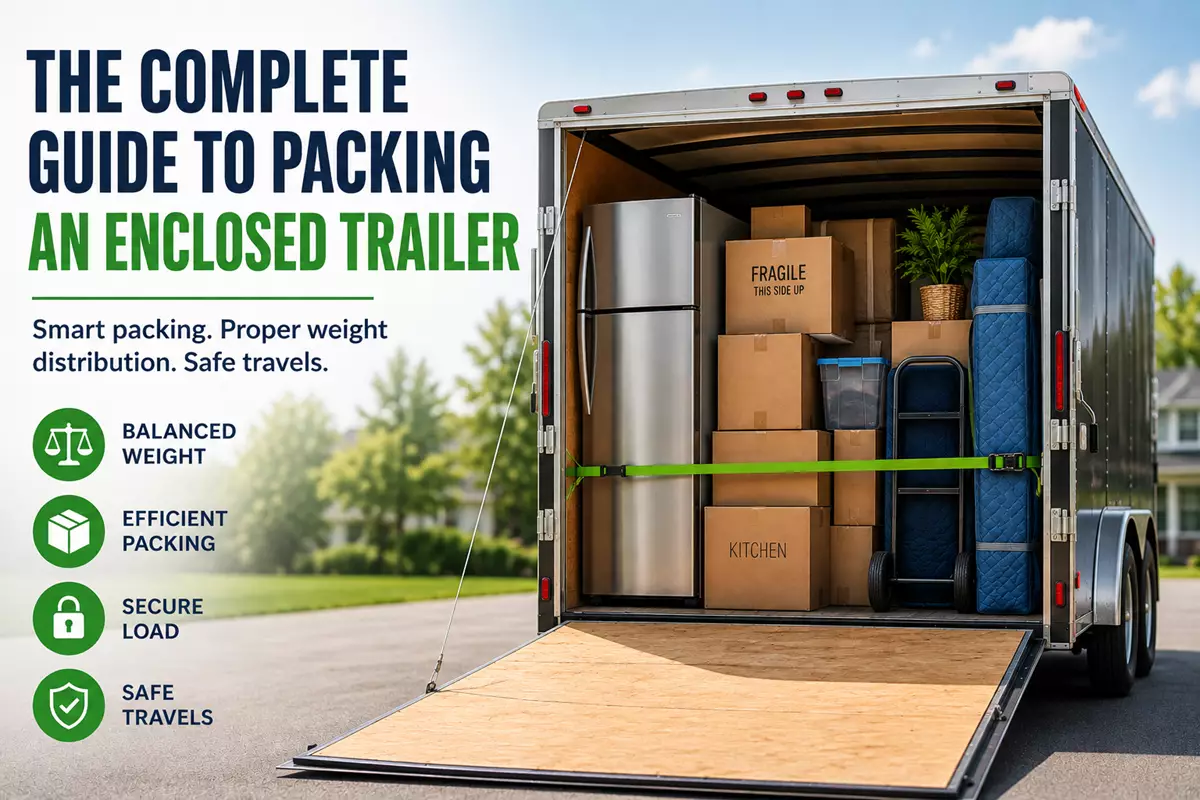
Enclosed Trailer Packing Guide: Tips for Safe & Efficient Loading
 Neighbors Trailer
Aug 4, 2026 100 10 min read
Congratulations on booking your enclosed trailer. The hard part is behind you: you picked the right trailer, secured your rental dates, and now the trip is ahead of you. The next step is packing it well. A well-packed enclosed trailer arrives at its destination with everything intact, the tow ride steady, and unloading straightforward. A poorly packed one shows up with damaged furniture, a stressful drive, and a mess to sort out on arrival.
The good news is that packing an enclosed trailer follows a repeatable set of practices. Whether you are moving apartments, hauling equipment across the state, or handling a weekend business project, the same principles apply. This guide walks through the whole process, from pre-packing prep to safety checks before you pull out.
Before You Start: Your Pre-Packing Checklist
Ten minutes of prep before you start loading saves hours of frustration later. Here is what to have ready.
Measurements to take:
- Interior length, width, and height of the trailer
- Rear door opening dimensions (often narrower than the interior)
- Height of your largest items (refrigerator, dressers, tall furniture)
- Total weight capacity of the trailer (GVWR minus the trailer's own weight)
Supplies to gather:
- Four to six ratchet straps rated for your load
- Moving blankets or furniture pads (more than you think you need)
- A furniture dolly for heavy items
- Boxes in a few standard sizes for stacking
- Packing tape, permanent markers for labeling
- Shrink wrap or rope for bundling
Planning steps:
- List your heaviest items (appliances, furniture) and identify where they'll go in the trailer
- Group items by fragility so you can load them in the right order
- Check the weather forecast for your travel window
- Confirm your tow vehicle can handle the fully loaded trailer weight
If you are still unsure whether you booked the right size, our trailer sizing guide covers how to match capacity to your load. For a fast weight check, our Moving Weight calculator will estimate the total pounds of a move room by room in about a minute.
Weight Distribution: The Rule That Matters Most
Every safe trailer load follows the same weight-distribution principles. Get this right and everything else gets easier.
The 60/40 rule: Roughly 60% of your cargo weight should sit in front of the trailer's axle, with 40% behind. This creates the correct tongue weight (10-15% of total trailer weight pressing down on the hitch), which prevents sway and keeps the trailer stable at highway speed.
How to check tongue weight: A bathroom scale under the tongue jack works for small trailers. For larger loads, a tongue weight scale (about $40) gives precise readings. If the front of your tow vehicle lifts noticeably when the trailer is hitched, tongue weight is too high. If the trailer feels tail-heavy or sways at highway speed, tongue weight is too low. Aim for the sweet spot in the 10-15% range.
Vertical distribution:
- Heaviest items on the floor, positioned low and toward the front
- Medium-weight items in the middle layer
- Light, fragile items on top or in gaps
- Nothing heavy stacked on top of fragile items, even if there's space
Side-to-side balance: Distribute weight evenly across the trailer's width. Loading heavy items only on one side creates lateral imbalance that causes handling problems and uneven tire wear. Aim for symmetry when possible.
Our trailer loading guide covers the detailed weight-distribution math for different cargo types and trailer sizes. To visualize how your specific load balances on the trailer deck, try the Weight Distribution calculator with its interactive load planner.
Loading Order: What Goes In First
The trailer loads in reverse of how you'll unload. Whatever goes in first comes out last. Plan accordingly.
Standard loading sequence:
- First: Heaviest furniture and appliances against the front wall (refrigerator, washer, dryer, dressers, couches)
- Second: Sturdy boxes stacked in the front and middle sections
- Third: Mattresses and box springs on their sides against the walls (protects them and creates padding for other items)
- Fourth: Medium furniture (chairs, side tables, smaller items)
- Fifth: Fragile boxes and delicate items on top or in the last section
- Last: Items you'll need first at the destination (near the door)
Think of the load as a solid block. Every layer should support the next without shifting. Gaps invite movement, which invites damage.
Multi-day move example: For a two-bedroom apartment move, load in this order: refrigerator against the front-left wall, washer and dryer front-right, dressers and armoires along the sides behind the appliances, mattresses on their sides against the walls, sturdy boxes stacked in the middle, then chairs and side tables filling remaining floor space, and fragile boxes on top of the sturdy stacks near the door. Save a small pocket near the door for the box of "first-night essentials" you'll want immediately at the destination.
Pro Tips for Maximizing Space
An enclosed trailer holds more than most people think, if you use its space intelligently.
Use vertical space fully:
- Stack boxes as high as they'll go safely (heavy on bottom, light on top)
- Stand mattresses and headboards on their sides
- Use folded ladders or shelving units as vertical dividers
- Place tall items (lamps, brooms, plants) in the corners where standard rectangular items don't fit
Fill hollow items:
- Empty dresser drawers can hold soft items (linens, clothes, pillows)
- Refrigerators (with doors taped shut) hold non-fragile soft goods
- Washer drums hold blankets or towels
- Wardrobes and cabinets hold packed boxes
Padding is protection AND filler:
- Wrap furniture edges and corners with moving blankets
- Stuff towels and linens between items to prevent shifting
- Use pillows and cushions as gap fillers around fragile items
- Bubble wrap or foam for glass, mirrors, framed art
Use a furniture dolly: A four-wheel furniture dolly rents for about $10 and saves your back. For appliances specifically, our appliance hauling guide covers the specific dolly and loading techniques.
Label everything before you load:
- Mark each box with its destination room and general contents
- Use a distinct color or symbol for "fragile" boxes so they're easy to spot
- Number your boxes and keep a master list on your phone
- Mark "load last" on boxes you'll need immediately at the destination
Ten minutes of labeling saves an hour of "where did I put the coffee maker" at 10 PM in the new place.
Securing Your Load: Straps, Ties, and Anchors
Even a perfectly organized load will shift without proper tie-downs. Enclosed trailers have interior anchor points (D-rings, E-track, or tie-down loops) built into the walls and floor.
Strap types and when to use them:
- Ratchet straps for anything heavy that needs to stay put (appliances, furniture)
- Cam-buckle straps for lighter items where ratchets would be overkill
- Rope for bundling loose items together (not for anchoring)
- Skip bungee cords entirely; they lose tension and cannot hold real loads
How to strap effectively:
- Anchor tall items with cross-ties from opposite corners over the top
- Use padding under strap contact points to prevent damage to painted surfaces
- Compress your load into a solid block by strapping across large sections
- Test each strap by pulling firmly; it should not move
Mid-trip checks: At every fuel stop, walk around the trailer and check straps for loosening. Vibration causes even properly-tightened straps to work loose over hundreds of miles. Retighten as needed.
Common Packing Mistakes to Avoid
Certain mistakes come up repeatedly, and each one is preventable.
- Overloading past the weight rating. Trailers have a Gross Vehicle Weight Rating (GVWR) that includes the trailer's own weight. Exceed it and you risk tire failure, brake failure, or worse. When in doubt, weigh at a truck stop scale.
- Loading everything in the back. Rear-heavy trailers sway dangerously at highway speed. Follow the 60/40 rule and put the weight forward.
- Skipping padding to save space. Padding prevents damage that costs far more than the padding itself. Never leave hard surfaces touching each other.
- Not securing loose items. Every object in an unsecured pile becomes a projectile at the first hard brake. Anything that can move, will move.
- Blocking the door with essentials. Whatever you need first at the destination should be nearest the door, not buried at the front.
- Forgetting the load height. Tall items near the door can shift forward and block the door from opening. Keep tall items away from the exit.
- Ignoring the weather forecast. Even enclosed trailers can develop moisture inside on a long humid trip. Wrap fabric items and mattresses in plastic if extended rain is expected.
What NOT to Pack in a Trailer
Some items simply do not belong in a trailer, whether for legal, safety, or practical reasons. The categories below cover what to keep out.
| Category | Examples | Why |
|---|---|---|
| Hazardous materials | Propane tanks, gasoline, kerosene, pool chemicals, aerosol cans | Fire and explosion risk in a sealed space; often illegal to transport by non-licensed carriers |
| Perishables | Fresh food, frozen items, plants, medications requiring refrigeration | Temperature swings inside a trailer damage or destroy them within hours |
| Valuables and irreplaceables | Cash, jewelry, passports, birth certificates, family photos, external drives | Should travel with you in the tow vehicle where you have direct control |
| Living things | Pets, plants, aquarium fish | No ventilation, temperature control, or ability to check on them safely |
| Firearms and ammunition | Any firearm, ammunition, gunpowder | State-by-state legal restrictions on transport; theft risk; safety in a moving trailer |
| Anything you need en route | Snacks, water, phone chargers, first aid kit, road maps, medications | You will not be able to access the trailer during the drive |
Safety Considerations Before You Hit the Road
Once the load is packed, a few final checks protect the trip and everyone on the road.
Weight verification:
- Confirm total cargo weight is under the trailer's payload capacity
- Verify your tow vehicle can handle the loaded trailer weight (owner's manual has the number)
- Check tongue weight is 10-15% of loaded trailer weight (our Tongue Weight calculator gives you the target number in seconds)
- If you're near any limit, weigh at a CAT scale before the highway
Ventilation: Enclosed trailers are sealed. Never transport anything that off-gasses (fresh paint, treated lumber, opened chemical containers), living things, or anything that generates heat. On long summer trips, interior temperatures can exceed 140 degrees.
Door security:
- Test the rear door latch and any padlock before pulling out
- Verify the door is fully closed and latched (not just pushed shut)
- If the trailer has multiple locks, use them all
Pre-trip walk-around:
- All lights working (brake, turn, running)
- Tire pressure and condition on all trailer tires
- Safety chains crossed and attached
- Emergency breakaway cable connected
- Coupler locked and secured
- Nothing dragging or hanging loose
Loading and parking safety:
- Chock the trailer wheels during loading to prevent rolling
- Keep the tow vehicle in park with the parking brake engaged while loading
- Never stand under the trailer's ramp door while it's open; support it or fully lower it first
- Load the trailer on level ground; slopes shift weight unpredictably
- At the destination, chock the wheels again before opening the door to unload
For the full pre-trip protocol, our ultimate towing safety guide walks through every check point.
You're Ready
An enclosed trailer well-packed is one of the most efficient ways to move a household, transport equipment, or handle any weather-sensitive cargo. The extra hour spent on planning, weight distribution, and proper securing pays back in a smoother drive and undamaged cargo at the destination.
Ready to book your next enclosed trailer? Browse enclosed trailers on Neighbors Trailer to find the right size and features for your move. Owners on the platform can advise on their specific trailer's tie-down points, interior dimensions, and any features that will help you pack more efficiently. Message them before you arrive with any questions about your specific load.