

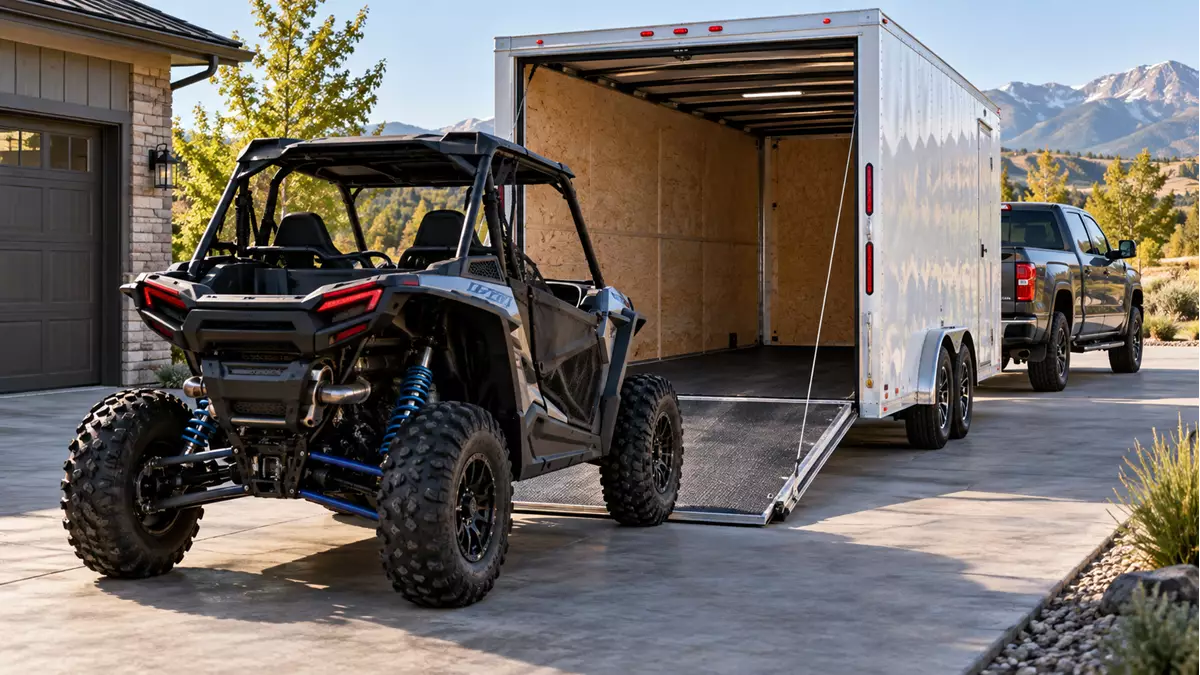
Will Your UTV or Side-by-Side Fit in an Enclosed Trailer?
 Neighbors Trailer
Sep 15, 2026 16 11 min read
You found a great deal on an enclosed trailer rental and you are ready to book, but one question stops you cold: will your side-by-side actually fit inside it? It is the right question to ask, and it trips up more powersports owners than any other part of renting a trailer. A UTV is wide, and enclosed trailers are narrower on the inside than their advertised size suggests, so a machine that looks like it should fit can turn out to be an inch too wide at the door or blocked by the fender wells. This guide walks through the measurements that actually matter, why the door opening is the real constraint, and how to know your UTV will fit before you book instead of finding out on loading day.
Why UTV Width Is the Whole Problem
ATVs are relatively easy to haul. A typical four-wheeler is around 48 inches wide, so it fits comfortably in almost any enclosed trailer with room to spare. UTVs and side-by-sides are a different story. These machines run much wider, and their width is right at the edge of what a common enclosed trailer can swallow, which is exactly why "will it fit" is a real question for a UTV and a non-issue for an ATV.
Here is the trap: an enclosed trailer's advertised width is the exterior dimension, not the usable interior. A trailer sold as "7 foot wide" is 84 inches on the outside, but the interior is narrower once you account for the wall thickness, and the door opening you actually have to drive through is narrower still. So the number on the listing is not the number your UTV has to fit into. The measurement that matters is the interior width and, more importantly, the width of the opening at the ramp door.
Know Your UTV's Real Width
Start with your machine. UTV width varies a lot by class, and you need the actual number for your specific model, not a rough guess. Manufacturer specs list an overall width, but confirm it against your machine as it sits, because aftermarket tires, wheel spacers, or wider fender flares can add inches the factory spec does not include.
As a general guide, here is where common UTV classes fall. Use it to understand the ballpark, then verify your exact model.
| UTV Class | Typical Width | Examples of This Size |
|---|---|---|
| Trail / narrow sport | 50 to 60 inches | Trail-specific models built to fit 50-inch trails |
| Sport side-by-side | 60 to 64 inches | Most two-seat sport machines |
| Utility side-by-side | 60 to 65 inches | Most work-oriented two-seat UTVs |
| Wide sport / rec | 64 to 72 inches | High-performance and wider-stance models |
| Full-size / multi-seat | 62 to 74 inches | Crew and four-seat machines |
These are representative ranges to show how the classes compare, not exact specs for any one machine. Your model's real number is what counts, so measure or look it up before you match it to a trailer.
Match It to the Trailer's Real Interior
Now the other half of the equation: the trailer. Enclosed cargo trailers come in a few standard widths, and the difference between them is exactly what decides whether your UTV fits.
A "6 foot wide" enclosed trailer has an interior of roughly 68 to 70 inches and a door opening narrower than that, which makes it tight-to-impossible for most true UTVs. A "7 foot wide" trailer, the most common size, runs about 80 to 81 inches inside with a door opening in the low-to-mid 70s. An "8.5 foot wide" trailer, the widest common size, gives you roughly 100 inches inside and a much more forgiving door. The jump from a 7-foot to an 8.5-foot trailer is the single biggest factor in whether a wide UTV loads easily or not at all.
The rule of thumb: you want meaningful clearance between your UTV's width and the door opening, not a measurement that matches to the inch. A machine that is technically an inch narrower than the opening is a white-knuckle load with no room for steering error, and it leaves no margin for tie-down access along the sides. Aim for several inches of clearance on each side, which for most sport and utility side-by-sides means a 7-foot trailer at minimum and an 8.5-foot trailer for comfort or for anything in the wider classes.
The Door Opening Is the Real Gatekeeper
This is the part most people miss, and it is the one that causes loading-day surprises. Your UTV does not just need to fit the interior width once it is inside; it has to fit through the ramp door opening to get in there. On many enclosed trailers, the rear door opening is narrower than the interior, because the frame, hinges, and door hardware eat into the width at the very point your machine has to pass through.
So a UTV that would sit fine inside the box can still be too wide to drive through the door. Always get the door opening width, not just the interior width, and compare your machine to that smaller number. If a rental listing gives you the interior dimension but not the door opening, ask, because that is the measurement that actually determines whether loading is possible.
Watch the Fender Wells and the Height
Width at the floor is the main event, but two more measurements can catch you out.
The fender wells, the housings that cover the trailer's own wheels, intrude into the lower interior on both sides. On a narrower trailer, a wide UTV's tires can line up right where the fender wells sit, so even if the machine clears the door it may not be able to sit flat between the wells. On a UTV that is close to the trailer's width, check where your tires will land relative to the wells, not just the open interior above them.
Height matters too, especially for UTVs with roll cages, roofs, light bars, or raised suspension. Enclosed trailers have a fixed interior height, commonly around 6 to 7 feet, and a tall side-by-side with a cage and a light bar can be surprisingly close to the ceiling. Measure your machine's tallest point and confirm it clears the interior height with room to load and strap down, not just barely.
Securing a Wide Machine Inside a Tight Fit
Fitting the UTV through the door is only half the job. Once it is inside, a machine that fills most of the trailer's width leaves little room along the sides to reach tie-down points, and that changes how you load and strap it. Plan your tie-downs before the machine goes in, because you may not be able to squeeze past it once it is positioned.
Load the UTV so its weight sits forward, over or just ahead of the trailer's axles, to keep the tongue weight right and the trailer towing straight. Use four ratchet straps, one at each corner, anchored to the machine's frame or designated tie-down points and to the trailer's floor anchors, pulling down and outward so the machine cannot shift in any direction. If you want a step-by-step walkthrough of the strapping technique itself, our guide on how to tie down your machine on a trailer covers the anchor points and strap angles in detail. On a tight-width fit, thread and pre-position your straps at the corners before you drive the machine all the way in, so you are not trying to reach a far-side anchor with the UTV already blocking it. Snug each strap until the suspension compresses slightly, which keeps the straps from loosening as the machine bounces over the road.
What About Hauling Two Machines?
If you are hauling more than one UTV, or a UTV plus an ATV or a couple of dirt bikes for a trail weekend, width and length both come into play. Two side-by-sides almost never fit side by side in any common enclosed trailer, since two 62-inch machines need well over ten feet of width that no standard trailer offers. Multi-machine hauls load front to back instead, which makes trailer length and total weight the constraints rather than width alone.
For a UTV plus smaller machines, you can often nose the side-by-side in first and fit ATVs or dirt bikes behind or alongside in the remaining space, but this is where measuring the real interior length and checking the combined weight against the trailer's rating matters. A machine that fits width-wise can still put you over the trailer's cargo capacity once you add a second or third. When your haul is more than one machine, size the trailer to the total load, not just to the widest single vehicle.
When an Open Trailer Is the Better Answer
If your UTV is genuinely too wide for the enclosed trailers available to you, or you are looking at a white-knuckle fit with no clearance, an open trailer solves the width problem entirely. A flatbed or open utility trailer has no walls, no door opening, and no fender-well intrusion to work around, so width simply stops being a constraint. You lose the weather protection and security an enclosed trailer gives you, but you gain the ability to haul a machine that would never fit inside a box. If you go that route, our guide to choosing the right-sized utility trailer rental for your machine walks through picking the deck length and weight rating to match.
This is the honest trade for wide machines: enclosed protects your UTV but limits what fits, open fits anything but leaves it exposed. If you are hauling a high-value or show-condition machine and it fits an 8.5-foot enclosed trailer, enclosed is worth it. If your machine is too wide, or you are hauling to a trail day where a little dust and weather does not matter, an open trailer is the simpler, cheaper, always-fits option. Our what trailer do I need calculator can help you weigh the trade for your specific machine and haul.
Why Fight the Width Problem at All?
If a UTV is this fiddly to fit in an enclosed trailer, it is worth remembering why people go to the trouble instead of just using an open one. An enclosed trailer keeps your machine out of the weather for the whole haul, which matters on a long drive or an overnight trip where an open-trailer machine sits exposed to rain and road grime the entire way. It also hides the machine from view and locks it away, so a valuable side-by-side is not advertising itself at every gas station and motel parking lot. And it doubles as dry, secure storage and a changing or staging space at the trailhead.
For an expensive, clean, or heavily accessorized machine, those benefits are the reason to find the trailer it fits rather than defaulting to open. The width work is a one-time measurement exercise; the protection lasts every mile of every haul. So the goal is not to avoid enclosed trailers because UTVs are wide, it is to confirm the fit up front so you get the protection without the loading-day surprise.
Confirm the Fit Before You Book
Putting it together, here is how to know your UTV will fit before you reserve anything rather than discovering a problem on loading day.
Do that short check before you reserve, and you will never be the person standing at the ramp on loading day realizing the machine is an inch too wide to go in.
Get the Right Trailer for Your Side-by-Side
A UTV or side-by-side can absolutely travel in an enclosed trailer, and for a valuable machine the weather and theft protection are worth it, but only if you match the real numbers first: your machine's true width against the trailer's door opening, not its advertised size. Get that right and an enclosed trailer keeps your side-by-side clean, dry, and secure from driveway to trailhead. Get it wrong and you are unloading a problem on booking day.
Ready to haul your UTV? Browse enclosed and open trailers on Neighbors Trailer, check the interior and door dimensions on the listing, and book a local trailer sized to your machine. Measure once, book right, and get your side-by-side to the trail without a loading-day surprise.