

What License Do You Need to Tow a Trailer? (State-by-State Guide for 2026)
 Neighbors Trailer
Mar 31, 2026 2726 7 min read trailer towing, license requirements, GVWR, state towing laws, Class A license
Quick Answer (Read This First)
- Most states: No special license required if your combined weight is under 26,000 lbs.
- California and Nevada: Additional requirements can apply at 10,000 lbs trailer GVWR.
- License requirements depend on:
- Trailer GVWR (not always actual weight)
- Your state of residence
- Commercial vs. personal use
Bottom line: You can be fully legal in one state and illegal in another with the exact same trailer setup.
Are you towing commercially?
↓
Yes → CDL rules apply
No → Continue
↓
Is trailer over 10,000 GVWR?
↓
Yes → CA/NV? → Special license required
No → Standard license OK (most states)
Why This Matters
Most drivers assume that if their truck can tow a trailer, they are automatically legal. That is not always true.
Getting this wrong can lead to:
- Tickets and fines
- Vehicle impoundment
- Denied insurance claims after an accident
If you are renting, listing, or towing across state lines, understanding the law is essential.
What License Do You Need to Tow a Trailer?
Federal Baseline: Where Most States Start
Under federal CDL rules, a CDL is generally required if:
- The combined weight (GCWR) exceeds 26,000 lbs,
- The trailer exceeds 10,000 lbs, and
- The vehicle is used in commerce.
CDL Classes
- Class A CDL: GCWR over 26,000 lbs and trailer over 10,000 lbs
- Class B CDL: Single vehicle over 26,000 lbs with trailer under 10,000 lbs
- Class C CDL: Vehicles carrying 16 or more passengers or hazardous materials
For Personal, Non-Commercial Towing
In most states, you can tow with a standard driver’s license as long as your combined weight stays under 26,001 pounds.
However, some states impose stricter rules below that threshold.
GVWR vs. Actual Weight
This is where most drivers accidentally break the law:

This is one of the most important distinctions in trailer law.
- GVWR: Gross Vehicle Weight Rating set by the manufacturer
- Actual Weight: What the trailer weighs when loaded at the time of towing
A trailer may weigh 6,000 lbs empty but still have a GVWR of 14,000 lbs. In some states, that 14,000-lb rating is what determines the license requirement, even if the trailer is empty.
California Example
California uses GVWR, not actual loaded weight. That means a trailer rated at 14,000 lbs GVWR may require a higher license class even when not carrying cargo.
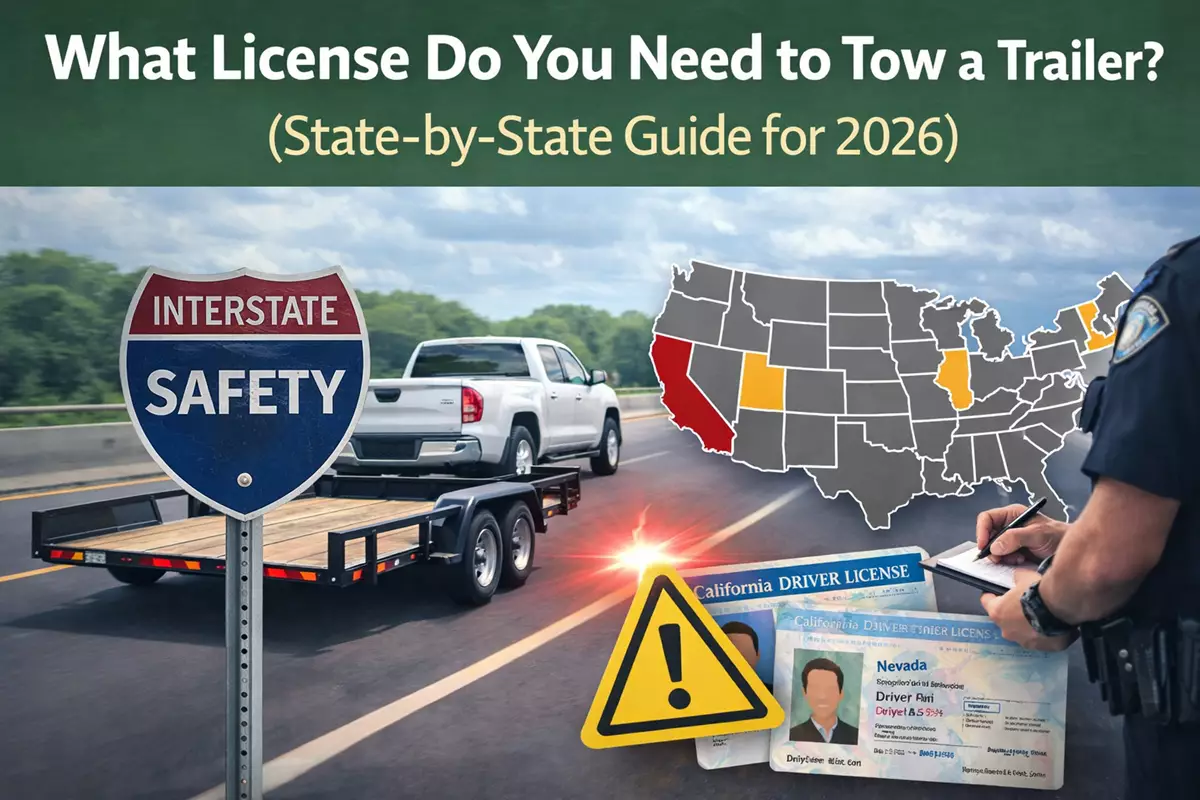
The map below highlights the states with additional license requirements.

States With Stricter Trailer License Laws
California
California has some of the strictest trailer licensing rules in the country.
- Noncommercial Class A required for bumper-pull trailers over 10,000 lbs GVWR
- Noncommercial Class A required for fifth-wheel trailers over 15,000 lbs GVWR
California also offers Restriction 41, which allows a driver with a Class C license to tow a fifth-wheel trailer between 10,001 and 15,000 lbs GVWR after passing a written test.
Nevada
Nevada requires a J Endorsement for trailers over 10,000 lbs GVWR, even if the total combined weight remains under 26,000 lbs.
- Written test required
- Driving test required
New York
New York requires an R Endorsement for certain large recreational vehicles over 26,000 lbs GVWR. It also has special registration rules for some larger pickup trucks, including commercial plates for certain three-quarter-ton and larger pickups.
Other States With Higher-Weight Noncommercial Rules
These states generally require an upgraded license only at the 26,000-pound threshold:
- Texas
- Pennsylvania
- Michigan
- North Carolina
- South Carolina
- Wyoming
Quick State Comparison
| State | Key Rule | Trigger | License Needed |
| California | Noncommercial Class A for heavier trailers | Over 10,000 lbs GVWR | Noncommercial Class A |
| Nevada | J Endorsement for heavier trailers | Over 10,000 lbs GVWR | Class C with J Endorsement |
| New York | R Endorsement for large recreational vehicles | Over 26,000 lbs GVWR | R Endorsement |
| Texas | Higher license class for heavy combinations | Over 26,000 lbs GCWR | Noncommercial Class A |
| Most states | Standard driver’s license sufficient | Under 26,000 lbs combined | Standard license |
Trailer Length Limits
Weight is not the only factor that matters. Total vehicle length can also determine where you can legally tow.
- Most states allow a combined length of 60 to 65 feet
- Some states allow combinations up to 70 to 75 feet on specific routes
For example, a full-size pickup and a 40-foot trailer can quickly approach or exceed local limits.
California Length Limits
California generally caps the total length of a vehicle and trailer combination at 65 feet, with some local roads restricted to 60 feet.
What Happens When You Cross State Lines?
Your home state license is generally honored across state lines.
For example, a driver licensed in Texas may be allowed to tow a trailer combination in California that would require a higher license if the driver were a California resident.
However, equipment rules still vary by state. You should still confirm compliance with:
- Brake requirements
- Lighting requirements
- Safety chain laws
- Speed limits for towing
What This Means for Trailer Renters
- Check the trailer’s GVWR.
This is usually listed on the VIN sticker and should also appear in the trailer listing.
- Know your tow vehicle’s limits.
Check tow rating, payload, and GCWR before booking.
- Verify your license class.
If you are in California or Nevada and the trailer exceeds 10,000 lbs GVWR, confirm you have the correct license or endorsement.
- Plan your route.
Cross-state travel may be legal under your home-state license, but equipment laws still vary.
Tip: Filter trailers by weight class before booking so you do not accidentally rent one that you cannot legally tow.
What This Means for Trailer Owners
- State the requirement clearly in the listing.
Example: “California residents need a Noncommercial Class A license for this trailer.”
- Verify license class at pickup.
This helps reduce disputes, risk, and last-minute issues.
- Understand that the booker may not be the driver.
This is common in business and fleet rentals.
- Use platform protections.
Require clear acknowledgment that drivers must hold the proper license for the trailer they are towing.
GVWR Thresholds That Matter Most
- 10,000 lbs GVWR: Major trigger in California and Nevada
- 15,000 lbs GVWR: Important fifth-wheel threshold in California
- 26,000 lbs GCWR: Federal CDL threshold
These three numbers control most trailer licensing questions.

Frequently Asked Questions
Do I need a CDL to tow a trailer for personal use?
Usually no, as long as your combined weight stays under 26,000 lbs and your state does not impose stricter noncommercial rules.
What happens if I tow without the proper license?
You could face citations, fines, impoundment, and problems with insurance coverage after an accident.
Do you need a special license based on GVWR or actual weight?
It depends on the state. Some use actual weight, while others, including California, use GVWR.
Can I tow in another state with my home-state license?
Generally yes, but your equipment still needs to comply with the laws of the states you drive through.
The Bottom Line
Trailer license laws are more complicated than most drivers realize. The 26,000-pound rule is only the starting point. States like California and Nevada impose additional requirements at much lower trailer weights.
The safest approach is simple:
- Know your trailer’s GVWR
- Know your state’s rules
- Verify before you tow
Rent or List Trailers with Confidence
Neighbors Trailer helps renters and owners make better decisions by clearly displaying trailer details, supporting safer rentals, and encouraging compliance before pickup.
Browse trailers near you or list your own on Neighbors Trailer.