

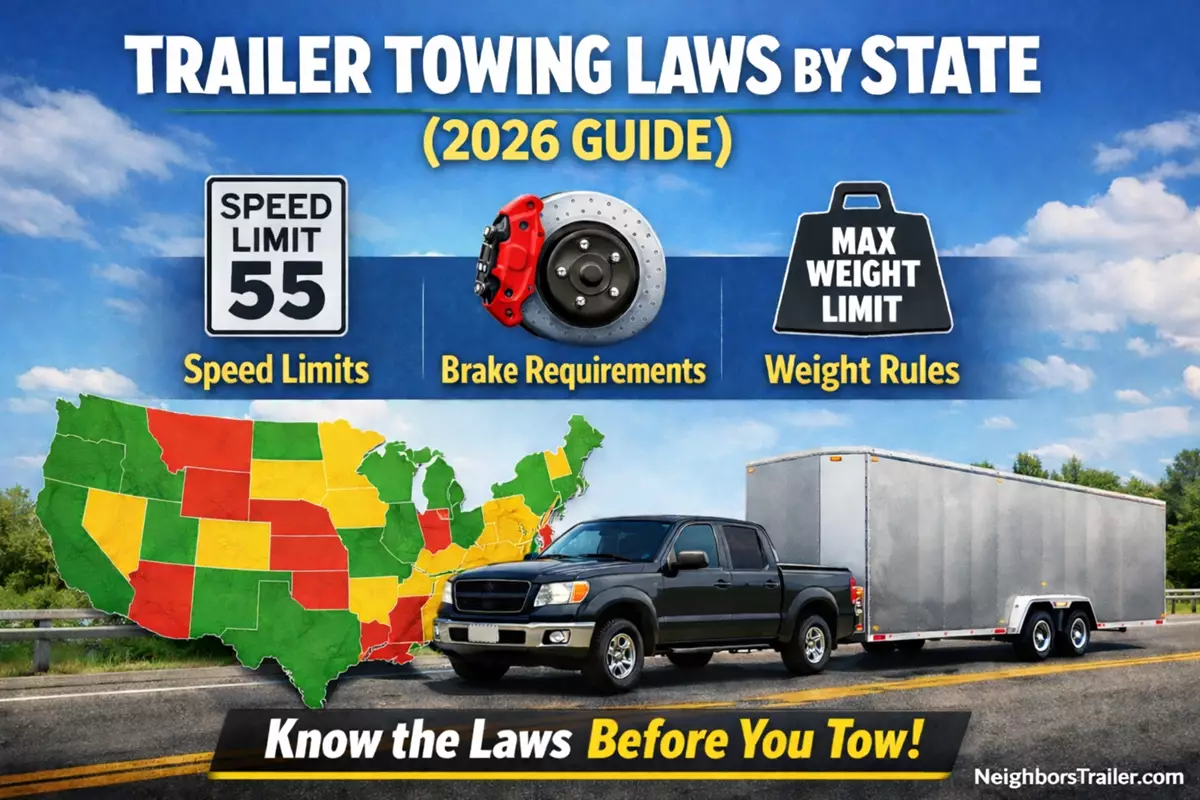
Trailer Towing Laws by State (2026 Guide): Speed Limits, Brake Requirements & Weight Rules
 Neighbors Trailer
Feb 17, 2026 4652 9 min read Trailer Towing Law
Trailer towing laws vary significantly by state. Brake requirements, maximum towing speeds, and equipment rules can change the moment you cross state lines. If you’re towing in 2026, understanding these laws isn’t optional — it’s essential for safety and compliance.
If you want the full towing fundamentals (vehicle ratings, tongue weight, and real-world loading examples), start with our Ultimate Trailer Towing Safety Guide.
Why Trailer Towing Laws Matter
Trailer towing laws exist to reduce crashes caused by long stopping distances, brake fade, trailer sway, and equipment failure. Even when a setup “feels fine,” exceeding legal thresholds can increase mechanical risk and legal exposure—especially if an accident occurs.
A key theme you’ll see throughout this guide: legal does not always equal safe. Some states allow higher towing speeds or higher brake thresholds, but your tow vehicle’s ratings and your trailer’s loaded weight still determine what is safe.
For a capacity-first approach (GVWR, payload, tongue weight, and real-world loading), see Can Your Vehicle Safely Tow a Trailer?.
Trailer Brake Requirements by State
Most states require trailer brakes once a trailer exceeds a specific weight threshold—but that threshold varies significantly. Some states require brakes at 1,000–1,500 lbs, while others allow 3,000–4,500 lbs before brakes are mandated. A few states define requirements using stopping-distance rules rather than a fixed weight.
When reviewing brake laws, use your fully loaded trailer weight (not the empty trailer weight). Cargo, tools, tie-downs, and fuel can push you over the brake threshold quickly.
Trailer brake requirements vary widely by state. Some states require brakes around 1,000–1,500 lbs, while others allow 3,000–4,500 lbs (or use stopping-distance rules). Always base compliance on your trailer’s fully loaded weight.

If your trailer meets or exceeds your state’s brake requirement threshold, proper setup matters. Review our flatbed trailer brake installation guide to understand brake controllers, wiring, breakaway systems, and inspection basics.
Many brake systems depend on compatible hitch and wiring connections. Use our hitch size compatibility chart to confirm your setup before towing.
Trailer Brake Requirements by State (A–Z)
| State | Brake Required Over (lbs) | Rule Type |
| Alabama | 3,000 | Weight threshold |
| Alaska | 5,000 | Weight threshold |
| Arizona | 3,000 | Weight threshold |
| Arkansas | 3,000 | Weight threshold |
| California | 1,500 | Weight threshold |
| Colorado | 3,000 | Weight threshold |
| Connecticut | 3,000 | Weight threshold |
| Delaware | 4,000 | Weight threshold |
| Florida | 3,000 | Weight threshold |
| Georgia | 3,000 | Weight threshold |
| Hawaii | 3,000 | Weight threshold |
| Idaho | 1,500 | Weight threshold |
| Illinois | 3,000 | Weight threshold |
| Indiana | 3,000 | Weight threshold |
| Iowa | 3,000 | Weight threshold |
| Kansas | Stopping-distance rule | Stopping-distance rule |
| Kentucky | Stopping-distance rule | Stopping-distance rule |
| Louisiana | 3,000 | Weight threshold |
| Maine | 3,000 | Weight threshold |
| Maryland | 3,000 | Weight threshold |
| Massachusetts | 10,000 | Weight threshold |
| Michigan | 15,000 | Weight threshold |
| Minnesota | 3,000 | Weight threshold |
| Mississippi | 2,000 | Weight threshold |
| Missouri | 3,000 | Weight threshold |
| Montana | 3,000 | Weight threshold |
| Nebraska | 3,000 | Weight threshold |
| Nevada | 1,500 | Weight threshold |
| New Hampshire | Stopping-distance rule | Stopping-distance rule |
| New Jersey | Always required | Brakes always required |
| New Mexico | 3,000 | Weight threshold |
| New York | 1,000 | Weight threshold |
| North Carolina | 4,000 | Weight threshold |
| North Dakota | Always required | Brakes always required |
| Ohio | 3,000 | Weight threshold |
| Oklahoma | 3,000 | Weight threshold |
| Oregon | Stopping-distance rule | Stopping-distance rule |
| Pennsylvania | 3,000 | Weight threshold |
| Rhode Island | 4,000 | Weight threshold |
| South Carolina | 3,000 | Weight threshold |
| South Dakota | 3,000 | Weight threshold |
| Tennessee | 3,000 | Weight threshold |
| Texas | 4,500 | Weight threshold |
| Utah | Stopping-distance rule | Stopping-distance rule |
| Vermont | 3,000 | Weight threshold |
| Virginia | 3,000 | Weight threshold |
| Washington | 3,000 | Weight threshold |
| West Virginia | 3,000 | Weight threshold |
| Wisconsin | 3,000 | Weight threshold |
| Wyoming | Stopping-distance rule | Stopping-distance rule |
Note:
- Weight thresholds indicate the trailer’s fully loaded weight at which a braking system is legally required.
- Stopping-distance rules mean the statute is written in terms of the distance a vehicle + trailer must stop from a set speed (e.g., 20–30 feet at 20 mph), rather than a numeric weight threshold.
- Brakes always required means statute language does not provide a weight threshold — brakes are required on all trailers of a certain type or configuration per statute.
These summaries reflect publicly available state statutes as of 2026. Because laws can change, always verify current requirements through your state’s Department of Transportation.
Maximum Legal Towing Speed by State
Maximum towing speed limits also vary by state. Some states cap towing at 55 mph statewide, others commonly allow 65 mph, and some follow posted highway limits. Certain roads may post trailer-specific speed signs that override general state limits.
Even if a higher speed is legal, towing stability often decreases as speed rises. If you’re towing an enclosed trailer, sway risk can increase with wind, traffic turbulence, or improper load balance. Learn how stability equipment can help in our guide to enclosed trailer sway control hitches.

Tip: Posted signage can be more restrictive than general state rules. When you see a trailer-specific speed sign, it takes priority.
Maximum Trailer Towing Speed by State (A–Z)
| State | Maximum Towing Speed | Rule Type |
| Alabama | 55 mph | Statewide towing limit |
| Alaska | 55 mph | Statewide towing limit |
| Arizona | 65 mph | Statewide towing limit |
| Arkansas | 65 mph | Statewide towing limit |
| California | 55 mph | Statewide towing limit |
| Colorado | 65 mph | Statewide towing limit |
| Connecticut | 55 mph | Statewide towing limit |
| Delaware | 55 mph | Statewide towing limit |
| Florida | 65 mph | Statewide towing limit |
| Georgia | 65 mph | Statewide towing limit |
| Hawaii | 55 mph | Statewide towing limit |
| Idaho | 65 mph | Statewide towing limit |
| Illinois | 55 mph | Statewide towing limit |
| Indiana | 65 mph | Statewide towing limit |
| Iowa | 65 mph | Statewide towing limit |
| Kansas | Posted limit | Follows posted speed limit |
| Kentucky | Posted limit | Follows posted speed limit |
| Louisiana | 65 mph | Statewide towing limit |
| Maine | 65 mph | Statewide towing limit |
| Maryland | 55 mph | Statewide towing limit |
| Massachusetts | 55 mph | Statewide towing limit |
| Michigan | 65 mph | Statewide towing limit |
| Minnesota | 65 mph | Statewide towing limit |
| Mississippi | 65 mph | Statewide towing limit |
| Missouri | 65 mph | Statewide towing limit |
| Montana | 65 mph | Statewide towing limit |
| Nebraska | 65 mph | Statewide towing limit |
| Nevada | 65 mph | Statewide towing limit |
| New Hampshire | 65 mph | Statewide towing limit |
| New Jersey | 55 mph | Statewide towing limit |
| New Mexico | 65 mph | Statewide towing limit |
| New York | 55 mph | Statewide towing limit |
| North Carolina | 65 mph | Statewide towing limit |
| North Dakota | 65 mph | Statewide towing limit |
| Ohio | 65 mph | Statewide towing limit |
| Oklahoma | 65 mph | Statewide towing limit |
| Oregon | Posted limit | Follows posted speed limit |
| Pennsylvania | 55 mph | Statewide towing limit |
| Rhode Island | 55 mph | Statewide towing limit |
| South Carolina | 65 mph | Statewide towing limit |
| South Dakota | 65 mph | Statewide towing limit |
| Tennessee | 65 mph | Statewide towing limit |
| Texas | 65 mph | Statewide towing limit |
| Utah | Posted limit | Follows posted speed limit |
| Vermont | 65 mph | Statewide towing limit |
| Virginia | 55 mph | Statewide towing limit |
| Washington | 65 mph | Statewide towing limit |
| West Virginia | 65 mph | Statewide towing limit |
| Wisconsin | 65 mph | Statewide towing limit |
| Wyoming | Posted limit | Follows posted speed limit |
Note: Some states follow posted highway speed limits rather than establishing a separate trailer-specific speed cap. Always obey trailer-specific signage when present.
Weight, Length & Equipment Rules
Brake and speed laws are the most searched towing questions, but many states also regulate trailer size and required equipment. Limits can vary by state and road type, and oversized loads may require permits.
Common legal limits and requirements
- Trailer length: often capped around 40–48 feet for a single trailer (varies by state).
- Combined length: tow vehicle + trailer commonly capped around 65 feet (varies by state).
- Width: typically 8 to 8.5 feet without special permits.
- Height: commonly around 13’6” maximum.
- Safety chains: required in nearly all states in addition to hitch connection.
- Lighting: brake lights, turn signals, tail lights, and reflectors are required nationwide.
Before selecting a trailer, confirm your sizing needs using our guide on how to choose the right trailer rental size.
For a quick checklist before you tow, review the 3 most important trailer safety tips prior to pickup.
Crossing State Lines
If you tow across multiple states, you must comply with the rules of the state you are currently driving in. That means your brake threshold requirement and towing speed limit can change mid-trip.
Planning ahead is the safest approach: choose the correct trailer type and size, calculate loaded weight accurately, and plan your route with state rules in mind. If you’re selecting a trailer for a specific load, use how to choose the right trailer rental size to match capacity and compliance requirements.
What Happens If You Exceed Legal Limits
Exceeding towing laws can lead to citations and fines, but the larger risk is increased liability if something goes wrong. Overloading or towing without required brakes raises the chances of mechanical failure and can complicate insurance-related outcomes depending on the circumstances and policy.
- Traffic citations or fines
- Increased stopping distance and brake overheating
- Tire failures or equipment damage
- Higher liability exposure in accidents
- Insurance complications
Violations may also impact insurance claims depending on fault and coverage conditions.
To understand coverage considerations before your trip, review our guide: trailer rental insurance and protection coverage options.
Planning Your Rental with Compliance in Mind
Understanding state towing laws helps you select the right trailer type from the start—especially if you’re traveling long distance or hauling heavier cargo.
If you’re hauling cargo, tools, or equipment inside a covered trailer, browse available enclosed trailers near you to compare options and weight ratings.
If you’re new to renting, here’s what to expect when booking through the platform: Why Rent from Neighbors Trailer.
Final Thoughts
Trailer towing laws vary significantly across the United States. Brake thresholds can range from 1,000 lbs to 4,500 lbs or more, and towing speed limits may be capped at 55 mph in some states and higher in others.
Legal compliance is only part of safe towing. Before you tow, make sure you understand your vehicle’s ratings, your trailer’s fully loaded weight, and how to avoid instability on the road.
FAQ
Do trailer towing laws vary by state in 2026?
Yes. Laws vary by state for trailer brake requirements, maximum towing speed limits, and equipment rules like breakaway systems, safety chains, and lighting. When you cross state lines, you must follow the laws of the state you are currently driving in.
When are trailer brakes required?
Trailer brakes are typically required once the trailer exceeds a weight threshold, but the threshold varies by state. Some states use fixed weights (like 1,500 lbs or 3,000 lbs), while others use stopping-distance standards. Always use fully loaded trailer weight when checking requirements.
What is the maximum speed limit when towing a trailer?
Maximum towing speed depends on the state. Some states cap towing at 55 mph, others allow 65 mph, and some follow posted limits. Trailer-specific speed signs can override general state rules.
Do I need different equipment for towing across states?
Possibly. Brake thresholds and equipment rules can change between states. Before a multi-state trip, verify brake requirements, ensure your lights and safety chains are correct, and confirm your trailer is loaded within legal limits.