

Trailer Theft Is Up: How to Protect Your Trailer (and Your Rental) in 2026
 Neighbors Trailer
May 1, 2026 208 14 min read Theft
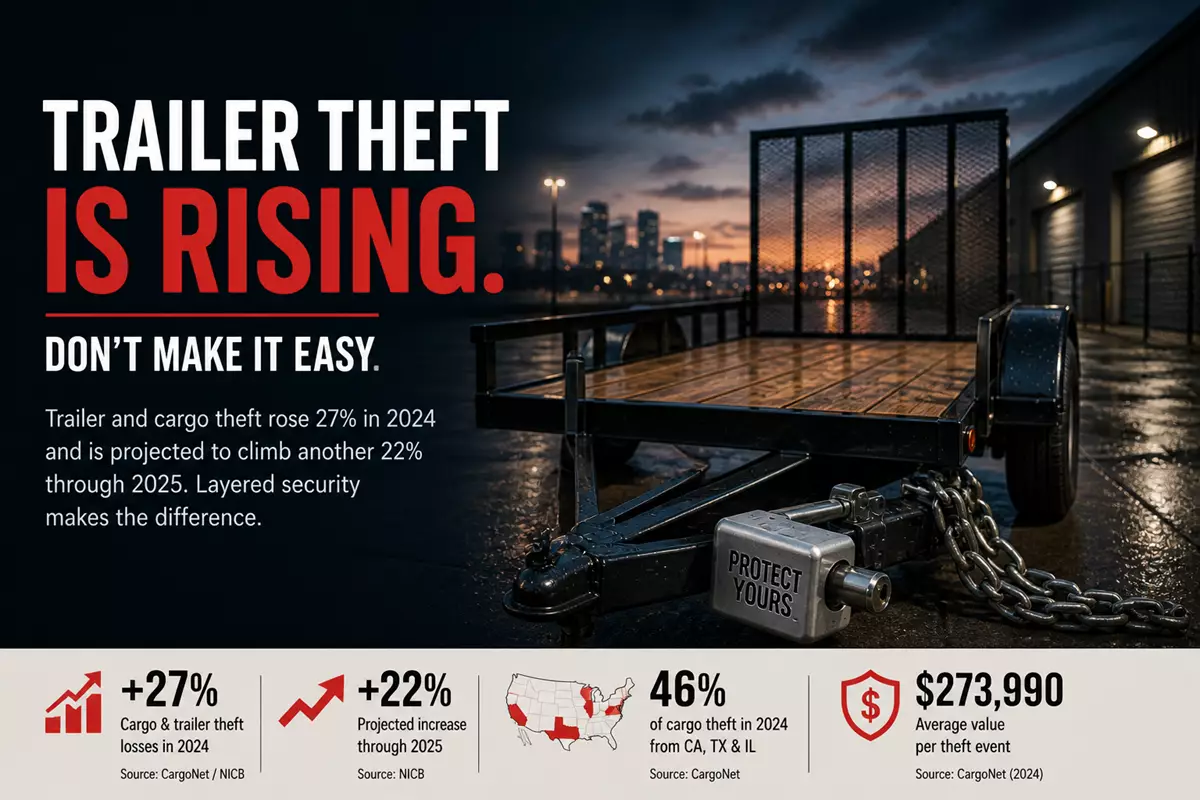
While overall vehicle theft in the United States fell 23% in the first half of 2025, trailer and cargo theft moved sharply in the opposite direction — rising 27% in 2024, with the National Insurance Crime Bureau projecting another 22% increase through 2025. California, Texas, and Illinois accounted for 46% of all cargo theft in 2024. Twelve states have no registration requirement for small utility trailers, creating a systemic gap that lets stolen trailers be re-titled with new VINs. The strategies that meaningfully reduce theft risk are layered: hitch and coupler locks, wheel locks, GPS tracking, secure storage, and choosing platforms with theft protection built in.
Key Takeaways
- Trailer theft is rising while overall vehicle theft is falling — a divergence first observed in 2024 and continuing through 2025
- Cargo and trailer theft losses jumped 27% in 2024 with another 22% projected increase through 2025 (NICB)
- California, Texas, and Illinois accounted for 46% of cargo theft in 2024
- Average value per theft event: $273,990 (CargoNet, 2024 data)
- Twelve states have no registration requirement for small utility trailers, enabling stolen-trailer re-titling
- Layered security works. No single device prevents theft — combinations of hitch locks, wheel locks, GPS tracking, secured storage, and visible deterrents do
The Theft Trend Most Owners Haven't Heard About
If you follow auto crime headlines, you've probably seen good news lately. Vehicle theft in the United States dropped 17% from 2023 to 2024, the largest annual decrease in 40 years according to the National Insurance Crime Bureau (NICB). The decline accelerated through the first half of 2025, with thefts down another 23% year-over-year. After a pandemic-era surge that peaked in 2023, stolen-vehicle figures are returning to pre-pandemic norms.
Trailer theft did not follow.
While the broader auto-theft category fell, cargo and trailer theft rose 27% in 2024 and is projected to climb another 22% through 2025, according to NICB and CargoNet data. The divergence is striking enough that NICB's President and CEO, David J. Glawe, formally testified before the U.S. Senate Judiciary Committee in July 2025 about the scale of the problem. The Senate hearing — titled "Beyond the Smash and Grab: Criminal Networks and Organized Theft" — placed annual cargo theft costs at $15 billion to $35 billion, citing Homeland Security Investigations estimates.
That's the part of the story most trailer owners haven't heard. The auto-theft headlines are real, but trailers are a category apart. They're easier to steal, harder to track, and often easier to resell or re-title than passenger vehicles. The criminal economy responded accordingly.
This post breaks down what the data actually shows, where theft is concentrated, why trailers are attractive targets, and the security strategies that meaningfully reduce risk. We'll close with how Neighbors Trailer renters and owners are protected on the platform — and what you can still do beyond what platforms cover.
What the 2025 Numbers Actually Say
Several different data sources cover this space, each measuring slightly different categories. The clearest picture comes from combining them.
Trailer & Cargo Theft Trends (2023–2025)
| Metric | Source | Direction |
|---|---|---|
| Overall vehicle theft, H1 2025 | NICB | Down 23% |
| Cargo theft losses, 2024 | CargoNet via NICB | Up 27% |
| Cargo theft loss projection, 2025 | NICB | Up 22% |
| Average value per cargo-theft event | CargoNet | $273,990 (up 36% YoY) |
| Estimated annual cargo theft cost (US) | Homeland Security Investigations | $15B–$35B |
The takeaway: the headline "vehicle theft is falling" story is true, but it's not the trailer story. If you're an owner or a renter, the question isn't whether overall trends are improving — it's whether your category is.
Where Theft Is Concentrated
Cargo and trailer theft cluster heavily by state. According to CargoNet data:
- California, Texas, and Illinois accounted for 46% of all cargo theft in 2024
- Florida and Washington rounded out the top five
- Dallas County alone experienced a 78% year-over-year increase in reported incidents
- Most theft happens at truck stops, parking lots, distribution centers, ports, and rail yards — and along highways and rest areas
- Holiday weekends and the Q4 shipping season see the most concentrated activity
If you own or operate trailers in those five states — and especially if you're moving them through major freight corridors — your statistical risk is meaningfully higher than the national average.
Why Trailers Specifically
Trailers are attractive theft targets for reasons that don't apply to most cars:
- No engine, no key, no ignition. A trailer is a wheeled platform with a coupler. Defeating a coupler lock is faster than defeating a modern car's anti-theft system.
- Often unattended for long periods. Trailers sit parked at homes, job sites, storage lots, and truck stops between uses. Cars are typically in motion or attended.
- Re-titling is easy in some states. Twelve U.S. states maintain no registration requirements for small utility trailers, according to industry analyses. That gap lets stolen trailers be re-titled through "homemade trailer" applications and assigned new VINs with minimal scrutiny.
- Resale liquidity. Used trailers move quickly through online marketplaces, auctions, and informal sales. A stolen utility trailer can be sold within days of theft, often hundreds of miles from where it was stolen.
- Low recovery rates. Recovery rates for stolen trailers and cargo remain exceptionally low. NICB has openly described the recovery problem in its 2025 testimony.
The combination — easy to take, easy to hide, easy to sell, hard to recover — is what makes the category attractive even as overall auto theft declines.
What Actually Works: The Layered Security Approach
There is no single device that will stop a determined thief. The trailers that don't get stolen are usually the ones that take longer to steal than the ones parked next to them. Theft is opportunistic; friction wins.
The strategies below are listed roughly in order from most-essential to most-advanced. Most owners should combine at least three. High-value or high-risk trailers should run all of them.
1. Hitch and Coupler Locks
A hitch lock prevents a thief from connecting the trailer to a tow vehicle. A coupler lock fills the same role from the other direction — preventing the trailer's coupler from accepting a ball hitch. Both are inexpensive ($30–$80 range), and the visible presence of either deters opportunistic theft.
The caveat: cheaper locks can be defeated with bolt cutters or angle grinders in under a minute. Look for hardened-steel models from reputable brands. The lock isn't supposed to be unbreakable — it's supposed to take long enough that the thief moves on.
2. Wheel Locks (Boots and Chocks)
A wheel lock makes the trailer un-towable even if the coupler is defeated. They're the most visible deterrent on this list, which matters: a thief scanning a parking lot for targets will skip the trailer with a wheel boot every time.
Common types: tire boots (the brightly colored steel clamps you've seen on parked cars), wheel chock locks, and lug-bolt locks that prevent wheel removal. All work; visibility varies.
3. GPS Tracking
GPS is the most consequential change in trailer security in the last decade. A GPS-tracked trailer can be located after theft — often within hours — and recovered before it's resold.
Two categories matter:
Dedicated GPS trackers — purpose-built devices with cellular connectivity, typically requiring a monthly subscription ($10–$30/month). Pros: longer battery life, stronger signal, harder to defeat. Cons: ongoing cost.
Apple AirTags and similar — consumer Bluetooth trackers that piggyback on nearby Apple devices. Pros: cheap, no subscription. Cons: only work where iPhones are present (rural areas are weak), thieves can detect them, and they're not designed for vehicles.
For valuable trailers, dedicated GPS is the better choice. AirTags are useful as a backup or for low-value trailers, but they're not a substitute. We've covered this comparison in detail in our AirTag vs GPS Tracker for Trailers guide.
4. Secure Storage
Where a trailer sleeps matters as much as how it's locked. In order of decreasing security:
- Locked indoor storage — garage, barn, or rented enclosed unit
- Locked fenced lot with cameras — commercial storage facility
- Driveway with motion-sensor lighting and visible cameras
- Driveway, no lighting
- Street parking
- Truck stops, rest areas, public lots (highest-risk per NICB data)
If your trailer must sleep in a driveway, the upgrade to motion lighting plus a visible camera is one of the cheapest and highest-impact security investments available.
5. VIN and Registration Hygiene
The "twelve states with no registration requirement" gap exists because some states historically didn't bother with low-value trailers. That changed how stolen trailers move. Registering and titling your trailer — even if your state doesn't require it — creates a paper trail that makes the trailer harder to launder.
Photograph the VIN plate. Save the photo somewhere accessible. If a trailer is stolen, the VIN is what makes recovery possible.
6. Anti-Theft Markings and Etching
Visible identification (painted ID numbers, stickered logos, etched windows on enclosed trailers) lowers resale value and signals to thieves that the trailer will be harder to flip cleanly. It's a soft deterrent but a meaningful one for fleet operators and businesses.
7. Insurance That Actually Covers Theft
This is where most owners get caught off guard. As we covered in our auto insurance and trailer rental guide, standard personal auto policies typically do not cover physical damage or theft of the trailer itself. Liability coverage from the tow vehicle extends to the trailer while in transit, but if the trailer is stolen from your driveway or a job site, that's usually outside the auto policy.
To cover theft, you generally need either:
- A scheduled trailer endorsement on your auto policy (specifically lists the trailer)
- A standalone trailer insurance policy
- Platform-provided protection (covered in the next section)
Do not assume your auto policy covers theft. Check the specific declarations page; the trailer must be listed by VIN for theft to be covered in most cases.
Where Platform-Based Protection Fits In
Personal auto insurance, trailer endorsements, and standalone trailer policies all leave gaps when applied to a peer-to-peer rental scenario. The renter typically isn't named on the owner's policy. The owner typically isn't covered for damage caused by a third party using their trailer. And neither side wants to discover the gap mid-claim.
Most major peer-to-peer marketplaces in the sharing economy now address this through built-in protection programs rather than relying on participants to coordinate insurance themselves. Turo's protection plans handle vehicle damage. Airbnb's AirCover handles property damage and host liability. Neighbors Trailer's NT Protect covers eligible damage, theft, and vandalism on trailer rentals. Each program differs in coverage caps, deductibles, eligibility criteria, and claims processes — but the structural pattern is the same. The platform sits between the two parties, defines coverage in its Terms of Use, and processes claims directly so neither side has to negotiate with an insurer they don't have a contract with.
What this changes for participants is mostly procedural. Claims are filed through the platform rather than between users. Coverage starts at booking rather than requiring a separate purchase. Eligibility, exclusions, and deductibles are defined in advance rather than negotiated case-by-case. Specific terms vary platform to platform, and renters and owners on any peer-to-peer rental should read the relevant Terms of Use to understand what is and isn't covered before booking.
The protection layer doesn't sit alone. Identity verification at signup, motor vehicle record screening at owner acceptance, and platform-level fraud detection on payments and messaging all sit upstream of the protection coverage. Together, the verification stack and the protection layer are what make a peer-to-peer rental architecturally different from an off-platform transaction. The broader trust architecture is covered in how peer-to-peer marketplaces verify users.
What to Do If Your Trailer Is Stolen
If a trailer is stolen, the first 24 hours matter the most. Recovery rates drop sharply after the first day.
- Call local law enforcement immediately. File a police report and get the report number. Reporting a vehicle as soon as possible after it is stolen significantly increases the chance of recovery, per NICB.
- Call NICB's hotline at 800-TEL-NICB (800-835-6422) to report the theft. NICB coordinates with law enforcement nationwide and can flag the VIN across multiple databases.
- Notify your insurance carrier. Theft claims typically have time-sensitive reporting windows.
- If the trailer was rented through Neighbors Trailer, notify the platform immediately. Both renters and owners should reach out to support@neighborstrailer.com or via the in-app messaging system. Don't wait — claims and recovery work better when initiated quickly.
- If you have GPS tracking, share the most recent location data with law enforcement. Do not attempt recovery yourself — recovered trailers are sometimes parked in locations where the thieves are still present.
- Check online resale platforms (Facebook Marketplace, Craigslist, OfferUp) for your trailer or matching VINs. Stolen trailers frequently appear on resale sites within days of theft.
The Bigger Picture
Trailer theft is part of a broader trend NICB and federal regulators have flagged: organized criminal networks are professionalizing. Cargo theft is being conducted by sophisticated organizations using identity theft, fraudulent pickups, fictitious carriers, and cyber-enabled logistics manipulation, according to NICB testimony. Stolen trailers and goods are increasingly being exported rather than sold domestically.
Individual owners can't address that scale. But individual owners can reduce their statistical risk meaningfully — by combining the security layers above and choosing platforms that include theft protection by default.
Trailer theft will likely continue rising through 2026. Owners and renters who treat it as a known, manageable risk — rather than a remote possibility — come out of the year with their assets and their finances intact.
Frequently Asked Questions
Is trailer theft really increasing?
Yes. While overall vehicle theft fell 23% in the first half of 2025, cargo and trailer theft losses rose 27% in 2024 and are projected to rise another 22% through 2025, according to the National Insurance Crime Bureau and CargoNet data.
Which states have the most trailer theft?
California, Texas, and Illinois accounted for 46% of cargo theft in 2024. Florida and Washington round out the top five. Dallas County alone saw a 78% year-over-year increase in reported incidents.
Does my auto insurance cover trailer theft?
Usually not. Standard personal auto policies typically extend liability coverage to a trailer while it's being towed, but physical damage and theft of the trailer itself are generally not covered unless the trailer is specifically scheduled on your policy. Verify with your insurer; do not assume coverage.
What's the most effective trailer security device?
None alone. Layered security is what works. Combine a hitch or coupler lock, a wheel lock, GPS tracking, and secure storage. Visibility matters — most theft is opportunistic, so making your trailer obviously harder to take than the next one is usually enough.
What does NT Protect cover for trailer theft?
NT Protect provides up to $25,000 in coverage for eligible theft, damage, and vandalism on every Neighbors Trailer rental, with a $500 deductible, backed by licensed and insured partners. Specific eligibility, exclusions, and claims processes are governed by Neighbors Trailer's Terms of Use.
What should I do immediately if my trailer is stolen?
File a police report, call NICB's hotline at 800-TEL-NICB, notify your insurance carrier, and — if it was rented through Neighbors Trailer — contact platform support immediately. Time-to-report is one of the strongest predictors of recovery.
Further Reading
- AirTag vs GPS Tracker for Trailers: Which Is Better? — detailed comparison of dedicated GPS vs. consumer Bluetooth tracking
- Trailer Rental Safety: Complete Guide for Renters and Owners (2026)
- How Peer-to-Peer Marketplaces Vet Users — the trust architecture that sits upstream of platform protection
- Texas Trailer Towing Laws (2026 Guide) — for Texas-based owners specifically (Texas is a top-three theft state)
Ready to rent or list?
- Renters: Browse trailers in your area — every eligible booking is covered by NT Protect
- Owners: List your trailer with built-in theft protection
Legal Disclaimer
This article summarizes publicly available trailer theft statistics and security guidance as of April 2026. Statistics are drawn from the National Insurance Crime Bureau, CargoNet, Homeland Security Investigations, and U.S. Senate Judiciary Committee testimony. Insurance coverage details vary by carrier and policy; readers should consult their specific declarations page and licensed insurance agent. NT Protect coverage is governed by Neighbors Trailer's Terms of Use; specific eligibility and exclusions apply. This article is not legal, insurance, or security advice. Last reviewed: April 2026.