How Peer-to-Peer Marketplaces Vet Users: Inside the Trust Stack Powering the Sharing Economy in 2026
 Neighbors Trailer
Apr 28, 2026 354 15 min read Trust
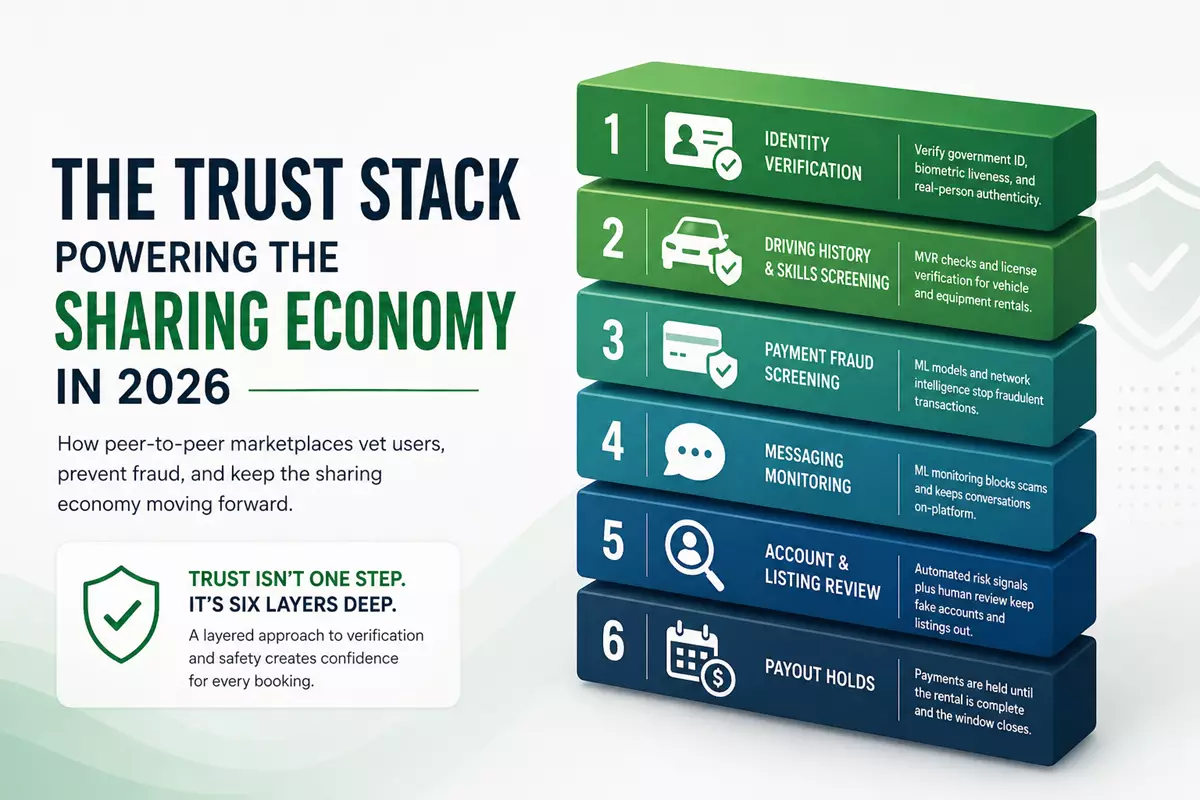
Peer-to-peer marketplaces verify users through a layered stack: identity verification against government ID, biometric liveness checks, payment fraud screening, behavioral machine learning, message monitoring, and — for vehicle and equipment platforms — motor vehicle record (MVR) screening. Airbnb, Turo, and Neighbors Trailer each implement this stack differently, but the underlying principles are consistent across the sharing economy. The quality of a marketplace is less about whether it verifies users and more about how many layers deep its verification goes, and when in the booking flow each layer fires.
Key Takeaways
- Identity verification is the baseline. Major P2P platforms partner with specialized identity vendors — Mitek for Turo, CLEAR and others across various platforms — to verify government IDs and match them to live biometric selfies.
- Machine learning handles the scale. Airbnb evaluates every listing against hundreds of risk signals using ML; similar approaches run across the category.
- Driving history only matters on vehicle platforms. Turo, car-share apps, and trailer marketplaces like Neighbors Trailer run MVR checks; home-rental platforms generally do not.
- Payment-layer fraud is a separate problem. Platforms run transaction-level screening (Stripe Radar, Sift, proprietary models) independent of user identity verification.
- Messaging is actively monitored. Airbnb strips contact information from messages until a booking is confirmed; other platforms use similar ML-based text moderation.
- Payout holds are structural trust. Holding host/owner payouts until a booking is marked complete is a defining feature of platform-based renting that off-platform transactions cannot replicate.
The Trust Problem Every Peer-to-Peer Marketplace Has to Solve
Peer-to-peer marketplaces exist to connect strangers. A guest sleeps in a host's home. A driver borrows someone else's car. A renter hitches up a trailer owned by a person they've never met, using it to move a couch across town or a skid-steer across state lines. Every successful booking rests on a fragile premise: the two sides trust each other enough — or trust the platform enough — to transact.
Naba Banerjee, Airbnb's director of trust product and operations, put it plainly in a 2023 MIT Sloan interview: her team is "trying to protect the good and ward off the bad" across millions of reservations where "people's lives" — not just their money — are at stake.
That's the core problem the trust and safety discipline exists to solve. And as the sharing economy has matured over the last fifteen years, a recognizable stack of techniques has emerged across the category. Different platforms implement it differently — with different vendors, different thresholds, different timing — but the architecture is remarkably consistent. Understanding that architecture is useful whether you're a renter deciding which platform to use, a host deciding which platform to list on, or simply someone curious about how modern online marketplaces stay functional at scale.
The rest of this article walks through the major layers of the trust stack as implemented by three peer-to-peer marketplaces: Airbnb, Turo, and Neighbors Trailer.
Layer 1: Identity Verification
Identity verification is the baseline layer every P2P marketplace implements. The goal is to confirm that a user account is tied to a real, verifiable human — not a synthetic profile, not a stolen identity, not a bot network.
The technique is well-established. A user uploads a government-issued ID. Optical character recognition (OCR) extracts the text. A document-authenticity check examines templates, holograms, and print patterns for signs of forgery. A liveness check captures a short selfie video to confirm a real person is present at the moment of verification. A face-matching algorithm compares the selfie to the photo on the ID.
How Airbnb does it. Airbnb verifies users through multiple factors, including government ID, email address, and phone number, and uses image recognition to detect discrepancies in uploaded listings. The company treats identity as one of many signals feeding into a broader trust model rather than a single gating event.
How Turo does it. Turo partnered with Mitek, a publicly-traded identity-verification company, to build its ID onboarding flow. Mike Wilkins, Turo's Senior Director of Trust and Safety, described the partnership in a 2024 interview: "Authentication helps Turo reduce fraud by verifying a user's identity each and every time they use our product." Turo also participates in early pilots of mobile driver's license (mDL) verification, a newer technology letting users present encrypted state-issued digital IDs directly from their phone wallets.
How Neighbors Trailer does it. Neighbors Trailer uses CLEAR — the same secure identity platform used at major airports, stadiums, and enterprises nationwide — for identity verification. Renters complete CLEAR verification to book. Owners are asked to complete CLEAR during onboarding; while completing CLEAR is not a hard gate on listing today, it is a visible trust signal on a listing and strongly encouraged.
The differences between these three implementations are real but narrower than they look. All three answer the same question — is this person who they say they are? — using the same general technique. What varies is the vendor, the timing (at signup vs. at booking), and whether verification is a soft signal or a hard gate.
Layer 2: Driving History and Skills-Based Screening
This layer only applies to platforms where users operate something — a car, a trailer, a piece of equipment — with real-world safety consequences. It's the dividing line between home-rental platforms and vehicle platforms, and it's where the trust stack varies most across the category.
How home-rental platforms handle it. They don't. Airbnb does not screen guests for driving history because guests don't drive Airbnb's inventory. A bad driver is not a risk to an Airbnb host's home; an unverified identity is.
How Turo handles it. Turo performs a driver's license verification and reviews driving history through DMV data when a guest books a trip. The company's policies disqualify users with certain violations, license suspensions, or recency thresholds on serious incidents.
How Neighbors Trailer handles it. Neighbors Trailer uses SambaSafety, a specialized motor vehicle record provider that checks records directly with state DMVs. The screening runs at a specific moment: when the owner accepts a booking request. If the renter passes, the booking confirms and payment clears. If the renter fails screening against the platform's MVR policy (disqualifying violations, license suspensions, and the other criteria outlined in the Terms of Use), the booking is automatically rejected by the system before any money changes hands. The owner does not have to evaluate the driver's record, and does not see the failed screening data. The platform handles it on their behalf, which protects both parties — the owner from having to make a safety judgment they are not qualified to make, and the renter from having their driving record reviewed by a stranger.
The timing choice matters. Screening at booking-request time (before the owner decides) puts the owner in the position of being a gatekeeper. Screening at acceptance time (after the owner decides) puts the platform in the position of being a gatekeeper. The acceptance-time model is less common in the P2P category and distinctively renter-friendly.
For a deeper look at how these specifics play out in trailer rentals, see our Trailer Rental Safety: Complete Guide for Renters and Owners (2026).
Layer 3: Payment Fraud Screening
Identity fraud and payment fraud are related but not the same problem. A user can be who they say they are and still pay with a stolen credit card. Payment-layer fraud has its own tool stack.
How Airbnb does it. Airbnb has published extensively on its engineering blog about using machine learning to detect payment fraud, with models trained on past examples of confirmed good and confirmed fraudulent behavior. The company uses "targeted friction" — additional verification steps that fire selectively when ML models flag a transaction as suspicious — to minimize impact on legitimate users while blocking stolen-card attempts.
How Turo does it. Turo has a longstanding partnership with Sift, a fraud-prevention company that uses machine learning to analyze transaction patterns across a network of participating platforms.
How Neighbors Trailer does it. Neighbors Trailer's payments infrastructure runs on Stripe, and every transaction is screened by Stripe Radar, Stripe's ML-based payment fraud prevention network. Radar analyzes billions of data points across Stripe's global network to score transactions for chargeback risk and block stolen-card attempts before they complete.
Common thread: every mature P2P marketplace runs ML-based payment fraud screening. It is not a differentiating feature of any single platform; it is table stakes for operating in the category.
Layer 4: Messaging and Off-Platform Transaction Prevention
This layer gets less public attention than identity or payment verification, but it's quietly doing significant work across the category. The core insight is that fraudsters need to get users off the platform to complete most scams — off-platform payment, off-platform communication, off-platform transaction. If the platform can keep the conversation on-platform, the fraud has a much harder time landing.
How Airbnb does it. Airbnb's system automatically screens out phone numbers, email addresses, and other personal contact information from listing descriptions, house rules, and messages between guests and hosts — until a reservation is confirmed. This forces fraudsters to convince a user to break platform rules explicitly, a friction point that kills most attempts.
How Turo does it. Similar messaging guardrails apply on Turo; the company's risk team has discussed using behavioral models to identify suspicious communication patterns.
How Neighbors Trailer does it. Neighbors Trailer uses automated fraud detection technology, powered by machine learning, to continuously monitor messages on the platform. When messages contain signals of scam patterns — attempts to move communication off-platform, suspicious payment requests, or contact-information exchange patterns — they are flagged for review. On top of that, Neighbors Trailer's Terms of Use explicitly prohibit off-platform payment, a policy backed by enforcement and account termination.
The subtle point: on-platform messaging is not just a convenience feature. It is a fraud-prevention layer. When a user tells you they'd rather pay in cash or over Venmo "to skip the platform fee," that is, in nearly every case, a scam indicator — and the platform's trust architecture is designed to catch exactly that pattern.
Layer 5: Account and Listing Review
Identity verification confirms a user is a real person. It does not confirm the account is legitimate. Fraudsters regularly pair verified identities with fraudulent accounts and fraudulent listings — fake inventory, stolen listing photos, inflated pricing, and misrepresented descriptions.
How Airbnb does it. Airbnb's Trust and Safety team evaluates each listing against hundreds of risk signals such as host reputation, template messaging, duplicate photos, and other discrepancies, using data learnings from millions of listings. When a listing is predicted as likely fake, Airbnb blocks it from appearing or delays it for additional review.
How Turo does it. Turo evaluates host listings through a combination of automated vehicle-data checks (VIN validation, registration, insurance) and manual review, with ongoing monitoring after the listing goes live.
How Neighbors Trailer does it. Every listing submitted to Neighbors Trailer runs through automated pre-screening for duplicate/stolen/stock photos, description inconsistencies, and anomalous pricing patterns. Listings that pass automated screening are then reviewed manually by a team member before going live. Accounts receive the same two-layer treatment: automated screening for fraud signals, followed by manual review.
The dual-layer architecture (automation + human review) is the emerging best practice across the category. Automation handles scale; humans handle ambiguity.
Layer 6: Payout Structures as Structural Trust
This is the least-discussed layer of the trust stack, but arguably the most important — because it is a feature of how the marketplace is structured, not a feature of how it verifies users. It cannot be replicated by an off-platform transaction, no matter how detailed the ID verification.
On a traditional peer-to-peer transaction — Craigslist, Facebook Marketplace, a local forum — the buyer and seller exchange money and goods at the same moment. If one side is fraudulent, the other side has no recourse.
On a platform-based transaction, the platform sits in the middle. It holds the renter's payment during the rental window. It releases the payment to the owner only after the rental is complete and the window for disputes has closed. This gives the renter time to flag problems; it protects the owner from payment reversals; and it gives the platform the ability to intervene.
How Airbnb does it. Airbnb does not release a host's payment until 24 hours after guest check-in. The design explicitly protects guests who arrive and find the listing is not as advertised.
How Turo does it. Turo releases host payouts on a periodic schedule after trip completion, with claims and damage-dispute windows built into the payout timing.
How Neighbors Trailer does it. Neighbors Trailer holds owner payouts until a rental is marked complete. The platform retains a short post-completion window during which it can hold or adjust payouts if disputes, damage claims, or safety concerns surface. This is distinct from the identity and MVR layers — it is a structural feature of the marketplace, not a verification layer.
The payout-hold mechanism is one of the strongest arguments for renting through a platform versus arranging an off-platform deal with someone you found online. An off-platform transaction cannot replicate it. Once the cash changes hands, the window closes.
The Trust Stack at a Glance
| Trust Layer | Airbnb | Turo | Neighbors Trailer |
|---|---|---|---|
| Identity verification | ID + biometric; ML behavioral signals | Mitek visual ID + mDL pilots | CLEAR ID verification |
| Driving history screening | N/A (not a vehicle platform) | License verification + DMV review at booking | SambaSafety MVR at owner acceptance |
| Payment fraud screening | Proprietary ML + targeted friction | Sift (network ML) | Stripe Radar |
| Messaging monitoring | Contact-info stripping pre-booking | Behavioral messaging models | ML-based continuous monitoring |
| Account/listing review | ML on hundreds of risk signals | Automated + ongoing monitoring | Automated pre-screen + manual review |
| Payout holds | 24 hours post-check-in | Periodic post-trip with dispute window | Held until rental marked complete |
Where the Trust Stack Is Still Evolving
Honest accounting requires acknowledging two things.
First, no marketplace catches every bad actor. In January 2025, two separate Turo rentals were used in the New Orleans New Year's attack and the Las Vegas Cybertruck explosion. The company's spokesperson stated publicly that neither renter involved had a criminal background that would have identified them as a security threat. Turo's response was to acknowledge the limits of any verification system and commit to continued investment in trust and safety technology — which is the honest answer. The trust stack is probabilistic, not absolute. The goal is to make bad outcomes rare, not impossible.
Second, the stack is evolving quickly. Mobile driver's licenses (mDLs), now rolling out in a growing number of U.S. states, let users present encrypted state-issued digital IDs directly to platforms without handing over a physical document. Continuous risk evaluation — ML models that score ongoing account behavior, not just signup — is emerging at major platforms. Cross-platform identity networks and reusable verification are being piloted. What the trust stack looks like in 2030 will not look exactly like what it looks like today.
What will remain consistent is the underlying principle: trust is built in layers, and the quality of a peer-to-peer marketplace is measured by the depth of the stack it deploys and the intelligence with which it deploys it.
Frequently Asked Questions
How do peer-to-peer rental platforms verify users?
Major peer-to-peer platforms verify users through layered systems that include government ID verification, biometric liveness checks, payment fraud screening, machine-learning behavioral models, message monitoring, and — for vehicle and equipment platforms — motor vehicle record screening.
Does Airbnb check criminal backgrounds?
Airbnb has stated publicly that it runs background checks on U.S. guests and hosts and uses machine learning to evaluate listings and bookings against hundreds of risk signals. Specific criminal history criteria are outlined in Airbnb's Trust & Safety policies.
Does Turo check driving records?
Yes. Turo verifies driver's licenses and reviews driving history at booking. Users with disqualifying violations or license issues are not approved to drive.
Does Neighbors Trailer run motor vehicle records on renters?
Yes. Neighbors Trailer runs an automatic motor vehicle record (MVR) screening through SambaSafety when an owner accepts a booking request. If the renter does not pass, the booking is rejected by the system before payment clears.
Why do peer-to-peer platforms hold payouts?
Holding host or owner payouts until the rental is complete gives renters a window to flag problems, protects hosts and owners from payment reversals, and gives the platform the ability to intervene in disputes. This is a structural trust feature that off-platform transactions cannot replicate.
Is a P2P rental safer than renting on Craigslist or Facebook Marketplace?
Peer-to-peer platforms layer multiple verification and fraud-prevention systems that off-platform listings do not have. Identity verification, driving record screening (for vehicle platforms), payment fraud detection, messaging controls, and payout holds are all designed to reduce the risk of fraud and unsafe transactions — none of which exist on open classified platforms.
Further Reading
- Trailer Rental Safety: Complete Guide for Renters and Owners (2026) — how trust and safety shows up in the specific context of a trailer rental
- Trailer Theft Prevention: The Ultimate Guide to Protecting Your Trailer (2026) — post-booking protection beyond platform-level verification
- AirTag vs GPS Tracker for Trailers: Which Is Better? — how physical-world trust layers complement platform verification
- Texas Trailer Towing Laws (2026 Guide) — a deep dive on a single state's trailer rules
Ready to rent or list?
- Renters: Browse trailers in your area
- Owners: How it works
Legal Disclaimer
This article summarizes publicly available information about peer-to-peer marketplace trust and safety architecture as of April 2026. Descriptions of Airbnb, Turo, and other platforms are drawn from public statements, published interviews, and company documentation. Specific platform policies are subject to change; readers should consult each platform's current Terms of Use and Trust & Safety documentation for authoritative information. Last reviewed: April 2026.