Texas Trailer Towing Laws (2026 Guide): Brakes, Speed Limits, Registration & Weight Rules
 Neighbors Trailer
Apr 24, 2026 1198 13 min read Texas Trailer Laws
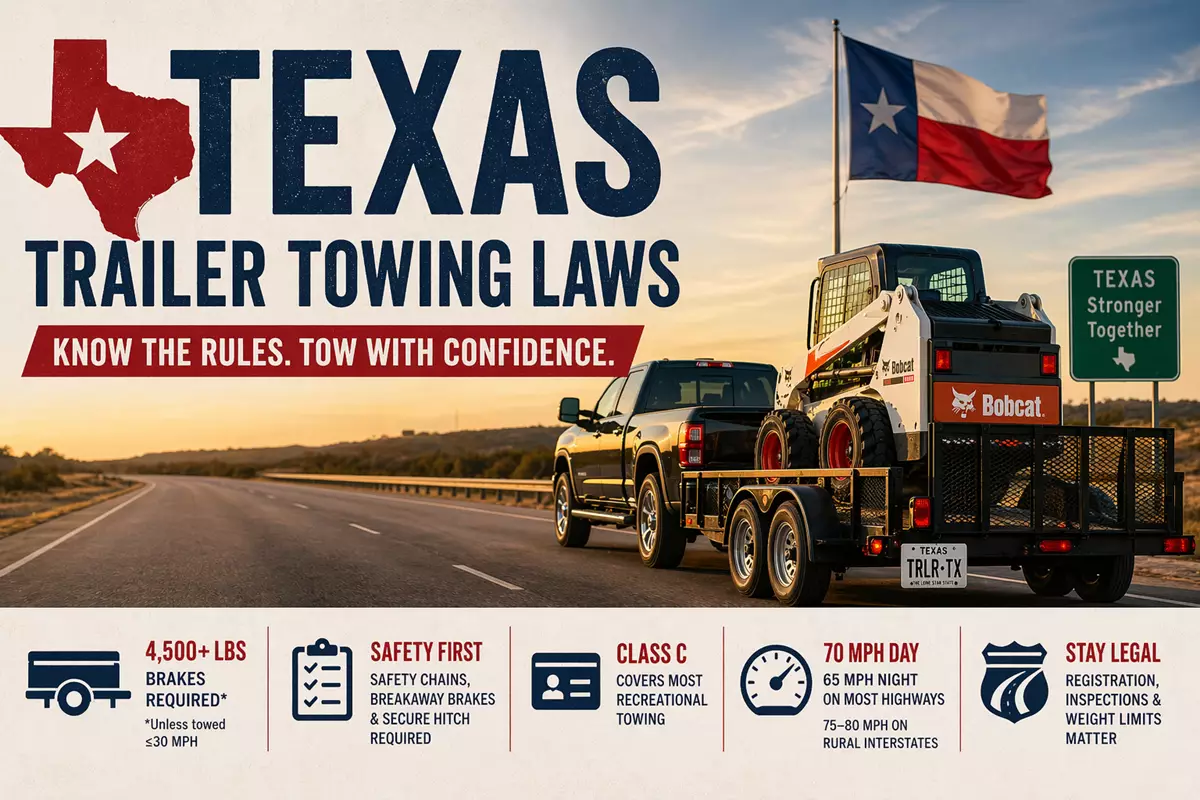
In Texas, a trailer with a gross weight of 4,500 pounds or less does not require brakes. Trailers over 4,500 pounds require brakes unless towed at 30 mph or less (15,000 lb ceiling). Trailers over 4,000 pounds GVWR must be titled and registered annually; trailers at or under 4,000 pounds require a one-time registration. A standard Texas Class C driver's license covers most non-commercial towing. A non-CDL Class A license is required only when the tow vehicle and trailer combined exceed 26,001 pounds GCWR and the trailer alone exceeds 10,000 pounds GVWR. Standard daytime highway speed for a passenger vehicle towing a trailer is 70 mph (65 mph at night) on most Texas highways, with some rural interstates posted up to 75 or 80 mph.
Key Takeaways
- Brakes required: Over 4,500 lbs gross weight, unless towed ≤30 mph — Tex. Transp. Code §547.401
- Breakaway brakes required: Trailers over 4,500 lbs or equipped with air/vacuum brakes — §547.405
- Surge/inertia brakes allowed: Up to 15,000 lbs gross weight — §547.402
- Safety chains & secure hitch: Required on all towed trailers — §§545.409, 545.410
- Registration required: All non-farm trailers on public roads
- Title required: Trailers over 4,000 lbs GVWR
- Speed limit (daytime): 70 mph standard for passenger vehicles with trailers; 75–80 mph on designated rural interstates — §§545.352, 545.353
- Speed limit (nighttime): 5 mph reduction on most posted highways
- License class: Class C covers most recreational towing; non-CDL Class A required only above 26,001 lbs GCWR and trailer GVWR over 10,000 lbs
Why Texas Has Its Own Trailer Rules
Texas is the largest trailer market in the United States, and its towing laws reflect that scale. With more than 313,000 miles of public roadway, an agricultural sector that moves everything from livestock to hay on trailers every day, and construction and energy industries that run on equipment trailers, Texas has written one of the most detailed trailer-specific codes in the country. For the broader picture across all 50 states, see our Trailer Towing Laws by State master guide, or compare Texas rules directly with our Florida Trailer Towing Laws guide.
Everything in this guide comes from the Texas Transportation Code — the actual statute — not a third-party summary. If you're renting a trailer in Texas, listing one for rent, or crossing the state line with a trailer in tow, these are the rules that apply.
If you rent or list on Neighbors Trailer, every rule below is already baked into how we verify participants, screen renters at owner acceptance, and publish listings. Knowing the law protects you. Renting through a platform that already knows it protects you more.
Speed Limits When Towing a Trailer in Texas
The foundation of Texas speed law is Tex. Transp. Code §545.351, the "maximum speed requirement":
"An operator may not drive at a speed greater than is reasonable and prudent under the circumstances then existing."
That's the basic speed law. Every posted limit in Texas sits on top of that rule, and any officer can cite a driver for going too fast for conditions even at or below the posted limit.
Tex. Transp. Code §545.352 sets the prima facie (statutory default) speed limits. For passenger vehicles and light trucks towing trailers, these are the numbers that matter:
Texas Trailer Towing Speed Limits (§545.352)
| Scenario | Daytime | Nighttime |
|---|---|---|
| Passenger vehicle or light truck towing boat under 26 ft, motorcycle trailer, or livestock/dog trailer — on numbered highway outside urban district | 70 mph | 65 mph |
| Passenger vehicle or motor vehicle towing a trailer (not in above category) | 60 mph | 55 mph |
| Urban district, street other than an alley | 30 mph | 30 mph |
| Alley | 15 mph | 15 mph |
Rural interstate exceptions. The Texas Transportation Commission is authorized under §545.353 to set speed limits up to 75 mph on designated parts of the state highway system, and up to 80 mph on portions of I-10 and I-20 in certain West Texas counties (Crockett, Culberson, Hudspeth, Jeff Davis, Kent, Kimble, Loving, Pecos, Reagan, Reeves, Sutton, Terrell, Upton, Val Verde, Ward, and Winkler). SH 130 between Austin and Seguin is posted at 85 mph under §545.353(h-2), but the towing-reduced limit still applies to vehicles in the §545.352(b)(4) category.
The nighttime reduction. The 5 mph drop is specific to trailers and easy to miss. Running 70 mph through West Texas at 10 PM with a trailer in tow is a common mistake and a common citation.
Trailer Brake Requirements in Texas
Brake law sits in Tex. Transp. Code §§547.401–547.405. The threshold most renters and owners need to know is 4,500 pounds.
Texas Trailer Brake Requirements (§547.401)
| Trailer Gross Weight | Brakes Required? | Statutory Basis |
|---|---|---|
| 4,500 lbs or less | No | §547.401(b)(1) |
| 4,501 – 15,000 lbs, towed at 30 mph or less | No | §547.401(b)(2) |
| 4,501 – 15,000 lbs, towed faster than 30 mph | Yes | §547.401(a) |
| Over 15,000 lbs | Yes, in all conditions | §547.401(a) |
Breakaway Brakes — §547.405
A trailer with a gross weight over 4,500 pounds, or any trailer equipped with air or vacuum brakes, must have breakaway brakes. In plain terms: if the trailer disconnects from the tow vehicle while in motion, its brakes must apply automatically and stay applied for at least 15 minutes. This is not optional, and it is one of the most commonly missed requirements by occasional renters.
Surge and Inertia Brakes — §547.402
A trailer with a gross weight of 15,000 pounds or less may use surge or inertia brake systems to satisfy the brake requirement. Above 15,000 pounds, the trailer needs a more robust system — typically electric brakes controlled by a brake controller in the tow vehicle.
Brake Controllers
Texas statute does not require a vehicle-mounted brake controller by name, but if you are towing a trailer with electric brakes, you must have a functional controller capable of activating those brakes from the driver's seat. If the trailer has surge or inertia brakes instead, no controller is needed — those activate mechanically when the tow vehicle slows.
For a complete breakdown of when a brake controller is legally required and how to set one up, see our Brake Controller Guide.
Safety Chains, Hitches, and Connection Requirements
Tex. Transp. Code §545.410 makes safety chains mandatory on virtually all towed trailers in Texas. Under §545.409, the hitch connection itself must be strong enough to pull the entire weight of the loaded trailer.
The practical checklist:
- Safety chains: Two chains, crossed beneath the tongue to form a cradle that catches the tongue if the coupler fails. Chains must be rated for the trailer's gross weight.
- Coupler: Must match the tow vehicle's ball size (1-7/8", 2", or 2-5/16" for most trailers). A mismatched ball size is the single most common cause of trailer-separation incidents in Texas.
- Hitch receiver: Must be rated for both the trailer's gross weight (GTW) and the tongue weight (typically 10–15% of GTW).
- Warning flag: A red or orange flag on any load or tow bar extending beyond the trailer's rear, visible at all times.
If any of these fail on the road, the driver of the tow vehicle — not the trailer's owner — is cited.
Texas Trailer Registration & Titling
Registration and titling depend almost entirely on gross weight, and the threshold is 4,000 pounds — different from the 4,500-pound brake threshold above. Getting this wrong is a surprisingly common error.
Texas Trailer Registration Requirements
| Trailer GVWR | Registration | Title |
|---|---|---|
| 4,000 lbs or less (manufactured) | One-time registration — no annual renewal | Not required |
| Over 4,000 lbs (manufactured) | Annual registration required | Title required |
| Any weight, homemade/assembled | Registration required | Title required if over 4,000 lbs |
| Farm trailer, 4,000 lbs or less | Not required | Not required |
| Farm trailer, 4,001–34,000 lbs | Farm Trailer plate ($5/yr) | Optional |
| Farm trailer, over 34,000 lbs | Standard trailer plate required | Title required |
Source: Tex. Transp. Code Chapter 501 (Certificate of Title Act) and Chapter 502 (Registration); TxDMV guidance.
Annual Safety Inspection
Under Texas law, a trailer with a gross weight over 4,500 pounds must pass an annual safety inspection. Farm trailers with a farm-trailer plate are exempt. Boat trailers are generally inspected at GVW 7,500 lbs and above per TxDMV guidance.
A missing or expired inspection sticker is a citable offense — and on a rental trailer, it is the owner's responsibility. On Neighbors Trailer, inspection status is part of the manual listing review conducted before any trailer goes live on the marketplace.
What Driver's License Do You Need to Tow a Trailer in Texas?
The short version: a standard Texas Class C license covers most recreational and DIY trailer towing. The threshold where that stops being true is surprisingly high. For a full state-by-state breakdown beyond Texas, see our state-by-state license requirements guide.
Texas Driver's License Classes for Trailer Towing
| Combined GCWR | Trailer GVWR | License Class Required |
|---|---|---|
| 26,000 lbs or less | Any | Class C (standard) |
| 26,001 lbs or more | 10,000 lbs or less | Class B (non-CDL if non-commercial) |
| 26,001 lbs or more | Over 10,000 lbs | Class A (non-CDL if non-commercial; CDL if commercial) |
| Any | Carrying hazmat in placarded quantities | Class C CDL with HAZMAT endorsement |
Source: Tex. Transp. Code §§521.081–521.085.
Key points that trip people up
1. Non-commercial Class A exists. If your personal truck and trailer combined exceed 26,001 lbs GCWR with the trailer over 10,000 lbs, you need a Class A license — but if you are not using the rig commercially, you do not need a commercial Class A. A non-CDL Class A is sufficient. Getting one requires a skills test that includes towing.
2. CDL triggers on commercial use, not just weight. Federal and Texas CDL rules apply when a vehicle is operated in commerce — transporting property or passengers for hire, or as part of a business. Someone moving their own personal property does not need a CDL, even at high combined weights. Someone hauling a commercial load for pay does.
3. Rented trailers still count toward your weight totals. If you rent a trailer on Neighbors Trailer and its gross weight plus your truck's weight crosses the Class A threshold, the license requirement applies to you as the driver, regardless of who owns the trailer.
For most Neighbors Trailer renters using standard utility, cargo, or car-hauler trailers with a typical half-ton or three-quarter-ton pickup, the combined weight stays well under 26,001 lbs and a Class C license is all that is required. The exceptions are large gooseneck and fifth-wheel trailers, loaded heavy equipment trailers, and heavy car haulers.
Insurance and Liability When Towing in Texas
Texas requires minimum liability insurance on the towing vehicle, and that policy's liability coverage generally extends to the trailer while it is being towed. Physical damage to the trailer itself is typically not covered by the tow vehicle's auto policy.
That gap is a major source of confusion — and, occasionally, financial disaster. If a rented trailer is damaged in an accident, your auto insurance will pay for damage you caused to other people and their property, but the trailer itself may fall outside coverage.
This is exactly the gap NT Protect™ fills on Neighbors Trailer rentals. Every eligible booking is automatically covered by NT Protect — up to $25,000 in coverage for eligible damage, theft, and vandalism, with a $500 deductible, backed by licensed and insured partners. No add-on. No opt-in. Applied by default on every rental.
A full breakdown of NT Protect — what it covers, what it does not, and how claims work — will be published on May 19, 2026.
Common Violations Texas Drivers Get Cited For
These are the citations Texas drivers most often catch while towing — and the ones we field questions about most on Neighbors Trailer:
1. Overloading past the trailer's GVWR. Every trailer has a GVWR (Gross Vehicle Weight Rating) stamped on the VIN plate. Exceeding it is a citable offense — and, more importantly, voids most insurance and protection coverage. Know the rating. Weigh the load. Stay under.
2. Running 70 mph after dark. The Texas statutory nighttime speed reduction catches drivers every night on I-10 and I-20. Match the posted limit and know the day/night distinction under §545.352.
3. No breakaway switch on a 4,500+ lb trailer. Under §547.405, this is non-optional. The switch itself is inexpensive; the ticket and the liability exposure if the trailer detaches are not.
4. Missing or improperly routed safety chains. Chains hanging straight back will not cradle the tongue if the coupler fails. They must be crossed under the tongue.
5. Expired inspection sticker on a 4,500+ lb trailer. The trailer owner is responsible for maintaining a valid inspection. On a rental, do a walk-around and check the sticker before you hitch up.
6. Class C holder towing a 26,001+ lb combination with a trailer over 10,000 lbs. Rare for pure recreation; more common for side jobs and weekend hauling of heavy equipment. Check the combined weight before you tow.
Frequently Asked Questions
Do I need a CDL to tow a trailer in Texas?
No — not unless you are towing commercially and the combination meets the federal CDL weight threshold (GCWR over 26,000 lbs with a trailer GVWR over 10,000 lbs). For personal, non-commercial towing at those weights, a non-CDL Class A license is required. Standard Class C covers most recreational towing.
What is the fastest I can legally drive with a trailer in Texas?
For a passenger vehicle or light truck towing a boat, motorcycle, or livestock/dog trailer on a numbered highway outside an urban district, the daytime default is 70 mph and nighttime default is 65 mph under §545.352(b)(2). Some rural interstates are posted at 75 or 80 mph. SH 130 between Austin and Seguin is posted at 85 mph, but the towing-reduced limit still applies to vehicles in the §545.352(b)(4) category.
Do I need brakes on a utility trailer in Texas?
Not if its gross weight is 4,500 pounds or less. Above that weight, brakes are required — unless the trailer is towed at 30 mph or less (Tex. Transp. Code §547.401).
Do I need to register a small utility trailer in Texas?
Yes — any non-farm trailer operated on public roads must be registered. Trailers at or under 4,000 lbs GVWR require a one-time registration. Trailers over 4,000 lbs require annual registration and a title.
Are breakaway brakes required on a rented trailer in Texas?
Yes, on any trailer with a gross weight over 4,500 pounds. Breakaway brakes must apply automatically within 15 minutes if the trailer separates from the tow vehicle (§547.405).
Who is responsible if a rented trailer fails inspection in Texas?
The trailer owner is responsible for maintaining a valid inspection. On Neighbors Trailer, inspection status is part of the manual listing review before any trailer goes live. Renters should still verify the sticker during pre-trip walk-around.
Ready to rent or list in Texas?
- Renters: Browse trailers in Texas
- Owners: List your Texas trailer and start earning
- Questions? Visit our Help Center or email service@neighborstrailer.com
Related Reading
For a broader guide to safe, secure trailer rentals — whether you're renting or listing — see our Trailer Rental Safety: Complete Guide for Renters and Owners (2026).
Legal Disclaimer
This article summarizes Texas trailer towing laws as of April 2026 and is for educational purposes only. It is not legal advice. Statutes are updated regularly. Always verify current statute text at statutes.capitol.texas.gov or consult a licensed Texas attorney for your specific situation. Last reviewed: April 2026.