

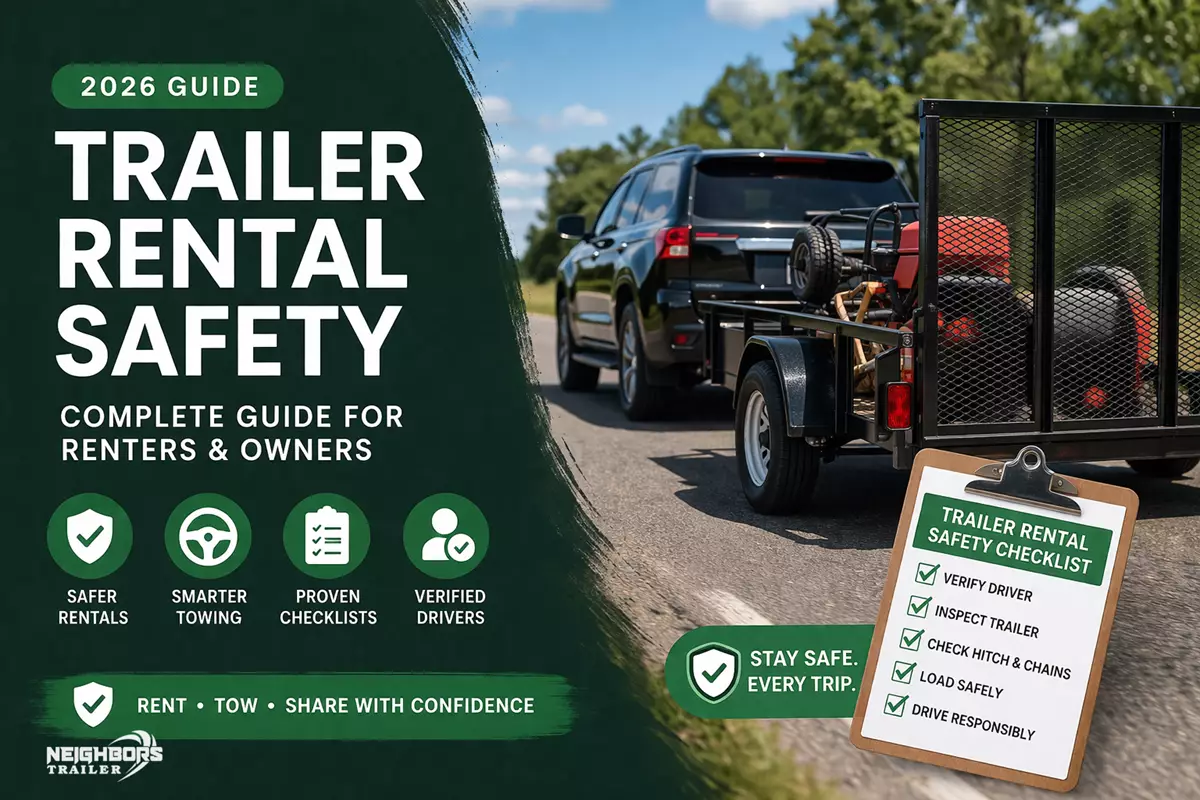
Trailer Rental Safety: Complete Guide for Renters and Owners (2026)
 Neighbors Trailer
Apr 14, 2026 242 6 min read trailer rental safety, safe trailer rental, trailer
Renting a trailer is one of the most practical ways to move equipment, haul materials, or transport vehicles—but it also introduces risks that many drivers underestimate.
From improper towing setups to unverified renters, trailer rental safety is one of the most overlooked aspects of the rental process. As peer-to-peer trailer rental marketplaces grow, safety standards are becoming the defining factor between a smooth rental experience and a costly mistake.
This guide covers the real risks, proven safety practices, and how modern platforms are raising the standard for safe trailer rentals.
Why Trailer Rental Safety Matters
Trailer towing behaves very differently than normal driving. Even experienced drivers can encounter issues if proper precautions aren’t taken.
Unsafe trailer rentals can lead to:
- Trailer sway at highway speeds
- Increased stopping distance
- Tire blowouts from improper load distribution
- Equipment damage or total loss
- Liability exposure for owners
According to the National Highway Traffic Safety Administration (NHTSA), improper loading and towing contribute to thousands of trailer-related incidents each year.
Improper loading and towing setup are among the most common causes of trailer-related incidents—especially when drivers lack experience or proper verification.
👉 Bottom line: safe trailer towing isn’t optional—it’s essential.
Top Trailer Rental Risks (And How to Avoid Them)

1. Driver Risk (Highest Impact)
The Problem:
Many trailer rentals involve drivers with little towing experience—or unsafe driving histories.
Why It Matters:
Driver behavior is the #1 factor in most towing-related incidents.
How to Reduce Risk:
- Use platforms with driver screening (MVR checks)
- Verify license status
- Rent only to qualified drivers
2. Improper Towing Setup
The Problem:
Incorrect hitching or mismatched vehicles can lead to instability and loss of control.
Why It Matters:
Improper setup is a leading cause of trailer sway and accidents.
How to Reduce Risk:
- Match trailer to vehicle capacity
- Maintain 10–15% tongue weight
- Double-check hitch and coupler connection
3. Overloading & Weight Distribution
The Problem:
Exceeding limits or loading unevenly creates dangerous conditions.
Why It Matters:
Overloading increases:
- Tire failure risk
- Brake strain
- Loss of control
How to Reduce Risk:
- Stay within weight limits
- Distribute cargo evenly
- Secure all loads
4. Poor Trailer Maintenance
The Problem:
Mechanical issues often go unnoticed until they become dangerous.
Why It Matters:
Failures typically occur on the road—when it’s too late.
How to Reduce Risk:
- Inspect before every rental
- Check lights, brakes, and tires
- Address issues immediately
Trailer Rental Safety Checklist
This printable checklist is designed for both trailer owners and renters to ensure safe towing every time. Use this checklist before, during and after every trailer rental:

Download the Trailer Rental Safety Checklist (Printable PDF)
Use this step-by-step safe trailer towing checklist before every rental to reduce risk, improve towing safety, and tow with confidence.
Before Booking
- Confirm driver qualifications
- Choose a platform with verification systems
- Review trailer specs and requirements
- Check your vehicle’s towing capacity
Before Pickup
- Inspect tires, lights, and brakes
- Check hitch, coupler, and latch
- Attach and secure safety chains
Before Driving
- Load cargo evenly
- Maintain proper tongue weight
- Secure all cargo
- Test lights and brakes
During Use
- Drive at reduced speeds
- Increase following distance
- Avoid sudden braking or sharp turns
After Return
- Inspect for damage
- Document condition with photos
- Report any issues
How to Rent a Trailer Safely
Safe trailer rental comes down to four fundamentals:
- Qualified Drivers – Only rent to drivers capable of towing safely
- Proper Setup – Ensure correct hitching and weight distribution
- Balanced Loads – Avoid overloading or uneven cargo
- Maintained Equipment – Always inspect before use
Following these steps dramatically reduces the likelihood of accidents or damage.
How Modern Platforms Improve Trailer Rental Safety
Traditional trailer rental options often rely on minimal verification and standardized processes.
Modern platforms are introducing technology-driven safety systems that reduce risk and improve accountability.
As a peer-to-peer trailer rental marketplace, Neighbors Trailer has implemented multiple layers of protection designed to make trailer rentals safer and more reliable.
Driver Screening (MVR): The Biggest Safety Upgrade
One of the most important advancements in trailer rental safety is driver screening using Motor Vehicle Records (MVR).
MVR screening evaluates:
- License validity
- Serious driving violations
- Patterns of unsafe behavior
This helps prevent high-risk drivers from completing bookings.
👉 Learn how driver screening (MVR) improves trailer rental safety.
How Neighbors Trailer Screens Renters
Driver screening is built directly into the booking process.
Before a renter can complete a reservation:
- Their driving record is checked through a licensed provider
- The record is evaluated against safety criteria
- Only qualified renters are approved
👉 Learn how Neighbors Trailer screens renters before rentals.
Additional Safety Systems That Matter
Beyond driver screening, strong platforms include:
✔ Identity Verification
Ensures users are who they claim to be
✔ Damage Protection Coverage
Helps reduce financial risk for owners
✔ Fraud Detection Systems
Prevents suspicious or high-risk activity
✔ Structured Dispute Resolution
Provides clear processes for resolving issues
Trailer Rental Safety: Peer-to-Peer vs Traditional Options
| Feature | Traditional Rental | Modern Peer-to-Peer |
|---|---|---|
| Driver Screening | Limited or none | Increasingly standard |
| Equipment Variety | Limited | Wide selection |
| Availability | Fixed locations | Local access |
| Safety Innovation | Slow | Rapid (tech-driven) |
👉 Verification and accountability are becoming the new standard in trailer rentals.
Real-World Safety Scenarios
Scenario 1: Unscreened Driver
A renter with prior violations books a trailer → higher risk of misuse or damage
Scenario 2: Improper Setup
Vehicle mismatch → trailer sway → loss of control
Scenario 3: Verified Rental
Screened driver + proper setup → safe, predictable experience
👉 The difference is process, preparation, and verification
Frequently Asked Questions About Trailer Rental Safety
Is it safe to rent a trailer?
Yes—when using proper precautions and platforms with safety systems in place.
Do trailer rental platforms check driving records?
Some do. Platforms using MVR screening verify driving history before booking.
What size trailer can I safely tow?
This depends on your vehicle’s towing capacity. Always check manufacturer specifications.
Do I need trailer brakes?
For heavier loads, trailer brakes are often required and significantly improve safety.
What happens if a renter damages a trailer?
This depends on the platform’s coverage policies. Many include damage protection to reduce risk.
What is the most important safety factor?
Driver qualification and proper towing setup are the two most critical factors.
The Future of Trailer Rental Safety
The trailer rental industry is evolving toward:
- Verified renters
- Data-driven risk reduction
- Built-in protection systems
Driver screening, identity verification, and fraud detection are quickly becoming baseline expectations.
Platforms that prioritize safety will define the future of trailer rentals.
Rent and List Trailers with Confidence
Trailer rental doesn’t have to be risky.
By following proven safety practices—and using platforms designed with safety in mind—you can confidently rent, tow, and share trailers.
👉 Browse verified trailers or list your own with built-in safety protections.
👉 List your trailer and start earning with confidence.