

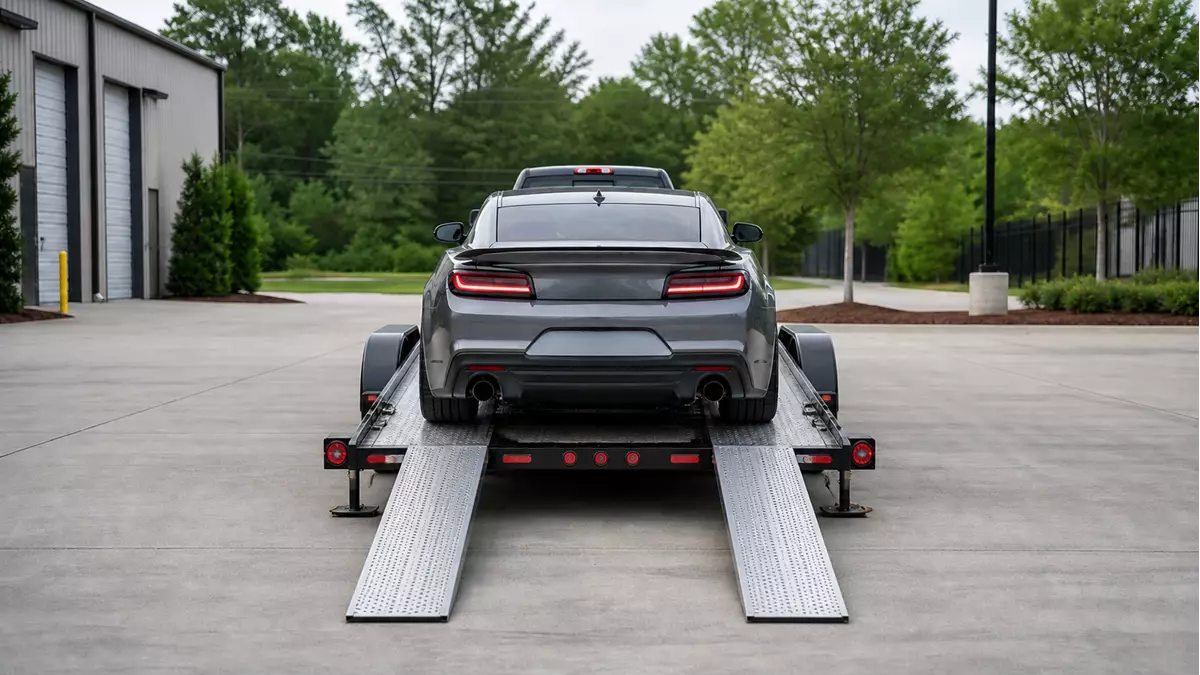
How to Load a Car onto a Car Hauler Trailer
 Neighbors Trailer
Aug 11, 2026 91 17 min read
Loading a car onto a car hauler is one of the highest-stakes cargo scenarios in trailer rentals. A car sitting on a car hauler is thousands of pounds of rolling metal balanced on a two-axle platform, secured by four straps and the driver's judgment. Get the loading right and the trip is uneventful. Get it wrong and the outcomes range from expensive body damage to a rolling accident on the highway. The difference between a smooth transport and a costly one is a repeatable set of practices: the right trailer for the vehicle, correct positioning for weight distribution, and a four-corner tie-down that immobilizes the car without damaging its suspension. This guide walks through the entire process, from pre-loading preparation to the securing pattern that professional transporters use, along with the mistakes that account for almost every car-transport failure.
Why Proper Loading Matters More Than It Feels Like
Cars are unusual cargo. They weigh 2,500 to 4,500 pounds for typical sedans and SUVs, they have four small contact patches that make them prone to rolling if not properly restrained, they have vulnerable body panels that dent under strap tension applied incorrectly, and their suspension components move, which means anything strapped to a moving suspension part either breaks the strap or damages the suspension. Every part of a car is designed to support the car's weight when the car is being driven. Almost nothing on a car is designed to withstand the specific forces of being strapped down to a moving trailer.
The Failure Modes
Three specific failure modes account for the vast majority of car-transport damage. The first is the car shifting during transport because straps loosen or the wheel chocks fail. This produces bent bumpers, damaged fenders, or in the worst case, a car sliding off the trailer entirely. The second is body damage from straps pulled against the wrong parts of the car: dented rocker panels, cracked plastic, torn suspension bushings. The third is trailer sway caused by improper weight distribution, which at highway speed can escalate into a jackknife or loss of control. All three are entirely preventable with the practices below.
The Cost Math
A car that arrives with even minor cosmetic damage is a repair bill in the hundreds to low thousands. A car that shifts and hits the trailer walls or another vehicle during transport becomes a five-figure claim. A car that comes off the trailer at highway speed is a total loss and potentially a fatality. Twenty extra minutes on loading and securing prevents essentially all of these outcomes. There is no scenario where rushing the load produces a better result than doing it correctly.
What You Need Before Loading
The right equipment matters as much as the right technique. Have everything ready before the car is anywhere near the trailer.
The Right Car Hauler for Your Vehicle
The trailer must be rated for the vehicle's weight with margin. A compact sedan (2,800 to 3,500 pounds) fits most car haulers rated 7,000 pounds or more. A full-size SUV or truck (4,500 to 6,000 pounds) needs a heavier-rated hauler, often 10,000 pounds or greater. Deck length matters too: a car with a long wheelbase needs a longer deck to sit forward of the axle for correct weight distribution. Standard consumer car haulers are 16 to 20 feet; commercial or heavier-duty variants run 22 feet or longer. To match your specific vehicle to an appropriately rated hauler, our Car Hauler calculator takes your vehicle year, make, and model and returns a compatible trailer size and capacity.
Straps, Chocks, and Loading Equipment
The strapping equipment you need depends on the securing method (see below), but the baseline is four ratchet straps rated for the vehicle's weight (at minimum 3,300 pounds working load capacity per strap for typical passenger cars, higher for trucks and SUVs). Add four wheel chocks (rubber or hard plastic wedges) for the trailer's own wheels during loading, and a set of soft loops if you plan to anchor to painted surfaces or metal that would be scratched by hook contact. Professional transporters use wheel nets or axle straps. These are worth having if you transport cars regularly, and they are the safer choice for classic, lowered, or valuable vehicles (more on this below).
The Setup Requirements
Load on level ground whenever possible. Uneven ground shifts the car's weight during loading in unpredictable ways and makes strap tensioning inaccurate. If level ground is not available, aim the trailer with the front of the loaded car pointed slightly uphill so the parking brake works with gravity, not against it. Have at least one helper for anything other than a small, straightforward car, someone to spot the driver during ramp approach, watch strap tension, and verify chock placement is invaluable.
Understanding Your Car Hauler Trailer
Not all car haulers are built the same. The specific type of trailer changes how you load, where the wheels sit, and how you secure.
Deck-Over vs Dovetail
Deck-over trailers sit above the wheels, giving a flat continuous deck with fenders that are typically low profile. These are common for heavier commercial haulers. Dovetail trailers have a lower main deck with a slight downward angle at the rear (the "dovetail") that reduces ramp angle for low-clearance vehicles. Most consumer-rental car haulers are dovetail designs for this reason.
Ramp Types
Fold-down ramps are the most common: two individual ramps that fold flat during transport and deploy for loading. Slide-out ramps pull out from within the trailer deck; they're less common but easier to deploy alone. Tilt-bed trailers have the entire rear deck section tilt to create a ramp; expensive but the easiest to load. Whatever the ramp type, verify it is fully deployed and secured (pinned or hooked) before the car touches it. A ramp that shifts under the car during loading is a serious hazard.
Anchor Points and D-Rings
Car haulers have specific anchor points built into the deck: D-rings, E-track slots, or fixed loops positioned to give favorable strap angles when the car is in place. Identify these before loading and plan your strap routing based on where they are. A car centered on the deck should have anchor points that allow straps to run down and outward at approximately 45-degree angles from the vehicle's structural points.
Pre-Load Positioning
Positioning happens before the car moves. Once the car is on the ramp, options narrow quickly.
Level Ground and Chocks
Position the trailer on level ground and chock the trailer's own wheels (in front of and behind the trailer tires) before loading. The trailer must not roll or shift while the car is being loaded. Even a slight roll during ramp climb can throw off the car's approach.
Connect the Trailer First (Critical)
Loading a car onto an unconnected trailer is one of the most dangerous mistakes in car transport. As the car drives up the ramp, its weight moves forward on the trailer. Without the tow vehicle holding the tongue down, the trailer's front end lifts, sometimes violently, potentially throwing the car backward off the trailer. Always connect the trailer to the tow vehicle before loading, even if you only plan to move the loaded trailer a few feet afterward. Confirm the coupler is locked, the safety chains are attached, and the trailer breakaway cable is connected.
Ramp Deployment
Deploy the ramps fully and verify they are secured with the trailer's provided pins, hooks, or latches. Check the angle: if the ramp angle is too steep for the car's ground clearance, add ramp extenders or use approach ramps to reduce the angle. Low-slung sports cars and modified vehicles often need ramp extenders. For lowered or low-clearance vehicles specifically, our Car Loading Clearance calculator runs the break-over geometry from your car and trailer measurements and tells you whether the car clears — plus how much to raise the tongue if it doesn't. Verify the ramp width matches the car's track width; narrower ramps make centering difficult and increase the risk of a wheel slipping off the side.
Loading the Car Onto the Trailer
With everything positioned, the actual load is the shortest step in the process.
Approach Straight, Drive Slowly
Line the car up straight with the ramps before starting the climb. The driver's view of ramp alignment is limited from inside the car, which is why a spotter matters. Drive slowly and steadily up the ramps. Pausing partway up is often more difficult than continuous slow motion because the transition from ramp to deck can trap a wheel at the seam. Once on the deck, roll the car forward until the front wheels are positioned for correct weight distribution (see below).
Loading a Non-Running Car
For non-running vehicles, you'll need to winch or push the car onto the trailer. A quality winch mounted at the front of the trailer or on the tow vehicle is the standard approach; pushing a car up a ramp by hand is dangerous and impractical for anything larger than a small sedan on a shallow ramp. If you're renting for auction transport or project-car recovery, verify the trailer has a winch or that you can bring one. Rental car haulers sometimes include winches; sometimes not.
Positioning for Weight Distribution
The car's final position on the trailer determines whether the loaded trailer tows correctly. The heaviest end of the car should sit forward of the trailer's axle. For most front-engine cars (nearly all modern sedans, SUVs, and pickups), this means driving the car onto the trailer facing forward and positioning it so the engine sits over or slightly ahead of the trailer's axle. This puts roughly 60% of the car's weight on the front half of the trailer, which produces the correct 10-15% tongue weight for stable towing. Our trailer loading guide covers the 60/40 rule and weight-distribution physics in detail.
Setting the Parking Brake and Chocks
Once positioned, set the car's parking brake firmly and put the transmission in park (automatic) or first gear (manual). Chock the car's wheels: small wheel chocks placed in front of and behind the drive wheels prevent rolling if the parking brake somehow fails. Chocks are a redundancy, not a replacement for straps, but the redundancy has saved many transports.
Weight Distribution for Car Transport
Weight distribution mistakes are the leading cause of transport-related crashes. Getting this right is not optional.
The 60/40 Rule Applied to Vehicles
The general trailer-loading principle is that 60% of cargo weight should sit forward of the trailer's axle. For a car on a car hauler, this usually means the front of the vehicle (with the engine) sits over the front third of the trailer deck. The exact position varies with the car's own weight distribution: sports cars with heavy front engines need to sit slightly farther back than trucks with weight distributed more evenly.
Tongue Weight Target
The correct load produces 10-15% tongue weight, meaning 10-15% of the total loaded trailer weight pressing down on the hitch. A 4,000-pound loaded trailer wants 400-600 pounds of tongue weight. Too little and the trailer sways at highway speed; too much and the tow vehicle's front tires unload, reducing steering and braking. To verify your specific setup, our Tongue Weight calculator returns the target range in seconds. For visualizing how the car's position affects tongue weight before you drive off, the Weight Distribution calculator has an interactive load planner.
Front-Engine vs Rear-Engine Cars
Most modern cars are front-engine and load nose-forward. Rear-engine cars (Porsche 911, older Volkswagen Beetles, some specialty vehicles) have their weight over the rear wheels, which changes the geometry. Load a rear-engine car with the engine (rear of vehicle) positioned forward on the trailer, meaning drive the car onto the trailer backward. This looks unusual but is correct: the heavy end of the vehicle needs to sit forward of the trailer's axle regardless of which end of the car it happens to be on.
The Four-Corner Tie-Down Method
Two strap methods are used to secure a car to a trailer: frame straps (also called axle straps or chassis straps) and wheel nets. Both use a four-corner pattern.
Where to Strap on the Car (Frame Method)
The car's frame or sub-frame is the only acceptable anchor point on the car itself. Structural tow points (marked on modern cars with removable eye-hooks or tie-down loops) are the ideal spots. On older cars, the sub-frame at the corner where the suspension mounts to the body is the correct point. Use soft loops around the anchor point, then hook the ratchet strap onto the soft loop. This protects both the paint and the metal from strap-hook contact.
What NOT to Strap To
Never strap to axles. They move with the suspension, so any strap tension applied through the axle either breaks the strap during compression or damages the suspension geometry. Never strap to shock absorbers, springs, or control arms; same reason, plus these components are expensive to replace. Never strap to body panels, chrome trim, bumpers, or plastic components; they will bend, break, or tear under load. Never strap to the exhaust system; heat plus tension damages both. Restrict all anchor points to structural metal that does not move.
Cross-Tension Pattern
Each strap runs from a car anchor point at approximately 45 degrees down and outward to a trailer anchor point. The four straps oppose each other: front-left strap pulls the front-left corner down and outward toward the trailer's front-left anchor; front-right does the mirror on the right; rear-left and rear-right complete the pattern. The combined tension immobilizes the car in all four directions. Any strap without a matching opposing strap creates an imbalance that can allow shifting during transport.
Suspension Compression Amount
Tighten each strap until the vehicle's suspension compresses slightly, about one to two inches at each corner is typical. This preloads the suspension so it cannot cycle during transport bumps, which is what causes straps to loosen mid-trip. Do not over-compress: crushing the suspension can damage shocks, tear bushings, or bottom out springs. Slight compression is enough. If the car appears to be sitting at its normal ride height after strapping, tighten a bit more. If the tires are visibly deforming from compression, back off.
Wheel Nets vs Frame Straps
The two methods handle the same forces differently.
Wheel Nets
Wheel nets are woven straps that cradle each tire and anchor to the trailer at four points around each wheel. The strap tension holds the wheel to the deck without applying any force to the car's frame, suspension, or body. Wheel nets are the professional preference for most modern car transports because they eliminate the risk of body or suspension damage entirely. They are essential for lowered vehicles, classics with irreplaceable bodywork, and any car where suspension compression would be problematic.
Frame Straps
Frame straps anchor directly to the car's structure and pull down against the suspension. They are the traditional method and remain acceptable for most modern cars in good structural condition. They are less expensive than wheel nets and often faster to apply if the car has purpose-made tow points.
When to Pick Each
Use wheel nets for: lowered or modified cars, classics or exotics, cars with fragile or compromised suspension, any car where you'd hate to explain a bent control arm. Use frame straps for: standard modern vehicles in good condition, trucks and SUVs (their frames are typically more forgiving), rental or fleet transports where wheel nets are unavailable. When in doubt, wheel nets are the safer choice.
Common Mistakes That Damage Cars in Transit
Certain mistakes come up repeatedly in car transport, and each has a specific cost.
| Mistake | What Gets Damaged | What to Do Instead |
|---|---|---|
| Loading an unconnected trailer | Trailer tongue lifts violently; car falls backward off trailer | Always connect trailer to tow vehicle before loading anything |
| Strapping to axles or suspension components | Bent control arms, torn bushings, damaged shocks | Strap only to frame, sub-frame, or purpose-made tow points |
| Strapping to body panels or chrome | Dented rocker panels, cracked bumpers, broken trim | Use soft loops on structural anchor points only |
| Loading the car backward (front-engine) | Rear-heavy trailer, dangerous sway at highway speed | Heavy end of car goes forward on trailer, over or ahead of axle |
| Skipping wheel chocks | Car rolls during transport, hits trailer walls | Chock all four wheels; parking brake alone is not enough |
| Over-compressing the suspension | Blown shocks, bottomed springs, torn bushings | Compress 1-2 inches at each corner, no more |
| Using worn or under-rated straps | Strap failure at highway speed; potential total loss | Rated ratchet straps only, inspected before every trip |
| Not verifying ramp attachment | Ramp shifts during load; car falls off | Verify pins/hooks fully engaged before any weight on ramp |
| Loading on uneven ground | Unreliable weight distribution; strap tension inaccurate | Move to level ground or angle uphill toward the front |
Mid-Trip Checks
Even a properly loaded car deserves a walk-around at every fuel stop. Straps loosen from vibration and thermal cycling over long distances, and small movements at highway speed become visible only when the trailer is stationary.
Push firmly on the front and rear of the car; if it moves more than a fraction of an inch, tighten the appropriate straps. Look at each strap for wear, twist, or slippage. Verify the ratchet mechanisms are still fully engaged. Check the wheel chocks are still seated against the tires. Any strap with visible loosening should be re-tensioned before continuing.
Unloading Safely
Unloading follows the reverse of loading, with one important sequence rule: release rear straps first, then front. This keeps the front of the car anchored while you reposition to control the roll-off. Only release the final front strap when you are ready to drive or roll the car off the trailer. Never release all four straps at once; a car sitting untethered on a slight incline can roll unexpectedly.
Position the trailer on level ground before unloading, chock the trailer wheels, and verify the ramps are fully deployed and secured, same requirements as loading. If the car is a manual transmission or a non-running vehicle, have a helper positioned to catch the car if it rolls unexpectedly.
The Bottom Line
Loading a car onto a car hauler is a repeatable process built on a handful of specific practices: the right trailer for the vehicle weight, level ground with the trailer connected to the tow vehicle before loading, correct positioning for weight distribution (heavy end forward, 60% forward of the axle), and a four-corner tie-down using either wheel nets or properly-anchored frame straps. Skip any of these and the trip becomes a gamble. Do them all and cars arrive at their destinations in the same condition they left. Our ultimate towing safety guide covers the broader driving practices that apply once you're on the road with a loaded car hauler.
Ready to book your next car transport? Browse car haulers on Neighbors Trailer and use the filters to match your vehicle's weight to an appropriately rated trailer. Message the host with your specific vehicle before booking; most hosts can confirm the trailer's tie-down points, ramp configuration, and any features that will help with your specific vehicle. For race car and motorsport transport, the Car Events hub shows upcoming SCCA racing, autocross, and track-day events alongside available enclosed trailers and car haulers to get your car there.