

How Much Can Your Trailer Ramp Door Hold?
 Neighbors Trailer
Jul 1, 2026 238 12 min read
One of the most expensive and most preventable forms of trailer damage happens at the ramp door. A renter loads a motorcycle and parks it on the ramp to strap it down. A renter sets a pallet of pavers across the open ramp because the trailer floor is full. A renter rolls an engine hoist up the ramp and pauses halfway to reposition. None of these things feel reckless in the moment, but each one routinely produces the same outcome: a bent ramp door, hinge mounts pulled away from the frame, or a permanently warped panel that costs hundreds or thousands of dollars to repair. The mistake in every case is treating the ramp door like a permanent floor extension. It is not. Ramp doors are designed for a very specific job, and understanding that job is the difference between a smooth trip and a damage claim that ends the rental on a bad note.
Why Ramp Door Failures Happen
Enclosed trailer ramp doors are engineered for one primary task: spreading the brief, distributed load of a vehicle (or wheeled cargo) as it transitions from the ground onto the trailer floor. The door is built to handle that load for the few seconds it takes to drive across it. Once the vehicle is fully on the trailer floor, the ramp's job is done. Everything beyond that brief transitional use puts the door into a load condition it was never designed to handle.
The failure mode is consistent. The ramp panel bends under sustained or concentrated weight, the hinge mounts (where the ramp connects to the trailer frame) begin to pull away, and over time the spring assist mechanisms weaken or break. None of this is catastrophic in the immediate moment. The ramp does not collapse and dump cargo on the ground. It bends slowly, and the damage shows up later when the host tries to close the door and finds it no longer sits flush. By then, the renter is long gone, and the repair bill is on the host. Most of these incidents end up as damage claims, and the renter is responsible because the load that caused the bend was on the renter's watch.
How Much Weight Can a Ramp Door Actually Hold?
The practical ceiling for most enclosed trailer ramp doors is about 4,000 pounds, and only as a rolling load. That means a vehicle or wheeled cargo moving across the ramp from ground to trailer floor without stopping. The four-thousand-pound figure is not a strict published spec from any one manufacturer; it is the real-world ceiling that emerges from looking at where these doors actually start to bend in regular rental use. Below 4,000 pounds rolling, most ramps handle the transition without issue. Above 4,000 pounds, the panel begins to flex even while the vehicle is moving, and damage becomes likely on the first load.
The word that does the work in that rule is "rolling." Stopping on the ramp at any weight changes everything (more on that in the next section). The 4,000-pound figure assumes continuous motion across the ramp surface. If the vehicle stops on the ramp, the safe weight drops dramatically, and even loads well under 1,000 pounds can bend the door if left sitting.
What Should Never Be Loaded on a Cargo Trailer Ramp
Two specific cases come up often enough in real-world rentals to deserve explicit attention. Both fall above the 4,000-pound rolling ceiling, and neither belongs on a typical enclosed cargo trailer regardless of how careful the renter is.
Medium and Large Trucks
A half-ton pickup already exceeds 4,500 pounds at curb weight, before any cargo. Three-quarter-ton and one-ton trucks push 6,000 to 8,000 pounds or more. Driving any of these up a standard cargo-trailer ramp damages the door on the first attempt, even if everything appears to go smoothly during the load. Vehicles in this weight class need dedicated car-hauler trailers with ramps specifically engineered for the load. If you are renting to haul a truck, rent the right trailer for the job; do not try to make a general-purpose cargo trailer work. Our Car Hauler calculator matches your specific vehicle's weight to an appropriately rated car hauler.
Forklifts
Forklifts are the other case worth calling out by name. A small electric warehouse forklift weighs 4,000 to 5,000 pounds empty. A standard counterbalance forklift weighs 6,000 to 10,000 pounds or more. Either one exceeds the ramp door's capacity by a wide margin, and the weight does not improve once the forklift is on the trailer floor (which has its own load limit). Forklifts should never be driven onto a typical enclosed cargo trailer, by ramp or by any other route. If a load needs forklift handling, use the forklift to place the cargo at the trailer's threshold, then transfer it inside with a pallet jack or by hand. Our hauling tips guide covers the broader set of habits that protect both the cargo and the trailer.
The Critical Distinction: Dynamic Load Versus Static Load
The single most important concept in ramp door safety is the difference between dynamic load and static load. The same vehicle can pass safely across a ramp at 5 miles per hour and cause damage if it stops and sits on the ramp for sixty seconds. Understanding why explains almost everything about ramp door care.
Dynamic Load: Driving Across the Ramp
When a vehicle drives up a ramp, its weight is distributed across four wheels (or two, on a motorcycle), and each wheel touches the ramp for only a brief moment as it rolls across the surface. The total weight is real, but the peak load at any single point on the ramp is much lower than the vehicle's total weight, and the duration of that peak load is short. The ramp panel and hinges can absorb this kind of transient, distributed load without damage. This is what ramp doors are designed for.
Static Load: Parking On the Ramp
When a vehicle stops on the ramp, the dynamic spreading effect disappears immediately. The full weight of the vehicle now rests on the ramp at four fixed contact points (or two), and the load is sustained rather than transient. The panel begins to flex under the concentrated weight, the hinge mounts experience continuous stress, and any deformation that occurs does not relax once the vehicle moves. A 700-pound motorcycle parked on a ramp door rated for distributed loads up to 3,000 pounds can still bend the door, because the static, concentrated load behaves very differently from the dynamic, distributed load the door is designed for.
What Bends Ramp Doors in the Real World
Several specific loading patterns show up over and over in real-world ramp door damage. Each one violates the dynamic-versus-static rule in a recognizable way.
| Cargo Pattern | Why It Risks the Door | What to Do Instead |
|---|---|---|
| Half-ton or larger truck driven across the ramp | Vehicle weight exceeds the 4,000-pound rolling ceiling; door flexes during transit | Use a dedicated car-hauler trailer rated for the vehicle's weight class |
| Forklift used to load cargo through the rear ramp | The forklift itself weighs 4,000-10,000+ pounds, far exceeding any cargo ramp rating | Use the forklift to stage cargo at the threshold; move it inside with a pallet jack |
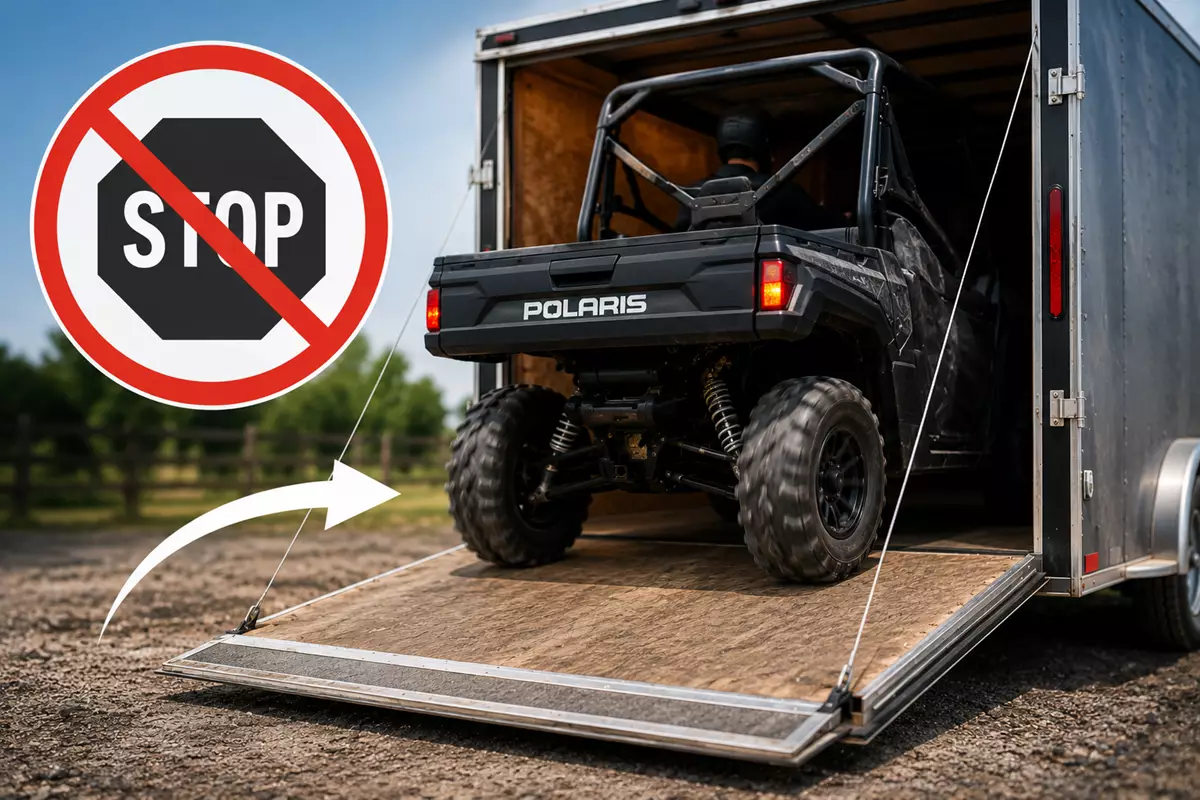
| Motorcycle parked on the ramp to strap it down | Static load concentrated on two small contact patches for an extended time | Roll the motorcycle fully onto the trailer floor before strapping |
| Dense pallet of bricks, tile, or concrete blocks on the ramp | Heavy point load on a panel never designed to support stationary dense cargo | Use a separate loading ramp; place pallets only on the trailer floor |
| Engine hoist or cherry picker rolled up and paused | All weight concentrated on the small caster wheels at one point | Roll continuously across the ramp; never stop mid-transition |
| Skid steer or compact tracked vehicle on a light-duty ramp | Track contact area is smaller than expected and may exceed the rolling ceiling at the contact line | Verify the ramp is rated for tracked equipment, or rent a dedicated equipment trailer |
| Vehicle parked half-on, half-off the trailer overnight | Static load on the ramp for many hours, often in temperature swings | Drive the vehicle fully onto the trailer floor or fully off; never leave it on the ramp |
Safe Loading Practices
The practices that protect the ramp door are not difficult, but they require thinking about the ramp as a transition rather than as floor space.
Drive Vehicles Fully Off the Ramp Before Securing
This is the single most important rule. Whatever you are loading (vehicle, motorcycle, lawn tractor, ATV), drive it all the way onto the trailer floor before stopping. Never strap down, lash, or secure cargo while any part of it is still resting on the ramp. The moment you stop on the ramp, the load becomes static, and the rules change. A vehicle parked fully on the trailer floor distributes its weight across the actual deck, which is built to handle sustained static loads.
Use Separate Loading Ramps for Static Dense Loads
For pallets of bricks, tile, concrete blocks, or other dense materials, the right tool is a separate loading ramp that bridges the ground and the trailer floor independently of the trailer's built-in ramp door. Aluminum loading ramps rated for 1,500 to 3,000 pounds are inexpensive and lightweight. A pallet jack rolling across an aluminum loading ramp transfers the load to the trailer floor without using the ramp door at all. The trailer ramp stays in its open or closed position; it never bears the weight.
Distribute Weight When Possible
If you must move heavy cargo across the ramp (and there is no alternative), distribute the weight as much as possible. A pallet of bricks on a four-wheel pallet jack distributes the load better than a two-wheel hand truck. A piece of equipment moved on dollies with multiple contact points distributes better than something dragged across the ramp on a single point. The more contact patches, the better the ramp handles the load.
Lower Heavy Items Through the Side Door
Many enclosed trailers have a side door in addition to the rear ramp. For dense, awkward, or single-point loads, the side door is often a better entry point than the ramp. The side door floor is part of the trailer's main deck, not a hinged panel, and it can handle sustained static loads that the ramp cannot.
Signs Your Ramp Door Is Already Compromised
Before you load anything, walk to the rear of the trailer and look at the ramp door. A few signs indicate prior damage that the host may or may not be aware of, and that you should flag at pickup so you are not held responsible.
Look for a ramp that does not sit flush against the trailer body when closed. A small gap at one edge usually means the panel has bent slightly or a hinge has shifted. Look for visible deformation in the ramp surface: a slight bow or dip in the panel, especially toward the center, suggests it has carried more load than it should have. Check the hinge mounts where the ramp connects to the trailer frame. Mounts that show fresh paint, fresh weld spots, or visible cracks have been repaired or are about to fail.
If you see any of these signs, photograph them and bring them up with the host before you load anything. Pre-existing damage that you document at pickup cannot be charged to you later, and the host may want to know about a developing problem they had not yet noticed.
When in Doubt, Ask the Host
The simplest way to avoid ramp door damage is to ask the host directly: "What is the ramp rated for, and is there anything I should know about loading it?" Most hosts who rent enclosed trailers know the rating of their ramps and can tell you exactly what their trailer can and cannot handle. A two-minute conversation at pickup is the easiest insurance against a damage claim later.
If you are planning to load something unusual (anything dense, unusually heavy, narrow-wheeled, or that you intend to keep on the ramp for any length of time), mention it in advance, ideally when you book. The host can either confirm the trailer can handle it or steer you toward a different trailer (theirs or someone else's) that is the right tool for the job.
The Special Case of Equipment Trailers
Dedicated equipment trailers (heavy-duty enclosed haulers built for skid steers, mini-excavators, and similar) have ramps rated for the loads they advertise. The same rules about dynamic versus static load still apply (do not park heavy equipment on the ramp), but the ramp itself is built to handle much heavier transient loads than a general-purpose cargo trailer. If you are renting for heavy equipment, verify the trailer is specifically rated for that use case. The Equipment Trailer calculator matches your specific equipment weight and dimensions to a compatible trailer. Our ultimate towing safety guide covers the broader safety considerations for hauling heavy equipment, including weight limits on the tow vehicle.
The Bottom Line
Enclosed trailer ramp doors are designed to handle vehicles driving across them, not vehicles or cargo parked on them. The difference between safe loading and a bent ramp door is almost always the difference between dynamic load (rolling across) and static load (parked or paused). Drive everything fully onto the trailer floor before stopping. Use separate loading ramps for dense static cargo. Lower awkward items through the side door when possible. Ask the host about the ramp rating when in doubt. Five minutes of awareness at loading time prevents the kind of damage that ends a rental on a bad note and costs the renter hundreds of dollars in claims.
Ready to load smart? Browse trailers on Neighbors Trailer and ask the host about ramp door specifications before you book, especially if you are planning to haul motorcycles, dense materials, or equipment with small contact patches. The right trailer for your specific load is always better than the closest available trailer that is not quite the right tool for the job.