

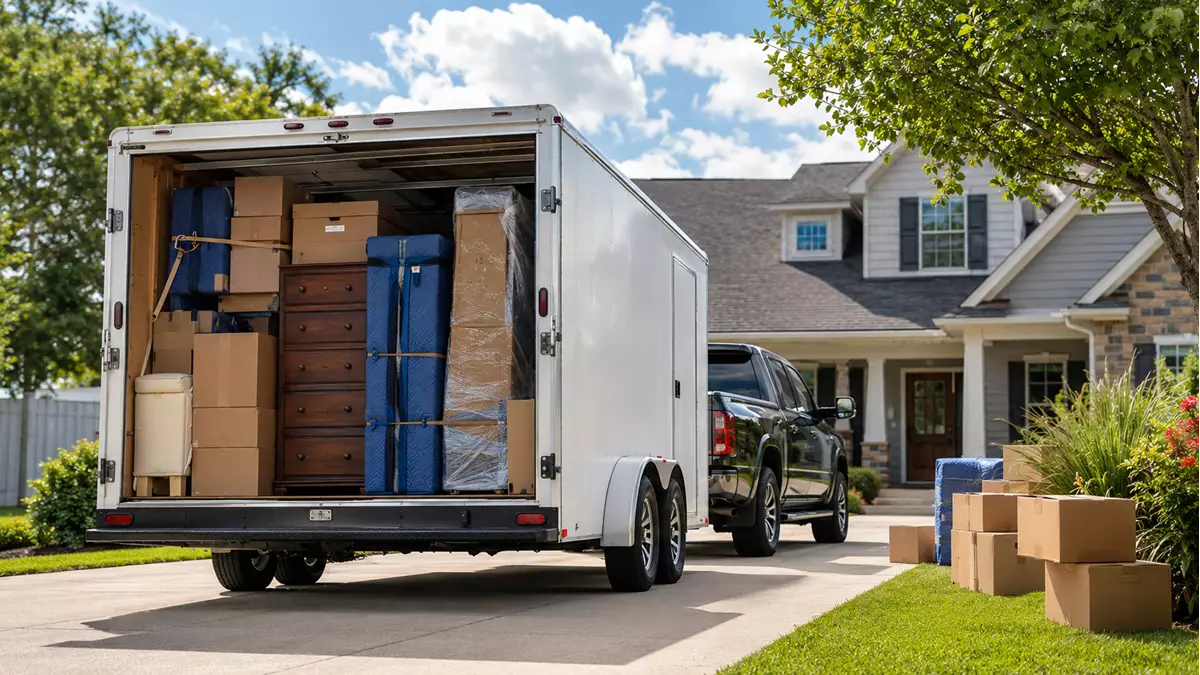
The 4-7 Day Move: Why an Enclosed Trailer Is the Right Rental for a Full Household Move
 Neighbors Trailer
Aug 25, 2026 106 11 min read
A full household move is a different animal from a quick furniture run. You are not hauling a couch across town on a Saturday afternoon; you are moving a life's worth of belongings, often over several days, sometimes across state lines, and usually with a hard deadline on both ends. For that kind of move, the trailer you choose matters more than almost any other decision you will make. An enclosed trailer, rented for the four to seven days a real move actually takes, is the option that protects your belongings, fits your timeline, and costs far less than the alternatives. Here is why it wins, and how to size and book one for a move that spans days rather than hours.
Why an Enclosed Trailer for a Multi-Day Move
When people picture moving, they often picture a big box truck. But for a huge share of moves, an enclosed trailer towed behind a vehicle you already have (or can rent) is the smarter call. The reasons come down to protection, flexibility, and cost.
Your Belongings Stay Protected
The single biggest advantage of an enclosed trailer over an open one is obvious the moment weather turns: your belongings are sealed inside solid walls and a roof. Rain, road spray, dust, and sun never touch them. On a multi-day move, that protection compounds. An open trailer exposes your furniture to whatever the sky does over three or four days on the road. An enclosed trailer is a locked, weatherproof box from the moment you load it until the moment you unload, which also means you can pack it the night before and leave it loaded overnight without worry.
The Timeline Flexibility a Move Actually Needs
Real moves do not happen in a single clean session. You load over a day or two, you drive, you might stop overnight, and you unload on the other end over another day or two. Renting an enclosed trailer for the full four-to-seven-day window matches how moving actually works. You are not racing a same-day return clock or paying penalty rates for keeping a truck an extra day. The trailer is yours for the whole move, so you can load at your pace, drive at a safe pace, and unload without the pressure of a looming return deadline.
The Cost Advantage Over a Moving Truck
Renting an enclosed trailer for several days, towed behind your own truck or SUV, typically costs a fraction of what a comparable box truck rental runs for the same period once you add the truck's daily rate, mileage charges, and fuel for a heavier, thirstier vehicle. If you already own a capable tow vehicle, the math tilts even further in the trailer's favor. You are paying for the box that holds your stuff, not for a second engine to move it.
The gap widens on a longer move. Box truck rentals typically charge by the day and then again by the mile, so a multi-day, multi-hundred-mile move stacks daily rate on top of per-mile fees on top of the fuel a heavy truck drinks. A trailer towed behind a vehicle you already own carries no separate per-mile charge and burns only the extra fuel the added weight costs you, which on most tow vehicles is modest. Over a four-to-seven-day move across real distance, that structural difference, no second engine to rent and no mileage meter running, is where the trailer's savings stop being a rounding error and start being real money you keep.
Enclosed vs. Open: Why the Walls Are Worth It for a Move
An open utility or flatbed trailer costs less to rent and is easier to load from any side, which makes it tempting for a budget move. For a short, local, single-day haul in good weather, it can be the right call. But for a move that spans days and distance, the open trailer's savings evaporate against its risks. Everything you own sits exposed to rain, highway grime, and prying eyes at every gas station and motel parking lot along the route. You cannot leave it loaded overnight with any confidence, which kills the timeline flexibility that makes a multi-day trailer rental work in the first place. The enclosed trailer's walls buy you weather protection, security, and the freedom to load early and unload late, and on a full household move, those three things are worth far more than the difference in daily rate. The one tradeoff, an enclosed trailer's walls and roof add empty weight that slightly reduces net payload, is easily managed by sizing up if you are near the limit. If you are still weighing the two, our beginner's guide to choosing the best enclosed trailer rental walks through the tradeoffs in more detail.
Matching Enclosed Trailer Size to Your Move
Getting the size right is where most first-time movers either overpay for space they do not use or, worse, run out of room halfway through loading. Enclosed cargo trailers for moving generally come in a handful of common sizes, and each maps to a rough home size. For a broader look at sizing across every trailer type, see our guide on how to choose the right trailer rental size.
| Trailer Size | Approx. Capacity | Best For | Typical Move |
|---|---|---|---|
| 6x12 enclosed | Studio to 1 bedroom | Small apartment, dorm, first place | 1-day load, short haul |
| 7x14 enclosed | 1 to 2 bedrooms | Apartment or small house | Multi-day regional move |
| 7x16 enclosed | 2 to 3 bedrooms | Mid-size house | Multi-day, longer distance |
| 8.5x20 enclosed | 3 to 4 bedrooms | Full house move | Cross-country, full household |
The diagram below shows those four common sizes drawn to relative scale, so you can see how much the usable box grows as you step up. The jump from a 6x12 to an 8.5x20 is not just length; the added width and height compound into far more cubic space than the footprint alone suggests.
6x12: studio to 1 bedroom
7x14: 1 to 2 bedrooms
7x16: 2 to 3 bedrooms
8.5x20: 3 to 4 bedrooms
Think in Weight, Not Just Volume
Square footage tells you whether your stuff fits. Weight tells you whether you can legally and safely tow it. A trailer packed with books, appliances, and dense furniture can hit its weight limit long before it looks full. Before you book, estimate the total weight of your household load and confirm both the trailer's cargo capacity and your tow vehicle's rating can handle it. A room-by-room weight estimate turns "it looks about right" into an actual number you can check against the specs. Our moving weight calculator builds that room-by-room estimate for you, so you can size the trailer and check your tow rating with a real number instead of a guess. That trailer weight distribution guide covers how that weight needs to sit once the trailer is loaded.
Can Your Vehicle Tow It?
The size of trailer you can rent is capped by what your vehicle can safely pull, so this is a decision to make before you fall in love with a particular trailer. Every tow vehicle has a maximum towing capacity listed in its owner's manual or on the driver's-door jamb. The loaded trailer, meaning the empty trailer weight plus everything you pack into it, has to sit comfortably under that number with margin to spare. A small enclosed trailer like a 6x12 is within reach of many mid-size SUVs and half-ton trucks. A fully loaded 8.5x20 for a whole-house move is a serious tow that calls for a three-quarter-ton or larger truck. If your own vehicle is not rated for the trailer your move needs, factor a tow-vehicle rental into the plan, and remember that even so, a capable truck plus an enclosed trailer usually still beats a large box truck on total cost. The key is to confirm the pairing works before booking, not to discover a mismatch on loading day.
Loading for the Long Haul: The Multi-Day Difference
Packing an enclosed trailer well is its own subject, and the fundamentals of weight distribution, loading order, and securing your load are covered in depth in our dedicated enclosed trailer packing guide. What changes on a multi-day move is the stakes: you will be living out of this loaded trailer for days, driving it across real distance, and often leaving it packed overnight. That means two things matter more than they would on a quick local haul. First, get your heavy items low and forward of the axle so the trailer tows stable for hundreds of highway miles, not just a few blocks. Second, over-secure everything, because vibration works tie-downs loose over distance, so strap tight, stop within the first several miles to re-check, and check again at every fuel stop. Do that, and a well-packed trailer stays well-packed all the way to the new driveway.
What a 4-to-7-Day Move Timeline Actually Looks Like
The reason a multi-day rental window matters is that a real household move is not one event, it is a sequence, and each stage needs its own time. Planning the trailer around that sequence is what keeps the move calm instead of frantic.
The first day or two is loading. A full house does not pack into a trailer in an afternoon; you are disassembling furniture, wrapping fragile pieces, and building the load carefully so it survives the drive. Having the trailer on hand for two days means you can load the garage and the non-essentials early, then finish with the daily-use items the morning you leave, instead of cramming everything into one exhausting session.
The middle stretch is the drive. A regional move might be a single long day behind the wheel; a cross-country move is two or three days with overnight stops. Towing a loaded trailer is slower and more tiring than driving unloaded, so honest daily-mileage expectations matter. Padding the schedule for weather, traffic, and rest is not wasted time, it is how you arrive with your belongings and your nerves intact. Our tips for a long haul trailer trip covers what to expect once the miles start adding up.
The final day or two is unloading and settling. You rarely unload a whole house the moment you arrive; you place the big pieces, then work through boxes over a day or two. A rental window that includes those days means the trailer is not a ticking clock the second you pull in. You unload at a human pace and return the trailer when you are genuinely done.
Map those three stages against a calendar before you book, and the right rental length becomes obvious. Most full household moves land squarely in the four-to-seven-day range, which is exactly the window this kind of rental is built for.
Booking for the Full Length of Your Move
The biggest booking mistake movers make is renting for too short a window and then scrambling. Think through your actual timeline before you reserve: a day to load, the driving days (including any overnight stops), and a day or two to unload. Book the trailer for that entire span. A four-to-seven-day rental is normal for a real household move, and reserving the full window up front is almost always cheaper and less stressful than extending a too-short rental mid-move.
It is also worth considering protection for a trip this size. When you rent through a peer-to-peer marketplace, coverage like NT Protect is available for a few dollars per day, which is inexpensive reassurance when a trailer holds everything you own for the better part of a week. For a multi-day move across real distance, that peace of mind is easy to justify.
The Right Trailer Makes the Whole Move Easier
A full household move is stressful enough without fighting your equipment. An enclosed trailer, sized to your home and booked for the full length of your move, gives you weatherproof protection, a timeline that matches how moving really works, and a cost that undercuts a box truck, especially if you already have a tow vehicle. Get the size right, load it heavy-and-forward, strap everything down, and reserve it for the whole span, and the trailer becomes the easy part of moving day instead of the hard one.
Planning a multi-day move? Browse enclosed trailers on Neighbors Trailer to find a local, affordable trailer sized to your household, available for the full length of your move. Book online, tow it with the vehicle you already have, and keep everything you own protected from driveway to driveway.