Trailer Towing Guide - How to Load a Vehicle on a Car Hauler for Safe Towing
 Neighbors Trailer
Mar 31, 2023 2549 7 min read trailer towing guid
Loading a vehicle onto a car hauler trailer is one of the most common towing tasks, and one of the most commonly done wrong. A poorly loaded car can shift during transit, damage the vehicle, stress the tow rig, or cause a serious accident on the highway. Whether you are moving a project car across town or transporting a second vehicle to a new home, this guide walks through every step of loading and securing a vehicle on a car hauler trailer safely.
Every trailer rental on Neighbors Trailer includes NT Protect, mandatory coverage that is automatically charged to the renter at booking for just a few dollars per day. With NT Protect built into every reservation, both the trailer owner and renter are covered from the moment the booking is confirmed.
Before You Load: Pre-Trip Vehicle and Trailer Checks
Before you drive any vehicle onto a car hauler, inspect both the trailer and the vehicle you plan to haul. Start with the trailer. Confirm that the ramps or tilt deck operate smoothly and lock into position. Check that the trailer's tires are properly inflated and that the lug nuts are torqued to specification. Inspect the coupler latch, safety chains, and breakaway cable to make sure everything is in working order. If you're still choosing a hauler, confirm it's sized for your vehicle with the Car Hauler Calculator.
On the tow vehicle side, verify that your hitch class and ball size match the trailer's coupler. Confirm your tow vehicle's gross combined weight rating (GCWR) can handle the trailer plus the loaded vehicle weight. For a detailed breakdown of tow vehicle preparation, see our guide on preparing your truck to tow a car trailer safely.
Step-by-Step: How to Load a Vehicle on a Car Hauler
Step 1: Position the trailer on level ground. Park your tow vehicle and trailer on a flat, hard surface. Engage the parking brake on the tow vehicle and chock the trailer wheels to prevent rolling during loading.
Step 2: Deploy the ramps or tilt the deck. If your car hauler has drive-on ramps, extend them fully and make sure they are locked in place. For tilt-deck trailers, release the tilt latch and allow the deck to lower to the ground. Verify the ramp angle is not too steep for the vehicle's ground clearance. For low or long vehicles, the Car Loading Clearance Calculator tells you whether it will clear the ramp.
Step 3: Drive the vehicle onto the trailer slowly. Have a spotter stand to the side where you can see them in your mirrors. Drive straight up the ramps at idle speed. Do not accelerate hard or turn the steering wheel while on the ramps. Keep the vehicle centered between the trailer's fender guides.
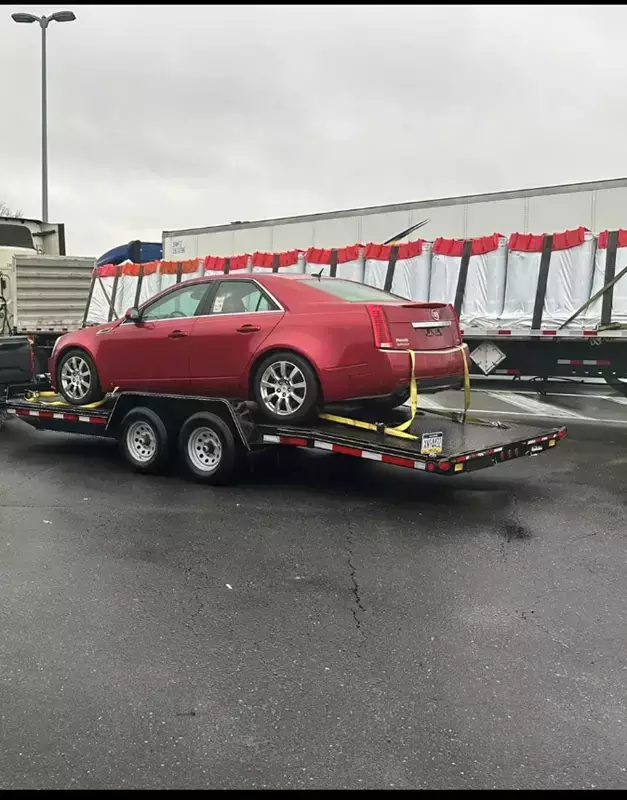
Step 4: Position the vehicle for proper weight distribution. The loaded vehicle should sit with approximately 60 percent of its weight ahead of the trailer's axle centerline. This places the right amount of tongue weight on the hitch and prevents trailer sway. For most sedans and small SUVs, driving the front wheels to within 6 to 12 inches of the trailer's front rail achieves the correct balance.
Step 5: Put the vehicle in park and set the parking brake. Turn off the engine, shift into park (or first gear for manual transmissions), and firmly set the parking brake.
Step 6: Secure the vehicle with tie-down straps. This is the most critical step. Use four ratchet straps or wheel nets, one at each corner of the vehicle. Attach each strap to a designated tie-down point on the trailer (D-rings or stake pockets) and to the vehicle's frame, axle, or tow hooks. Never strap to suspension components, steering linkage, or body panels. For a complete breakdown of proper strap technique, read our car trailer tiedown guide.
Step 7: Raise and secure the ramps. Lift the ramps back into their stored position and pin or latch them. Loose ramps can swing down during transit and strike the road surface.
Vehicle Loading Weight Distribution
| Vehicle Position | Tongue Weight % | Sway Risk | Recommendation |
| Too far forward | 15-20% | Low sway, heavy rear sag on tow vehicle | Move vehicle back slightly |
| Correct position (60/40) | 10-15% | Minimal sway, balanced ride | Ideal loading position |
| Too far back | 5-8% | High sway risk, light steering | Move vehicle forward immediately |
| Centered on axle | Under 5% | Dangerous sway, fishtailing likely | Do not tow, reposition vehicle |
Source: National Highway Traffic Safety Administration towing guidelines
Choosing the Right Tie-Down Equipment
Not all straps are created equal. For car hauling, you need straps rated for the weight of the vehicle you are transporting. A standard passenger car weighs 3,000 to 4,500 lbs, so each of the four straps should have a working load limit (WLL) of at least 1,500 lbs. Ratchet straps offer the most secure tension, while cam buckle straps are faster to use but provide less holding force.
Wheel nets and tire bonnets are another popular option. They wrap around each tire and cinch down to the trailer deck, eliminating the need to find frame tie-down points on the vehicle. This is especially useful for low-clearance sports cars where reaching under the vehicle is difficult. Learn more about strap types in our guide on ratchet straps and car trailer tie-downs.
NeighborsTrailer.com
Common Car Hauler Loading Mistakes
The most dangerous mistake is loading a vehicle too far back on the trailer. When the vehicle's weight sits behind the trailer axles, the tongue weight drops to near zero. This causes the rear of the tow vehicle to lift, reduces front-wheel traction, and creates violent trailer sway at highway speeds. If the trailer starts swaying, the driver has very little ability to recover control.
Another common error is using the vehicle's parking brake as the only form of securement. The parking brake is a backup, not a primary restraint. Straps or chains must hold the vehicle in place. During hard braking or a sudden lane change, a parking brake alone will not prevent the vehicle from sliding on the trailer deck.
Drivers also frequently skip the post-load walkaround. After loading and strapping, walk around the entire rig before pulling onto the road. Check that all four straps are tight, ramps are secured, trailer lights are working, and no part of the loaded vehicle hangs over the sides of the trailer.
Driving Tips When Hauling a Vehicle
With a car on the trailer, your overall rig length and weight increase significantly. Allow at least double your normal following distance. Reduce your speed, especially on highways and in windy conditions. Avoid sudden braking and sharp lane changes. Take wide turns to prevent the trailer from clipping curbs or cutting corners.
Stop and re-check your straps after the first 15 to 20 miles of driving. Straps can settle and loosen as the vehicle and trailer shake during initial travel. Tighten any strap that has slack.
Frequently Asked Questions
Can I load a car with a dead battery onto a car hauler?
Yes. Use a winch or have someone push the vehicle while you steer. Many car haulers on Neighbors Trailer come equipped with a hand winch for exactly this purpose. You can also check our guide on the best car trailer rental winches.
Should the loaded vehicle face forward or backward?
Always face the vehicle forward (front of the car toward the tow vehicle). This positions the heavier end of the vehicle (the engine) over the front of the trailer, which improves tongue weight and stability.
How tight should tie-down straps be?
Straps should be tight enough to compress the vehicle's suspension slightly. This prevents the vehicle from bouncing and loosening the straps during transit. If the suspension does not compress, the straps are not tight enough.
Do I need to disconnect the loaded vehicle's driveshaft?
On a car hauler (flatbed) trailer, the loaded vehicle's wheels do not spin during transit, so driveshaft disconnection is not necessary. This is only a concern with tow dollies where the rear wheels remain on the ground.
Related Articles
- Car Trailer Safe Loading Guide
- Car Trailer Rental Tiedown Guide
- Car Trailer Rental vs Tow Dolly
- Car Trailer Rental Transporting Cars
Content updated March 2026