

Car Trailer Rental Tiedown Guide: Straps, WLL & Rules
 Neighbors Trailer
Sep 25, 2023 1986 7 min read tie-down stra
Securing a vehicle to a car trailer is the last five minutes of loading, and it is the five minutes that decide whether the rest of the trip is safe. A car that shifts by an inch at highway speed becomes a swaying load that fights the tow vehicle. A car that breaks loose completely becomes a serious road hazard. A quality tie-down setup, used correctly on every corner of the vehicle, is the single cheapest insurance policy any car trailer renter can add.
This 2026 car trailer rental tiedown guide walks through every part of the process: which straps to choose, where to attach them, how to route them for zero slack, and how to check them at every stop. It applies to any car trailer you book on the Neighbors Trailer marketplace, from open single-axle trailers to enclosed tandem haulers.
Tie-Down Types for a Car Trailer Rental
Ratchet Straps
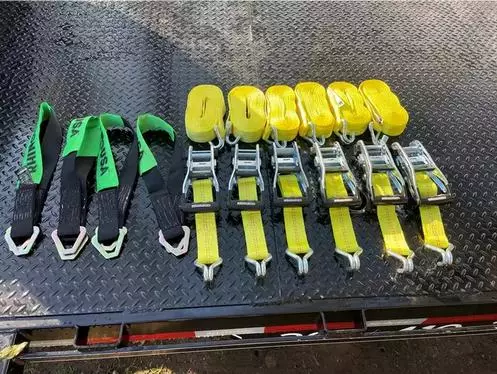
Ratchet straps are the default choice for car trailer tie-downs. The ratcheting mechanism lets one person apply several hundred pounds of tension with light hand pressure, and a properly rated strap will hold a car against braking forces well beyond anything a passenger vehicle can generate. Look for a working load limit (WLL) of at least 3,333 lbs per strap; four straps at that rating will hold any passenger car legally and safely.
Cam Buckle Straps
Cam buckle straps are quicker to attach than ratchets but apply less tension. They are best for light loads, like side straps used to stabilize a load that is already firmly held by the primary tie-downs. For the main four-corner attachment, always use ratchet straps.
Axle Straps vs Wheel Nets
An axle strap wraps around the axle tube and connects the ratchet to the trailer, while a wheel net or tire basket wraps the tire itself. Wheel nets are the safer choice for most renters because they do not transfer pressure to the suspension; the car can compress and rebound on its own springs without loosening the tie-down. For more on getting the trailer itself road-ready, see the Neighbors Trailer guide on preparing your truck to tow a car trailer rental safely.
Car Trailer Tiedown Comparison
The table below compares the most common tie-down options for car trailer rentals in 2026, ranked by working load limit, typical cost per set of four, and recommended use case.
| Tiedown Type | Working Load Limit | Set of 4 Cost | Best For |
| Wheel Net / Tire Basket | 3,333 lbs | $130 | Most passenger cars |
| Axle Strap with Ratchet | 3,333 lbs | $95 | Classic and rigid axles |
| Heavy-Duty Ratchet Strap | 5,000 lbs | $80 | Trucks and SUVs |
| Chain with Binder | 6,600 lbs | $160 | Heavy equipment |
| Cam Buckle Strap | 1,500 lbs | $40 | Secondary side straps |
Holding Power by Tiedown Type
The chart below compares the working load limit of each tiedown type in pounds, so you can quickly pick a strap that matches the weight of the vehicle you are hauling. Always multiply total vehicle weight by 0.5 per strap and make sure the WLL of each strap is at least that number.
NeighborsTrailer.com
Step-by-Step Tiedown Procedure
Load the vehicle onto the car trailer with the front wheels pushed firmly against the front stop bar or the trailer fender. Loading the car this far forward is also what sets the trailer’s tongue weight and balance, and our weight distribution planner helps you confirm it lands in the safe range. Set the parking brake and leave the transmission in park or first gear. Before attaching a single strap, verify the trailer itself is properly coupled and the tow vehicle is on level ground, because any sloped surface will skew your tension readings.
Start with the two front tiedowns. Attach a wheel net over each front tire, connect the net's D-ring to a dedicated trailer anchor point that pulls forward and outward from the tire, then ratchet down until the suspension just begins to compress slightly. Repeat on the rear wheels, pulling backward and outward. Four straps in an X-shaped pattern create opposing forces that keep the vehicle from shifting forward, backward, or side to side.
After the initial tension is set, walk around the vehicle and check every strap once more. Push on the vehicle's front and rear bumper and watch the straps; if any strap is visibly going slack while another tightens, the tension is uneven. Evenly tensioned straps are what keep the vehicle still over highway bumps. For the trailer itself, it is worth confirming how to measure the axles on your car trailer rental so you know which anchor points are structurally rated for full-load pulls.
Common Mistakes to Avoid
Most tiedown failures trace back to a handful of avoidable mistakes. First, never wrap a strap around suspension components; the strap will shift as the suspension moves and lose tension within 10 miles. Second, never attach to a steering linkage or brake line; you can crack a brake line with one hard bump and lose braking entirely on the way home. Third, never let straps cross sharp edges on the trailer rails, because fabric straps abrade quickly against a bare metal lip.
Fourth, do not overtighten. A ratcheted strap under maximum load can pull a car's suspension fully compressed, and then rebound force on a road bump can snap a strap at the weakest link. Tension is enough when the suspension is just barely compressed, no more. Fifth, always use four straps for a passenger car; two or three will not hold a load legally in most US states under DOT cargo securement rules.
On-the-Road Checks and Re-Tensioning
Straps loosen over the first 25 miles of a trip, no matter how good your initial tension was. Plan the first stop at 15 to 20 miles from the loading point, even if you are running on schedule. Walk around the vehicle, push on each bumper, and re-tension any strap that shows visible slack. After that first check, the load will settle and subsequent tension loss is minimal, but a second check at the halfway mark of a long trip is still good practice.
At every fuel stop or driver swap, take 30 seconds to eyeball every strap. A strap that is fraying, stretched white at the stitching, or partially unthreaded from its ratchet is a strap that is about to fail. Keep two spare straps in the tow vehicle just in case.
Frequently Asked Questions
How many tie-downs do I need for a car on a trailer?
DOT rules require a minimum of four tie-downs for any vehicle, each with a working load limit of at least half the vehicle's total weight. For a 4,000 lb sedan, that means four straps rated for 2,000 lbs each minimum, though 3,333 lb wheel nets are a safer and more common choice.
Can I use bungee cords instead of ratchet straps?
Never. Bungee cords have no working load rating, stretch under load, and can snap back and cause serious injuries. For any vehicle transport, use only rated ratchet straps, wheel nets, chains, or axle straps.
Do I need tie-downs for a car trailer if I have a wheel stop?
Yes. A front wheel stop prevents forward movement but does nothing for braking, lane changes, or road bumps. Tie-downs are required regardless of trailer design, and most state police will cite a trailer towed without them.
How often should tie-down straps be replaced?
Inspect straps before every trip and replace any strap with visible fraying, UV-faded webbing, or a bent ratchet. Under normal use, straps should be fully replaced every 3 to 4 years even if they look fine, because UV and age silently weaken fabric.
Final Thoughts
A car trailer rental is only as safe as the tie-down kit in the toolbox. Invest once in a set of four quality ratchet straps with wheel nets rated for 3,333 lbs each, carry two spares, and re-check tension at the 20-mile mark of every trip. Do that, and the vehicle on your trailer will arrive exactly as it left: on all four tires, paint intact, and ready to drive off the ramp.
Related Articles
- Complete Guide to Tiedowns for Enclosed Trailers
- How to Use Ratchet Straps on a Flatbed Trailer
- How to Choose the Right Car Trailer Rental
- Car Trailer Rental vs Tow Dolly
Content updated April 2026