

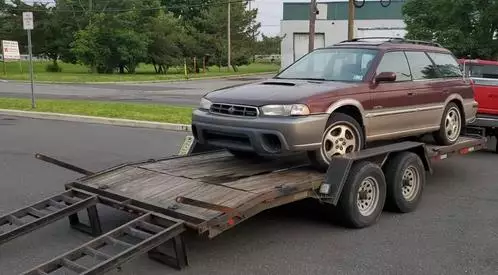
Learn How to Load a Disabled Vehicle on a Car Trailer Safely
 Neighbors Trailer
Mar 15, 2024 961 8 min read car trail
The Car Trailer Safe Loading Guide
A car trailer is only as safe as the loader behind it. Most highway incidents involving a trailer come down to one of three things: an unbalanced load, weak tie-downs, or a vehicle that was driven onto the deck without proper chocks or alignment. The good news is that all three are easy to avoid once you know what to do. This guide walks you through the full process of loading a vehicle, running or disabled, onto a car trailer, with the tie-down patterns, weight-distribution rules, and pre-trip checks that keep the load on the deck and the trailer behind you instead of beside you.
Before You Load: Five Pre-Flight Checks
Loading goes smoothly when the trailer is set up before the vehicle ever touches the ramps. Run through this list every time:
1. Park on level, paved ground. A slight grade is fine; a slope or soft gravel is not. The trailer should be hitched, the tow vehicle in park, and the parking brake on.
2. Drop the jack and chock the trailer wheels. A loaded car will shift the trailer, and you do not want it rolling away from you mid-load.
3. Inspect the ramps. Make sure they are seated, locked into the receivers if they fold, and free of mud or oil that could cause tire slip.
4. Confirm tie-down points. You want four solid attachment points on the deck (D-rings, slide rails, or stake pockets) and four matching points on the vehicle (frame loops, tow hooks, or factory tie-down rings).
5. Verify your tow setup. Hitch class, ball size, safety chains crossed, breakaway cable connected, and trailer brakes plugged in. If you are not sure your truck is rated for the loaded weight, our tow capacity guide walks through the math.
Loading a Running Vehicle
If the vehicle starts and drives, the load is straightforward. Center the trailer behind the vehicle so the deck and the front of the car are aligned. Have a spotter at the rear of the trailer if at all possible; you will not see the ramp angles or the deck centerline from the driver's seat alone.
Step-by-Step
Idle the car forward, do not gun it. Aim for the center of the deck and stop when the front wheels are about 60 percent of the way along the deck. That position puts roughly 60 percent of the vehicle weight forward of the trailer axle, which gives you the right tongue weight (10 to 15 percent of trailer weight) for stable towing. Set the parking brake, turn off the engine, and step out carefully (the trailer is taller than you expect).
Loading a Disabled Vehicle
A non-running vehicle takes more setup but is just as doable solo with the right gear. The two best options are a portable winch mounted to the trailer's front bulkhead or a come-along anchored to the front D-rings. Avoid pushing a disabled car onto a trailer by hand on any kind of grade; the load is too heavy and the consequences of losing control are too serious.
Winch-Loading a Disabled Vehicle
Run the winch cable straight back, through a snatch block if your geometry needs it, and connect to a stout factory recovery point on the towed vehicle. Never connect to a suspension component or a thin sheet-metal bracket. Keep yourself out of the bight (the danger zone where a snapped cable would whip). Winch slowly, keep the vehicle straight, and stop the moment you see the trailer shift.
The 60/40 Weight Rule
Tongue weight (the downward force on the hitch ball) should be 10 to 15 percent of total trailer weight. If it is too low, the trailer will sway. If it is too high, the tow vehicle squats and steers badly. The easiest way to hit the right tongue weight is to position the loaded vehicle so 60 percent of its weight is forward of the trailer axle. Our weight distribution planner helps you find that fore-aft position for a balanced load. The table below shows the right load position for the most common vehicle layouts.
| Vehicle Type | Engine Location | Load Direction | Front-of-Axle Position |
| Front-engine sedan or SUV | Front | Drive on facing forward | Front wheels 18 to 24 in ahead of axle |
| Front-engine pickup | Front | Drive on facing forward | Front wheels 24 to 30 in ahead of axle |
| Mid-engine sports car | Middle | Drive on facing forward | Center of car at axle line |
| Rear-engine vehicle (Porsche 911, classic VW) | Rear | Drive on facing backward | Engine 18 in ahead of axle |
| Heavy diesel truck | Front | Drive on facing forward | Front wheels 30 to 36 in ahead of axle |
Securing the Vehicle: The 4-Point Tie-Down
Four straps. Always four. Two front, two rear, each pulling forward or backward at an angle to lock the vehicle in three dimensions. Wheel straps that wrap directly around each tire are the safest method because they apply load to the wheel itself, not to suspension components that flex. If you must use frame loops or tow hooks, choose anchor points that are part of the vehicle structure (not bumpers, not body panels) and use straps rated for at least 10,000 lbs working load limit each.
Strap Angles That Actually Work
Each strap should pull at roughly a 45-degree angle from the deck. A strap pulling straight down does almost nothing to stop the car from rolling forward or backward. A strap pulling straight forward does almost nothing to keep the car from lifting off the deck. The 45-degree angle handles both. For a deeper dive on strap selection and ratchet placement, our tie-down guide walks through every common configuration.
Common Loading Mistakes to Avoid
Loading too far back. Tongue weight goes negative, trailer sways at any speed over 45 mph, and you end up white-knuckling every lane change.
Loading too far forward. The tow vehicle's rear suspension squats, headlights point at the sky, steering goes vague, and braking distance jumps by 30 percent.
Skipping the parking brake. The vehicle creeps during a heavy braking event and tears your tie-downs.
Using ratchet straps with frayed webbing. Always inspect every strap before each load. A $25 strap is cheaper than a windshield repair on the truck behind you.
Forgetting safety chains. Even if the trailer separates, the chains keep it tied to the truck long enough to slow down and pull over.
How Tongue Weight Affects Stability: The Math Visualized
The chart below shows how trailer sway risk changes as tongue weight drops below the recommended range. Our tongue weight calculator shows whether your setup lands in that 10 to 15 percent range.
NeighborsTrailer.com
The safe range is 10 to 12 percent tongue weight. Below 10 percent, sway risk climbs sharply. Above 13 percent, the tow vehicle starts to overload its rear axle. Stay in the green zone and the trailer behaves.
Pre-Departure Checklist
Before you pull away, walk around the rig and confirm:
All four tie-downs are tight and ratcheted to spec.
The parking brake on the loaded vehicle is set.
The trailer's lights, brakes, and breakaway cable all work.
Safety chains are crossed under the tongue.
The trailer jack is fully retracted.
The wheel chocks have been pulled and stowed.
The hitch coupler is fully seated and pinned or locked.
FAQ
Can I load a car onto a trailer alone?
Yes, but a spotter makes it twice as fast and noticeably safer. If you are loading solo, take more time, position the trailer perfectly straight first, and make small steering corrections as you idle on.
Do I need axle straps or wheel straps?
Wheel straps are safer because they capture the tire and load to the strongest part of the vehicle. Axle straps work but require a clean attachment point on a rated suspension component.
What is the maximum vehicle weight my car trailer can haul?
Subtract the trailer's empty weight from its GVWR (printed on the trailer's tag near the tongue). The result is your payload limit. Make sure the loaded vehicle plus any extra gear stays under that number. Our car hauler calculator checks your vehicle’s weight against a trailer’s payload limit.
Should I load a 4WD truck with the parking brake or in gear?
Both. Set the parking brake, then place an automatic transmission in Park or a manual in first gear.
How often should I stop and re-check straps?
Pull over after the first 5 to 10 miles to retighten. Webbing settles under load. After that, recheck at every fuel stop or every 100 to 150 miles.
Final Word
Safe loading is a checklist, not a feeling. Pre-flight the trailer, position the vehicle for 60/40 weight distribution, four-strap it down at proper angles, and walk around the rig before you pull away. Do those four things every time and the loaded trailer will track straight from the first mile to the last. Browse local car trailer owners on Neighbors Trailer to find a rental that matches your vehicle and your route.
Related Articles
- Cambuckle vs Ratchet Straps for Car Trailer Tie-Downs
- The Ultimate Trailer Towing Safety Guide
- How to Prepare Your Truck to Tow a Car Trailer Safely
- Trailer Towing Capacity Explained
Content updated May 2026