

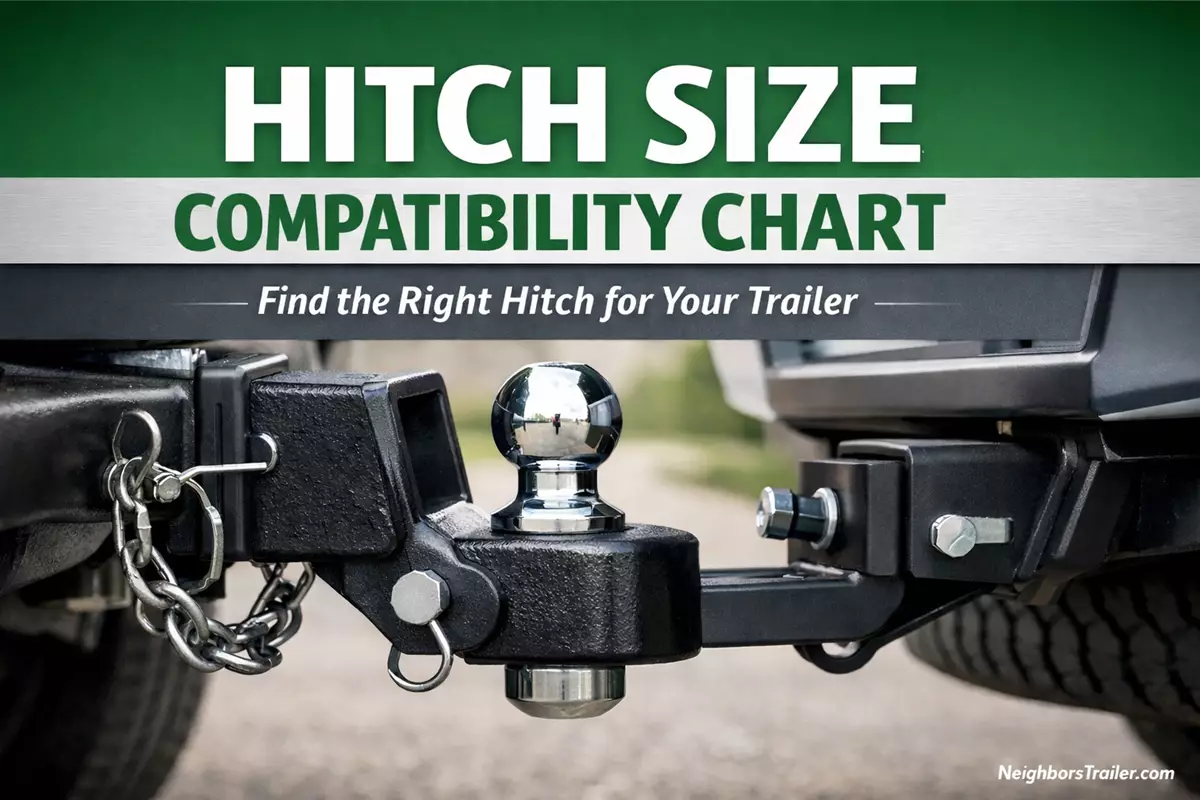
Hitch Size Compatibility Chart: Find the Right Hitch for Your Trailer
 Neighbors Trailer
Feb 3, 2026 1993 12 min read trailer hitch compatibilit
Renting a trailer is easy—but making sure your vehicle can safely tow it requires understanding hitch sizes and towing capacity. Using the wrong hitch can lead to unsafe towing, damage to your vehicle, or even accidents. This guide from Neighbors Trailer explains how hitch sizes work, which vehicles match which trailers, and includes a handy compatibility chart to make it simple.
What Is a Trailer Hitch?
A trailer hitch is the component that connects your towing vehicle to the trailer. It’s made up of:
- Receiver Hitch – the square tube on your vehicle’s bumper where a ball mount inserts
- Ball Mount & Hitch Ball – attaches inside the receiver and connects to the trailer coupler
- Coupler – the piece on the trailer that locks onto the hitch ball
Hitches are rated by class, which indicates their weight capacity, and by ball size, which must match the trailer coupler.
Understanding Hitch Classes
Hitches are grouped into five main classes, each suitable for different vehicles and trailer weights:
| Hitch Class | Max Trailer Weight | Max Tongue Weight | Typical Vehicles |
| Class I | Up to 2,000 lbs | 200 lbs | Compact cars, small SUVs |
| Class II | Up to 3,500 lbs | 350 lbs | Sedans, small trucks, midsize SUVs |
| Class III | Up to 8,000 lbs | 800 lbs | Full-size SUVs, trucks |
| Class IV | Up to 10,000 lbs | 1,000 lbs | Heavy-duty trucks, vans |
| Class V | Up to 20,000 lbs | 2,000 lbs | Commercial trucks, large SUVs |
Tip: Always check your vehicle manufacturer’s towing capacity. The hitch class must never exceed your vehicle’s rating.
Receiver Sizes Explained
Most passenger vehicles use either a 1-1/4-inch receiver or a 2-inch receiver. The receiver size refers to the square opening on your vehicle’s hitch where the ball mount slides in. This measurement determines which ball mounts, hitch accessories, and weight distribution systems will fit your vehicle.
1-1/4" Receiver
A 1-1/4-inch receiver is commonly found on compact cars, crossovers, and smaller SUVs. It is typically used for lighter-duty towing applications such as small utility trailers, bike racks, or cargo carriers. These receivers are often paired with Class I or Class II hitches and lower weight ratings.
2" Receiver
A 2-inch receiver is the most common size on trucks, full-size SUVs, and vehicles equipped with Class III, IV, or V hitches. It supports heavier trailer weights and allows compatibility with a wider range of ball mounts, hitch balls, and towing accessories. Most enclosed trailers, car haulers, and equipment trailers require a 2-inch receiver.
Receiver Size Comparison Chart
| Feature | 1-1/4" Receiver | 2" Receiver |
| Typical Hitch Class | Class I–II | Class III–V |
| Common Vehicles | Compact cars, small SUVs | Trucks, full-size SUVs |
| Typical Max Trailer Weight | Up to 3,500 lbs | Up to 20,000 lbs (varies by class) |
| Hitch Pin Diameter | 1/2" | 5/8" |
| Accessory Compatibility | Light-duty mounts & racks | Wide range of heavy-duty mounts |
Why Receiver Size Matters
Receiver size determines which ball mounts and towing accessories you can safely use. A ball mount designed for a 2-inch receiver will not fit into a 1-1/4-inch receiver, and vice versa. Using adapters may reduce your hitch’s rated capacity and should only be done according to manufacturer specifications.
Selecting the correct receiver size ensures proper load distribution, secure mounting, and safe towing performance.
Hitch Pin Diameter: 1/2" vs 5/8"
Receiver size also determines the required hitch pin diameter:
- 1-1/4-inch receivers typically use a 1/2-inch hitch pin
- 2-inch receivers typically use a 5/8-inch hitch pin
The hitch pin secures the ball mount inside the receiver. Using the wrong pin size can cause excessive movement, rattling, or unsafe attachment. Always match the pin diameter to your receiver size and confirm it is properly secured with a locking clip.
Quick Compatibility Check
Before towing, confirm:
- Your vehicle’s receiver size (1-1/4" or 2")
- The correct ball mount designed for that receiver
- The proper hitch pin diameter
- The ball size that matches your trailer coupler
Receiver size compatibility is just as important as hitch class and towing capacity when ensuring safe trailer operation.
Hitch Ball Sizes and Trailer Couplers
The hitch ball is the metal sphere that connects to the trailer coupler. Choosing the correct ball size is essential to prevent accidents.

Standard Ball Sizes:
- 1-7/8" – Small utility trailers, bike racks
- 2" – Most common, used for light to medium trailers
- 2-5/16" – Heavy-duty trailers and car haulers
2" vs 2-5/16" Hitch Ball Comparison
| Feature | 2" Hitch Ball | 2-5/16" Hitch Ball |
| Typical Use | Light to medium trailers | Heavy-duty trailers |
| Common Trailer Types | Utility, small cargo, small enclosed | Car haulers, equipment, large enclosed |
| Typical Weight Range | Up to ~8,000 lbs (varies by rating) | Up to 20,000+ lbs (varies by rating) |
| Vehicle Type | Midsize SUVs, half-ton trucks | 3/4-ton & heavy-duty trucks |
| Coupler Stamp | Marked "2" | Marked "2-5/16" |
Common Hitch Ball Mistakes
- Using the wrong ball size – Even a small mismatch (2" vs 2-5/16") can cause trailer separation.
- Ignoring weight ratings – The hitch ball must be rated equal to or higher than your trailer’s fully loaded weight.
- Not tightening to proper torque – A loose hitch ball can shift or detach under load.
- Skipping coupler inspection – Always check that the coupler locks securely and latches fully.
- Forgetting to re-check after first miles – Stop after 10–20 miles to confirm everything remains tight and secure.
Hitch Ball Torque Specification Guide
Proper torque ensures the hitch ball remains securely fastened to the ball mount. Always follow manufacturer specifications, but the chart below shows common torque ranges for standard hitch ball shank sizes.
| Ball Shank Diameter | Typical Torque Range | Common Ball Sizes |
| 3/4" | 160–180 ft-lbs | 1-7/8", 2" |
| 1" | 250–300 ft-lbs | 2", 2-5/16" |
| 1-1/4" | 430–450 ft-lbs | Heavy-duty 2-5/16" |
Note: Always verify torque specifications from the hitch ball manufacturer. Over-tightening or under-tightening can compromise safety.
How to Match a Ball to a Trailer Coupler:
- Look at the trailer coupler size (stamped on the coupler)
- Choose a ball with the same diameter
- Ensure the ball’s weight rating matches or exceeds the trailer’s tongue weight

Choosing the correct hitch size is only one part of safe towing. Getting the ball mount’s drop or rise right so the trailer sits level is another; the Hitch Drop & Rise Calculator sizes it for you. For a complete breakdown of tongue weight, braking requirements, speed limits, and real-world safety examples, review our Ultimate Trailer Towing Safety Guide.
Neighbors Trailer Hitch Compatibility Table
Below is a comprehensive table to quickly match vehicles, hitch classes, ball sizes, and trailer types:
| Vehicle Type | Hitch Class | Typical Ball Size | Trailer Type | Max Trailer Weight |
| Compact Car | Class I | 1-7/8" | Small utility, bike trailers | 2,000 lbs |
| Midsize SUV | Class II | 2" | Small cargo, utility trailers | 3,500 lbs |
| Full-size SUV | Class III | 2" or 2-5/16" | Utility, enclosed trailers | 8,000 lbs |
| Pickup Truck | Class III | 2" or 2-5/16" | Car hauler, utility trailers | 8,000 lbs |
| Heavy-duty Truck | Class IV | 2-5/16" | Large enclosed trailers | 10,000 lbs |
| Commercial Truck | Class V | 2-5/16" | Large cargo trailers, equipment | 20,000 lbs |
Pro Tip: For trailers near the top of your vehicle’s towing limit, always use a weight distribution hitch for better control.
Weight Distribution and Sway Control
A weight distribution hitch (WDH) is a towing system that redistributes trailer tongue weight across the front and rear axles of the tow vehicle and the trailer to improve stability, steering control, braking performance, and reduce sway.

Even with the correct hitch and ball size, heavy trailers can sway if weight isn’t distributed properly.
If you’re towing an enclosed trailer, sway control becomes even more important. Learn how different systems reduce movement and improve stability in our guide to enclosed trailer sway control hitches.
- Tongue weight should generally be 10–15% of the trailer’s total weight.
- Weight distribution hitches help transfer weight evenly across axles.
- Sway control devices reduce side-to-side trailer movement, especially in windy conditions or during lane changes.
How a Weight Distribution Hitch Works
A weight distribution hitch (WDH) is designed to spread the trailer’s tongue weight more evenly across all axles of both the towing vehicle and the trailer.
A WDH uses spring bars (also called tension bars) that attach from the hitch head to brackets on the trailer frame. When tightened, these bars act like levers.
As they apply tension, they transfer some of the downward force forward onto the tow vehicle’s front axle and backward onto the trailer’s axles. This redistribution helps keep the entire towing setup balanced.
When weight is properly distributed, the tow vehicle sits level. Steering control improves, braking performance becomes more stable, headlight alignment stays correct, and trailer sway is reduced.
Most importantly, a weight distribution hitch prevents the front axle from lifting under heavy load. Front-end lift can reduce tire traction, weaken steering response, and increase the risk of losing control while towing.
Step-by-Step Hitch Compatibility Check
Before renting a trailer, follow these steps to ensure proper compatibility:
- Check Vehicle Towing Capacity
Look in your owner’s manual or on the manufacturer’s website. Do not exceed the recommended towing limit. - Determine the Trailer Weight
Include cargo, equipment, and passengers. This is your gross trailer weight (GTW). - Check Tongue Weight
Ensure your vehicle can handle 10–15% of the GTW on the hitch. - Identify Hitch Class and Ball Size
Match your vehicle’s receiver hitch class with the trailer coupler and ball size. - Use Weight Distribution if Needed
For trailers near max weight, a weight distribution hitch keeps towing safe and stable.
Choosing the correct hitch class and ball size is only part of safe towing. You should also understand the legal requirements where you’ll be driving — including brake thresholds, maximum towing speeds, and equipment rules — in our Trailer Towing Laws by State (2026 Guide): Speed Limits, Brake Requirements & Weight Rules.
Common Hitch Mistakes to Avoid
- Assuming the ball size is correct without checking the coupler stamp – Never rely on appearance alone; always verify the stamped size before connecting.
- Exceeding vehicle towing capacity – Puts stress on engine, brakes, and suspension
- Ignoring tongue weight limits – Leads to swaying or trailer lift
- Skipping hitch maintenance – Grease, rust, or loose bolts can compromise safety
- Not checking trailer brakes – For trailers over 3,000 lbs, brakes are often required
How Neighbors Trailer Makes It Easy
With Neighbors Trailer:
- Every listing shows trailer weight capacity and ball size
- Hitch compatibility can be checked before booking
- You can filter trailers by vehicle type or hitch type
- Safety guides and tips are included for each rental
This helps ensure you rent the right trailer without guesswork, improving both safety and confidence. Always check the trailer specifications before connecting to the trailer.
Tips for Safe Towing
- Always test drive with the trailer empty first
- Check lights and signals before each trip
- Distribute cargo evenly – heavy items in the center, low to the ground
- Drive slower than usual, especially on highways
- Use mirrors or cameras to monitor trailer position
- Make wide turns at intersections and gas stations
- Use a spotter while backing
- Stay in the right lane except for passing
- Inspect the trailer and load at every stop
Frequently Asked Questions
What size hitch ball do I need?
The hitch ball size must exactly match the trailer coupler size. The three most common ball sizes are 1-7/8", 2", and 2-5/16". The correct size is typically stamped directly on the trailer coupler. Always choose a hitch ball with a weight rating that meets or exceeds your trailer’s fully loaded weight.
What happens if the hitch ball is too small?
If the hitch ball is too small, the trailer coupler may not secure properly and could detach while driving. This can lead to trailer separation, loss of control, and serious accidents. Even a slight size mismatch reduces stability and increases risk. Always verify the exact coupler size before connecting the trailer.
What is the difference between Class III and Class IV hitches?
A Class III hitch is typically rated for up to 8,000 lbs of trailer weight and 800 lbs of tongue weight, while a Class IV hitch is rated up to 10,000 lbs or more, depending on the manufacturer. Class IV hitches are generally used for heavier-duty trucks and larger enclosed or equipment trailers. Not sure which class fits your setup? The Hitch Class Calculator matches your trailer to the right class.
Can I use a higher class hitch than my vehicle rating?
No. Your vehicle’s manufacturer towing capacity is the limiting factor. Even if your hitch is rated higher, you must never exceed your vehicle’s maximum towing capacity or tongue weight rating. Installing a higher class hitch does not increase your vehicle’s safe towing limits.
Do I need a weight distribution hitch?
A weight distribution hitch is recommended when towing heavier trailers near your vehicle’s maximum rating. It helps distribute tongue weight more evenly across all axles, improving steering control, braking performance, and overall stability. Many manufacturers recommend using a weight distribution hitch for trailers over 5,000 lbs.
What Does a Weight Distribution Hitch Do?
A weight distribution hitch spreads trailer tongue weight more evenly across the tow vehicle and trailer axles. Instead of allowing the rear of the vehicle to sag under heavy load, it transfers some of the weight forward to the front axle and rearward to the trailer axles.
This helps keep the vehicle level, improves steering and braking control, and reduces trailer sway—especially when towing heavier trailers near your vehicle’s maximum rating.
Conclusion
Using the correct hitch, ball, and trailer combination is essential for safe towing. With the Neighbors Trailer Hitch Size Compatibility Chart, you can quickly match your vehicle with the perfect trailer and ensure safe, hassle-free transportation.
Whether you’re moving furniture, hauling equipment, or towing a car, knowing your hitch class, ball size, and trailer capacity is the first step to a successful rental.
Pro Tip: Bookmark this chart and refer to it every time you rent a trailer. Safety first, always.
Article revision on 2/18/26 for improved accuracy.