

How to Choose the Right Hitch Ball
 Neighbors Trailer
Jun 23, 2026 290 12 min read
One of the most consequential details in trailer towing is also one of the least talked about: the hitch ball. Most first-time renters do not realize that hitch balls come in different sizes, that the size has to match the trailer's coupler exactly, and that a wrong-size ball is a genuine safety hazard. A ball too small lets the coupler lift off at the first bump or sharp acceleration. A ball too large prevents the coupler from closing fully and creates the illusion of a connection without an actual lock. Either failure mode produces the same outcome on the highway: a trailer separating from the tow vehicle at speed. The good news is that picking the right hitch ball is straightforward once you know what to look for, and the check takes about thirty seconds at pickup. This guide walks through the three standard sizes, how to identify what your trailer needs, and the rules that keep the connection rock-solid through the trip.
Why Hitch Ball Size Matters
The trailer's coupler is the cup-shaped device at the front of the trailer that closes around the hitch ball. The coupler is sized for one specific ball diameter. When the size matches exactly, the coupler's latch and locking mechanism wrap around the ball and grip it from below the equator (the widest part of the ball). That underhook is what keeps the trailer from lifting off the ball during a bounce, a sharp acceleration, or a fast deceleration.
When the ball is too small, the coupler closes but the latch does not engage at the right point. The trailer sits loose on the ball, the latch fails to grip, and the first significant bump in the road can lift the coupler clean off. When the ball is too large, the coupler cannot close fully. The latch may appear to engage (some couplers will close partially over a slightly oversized ball), but the underhook is incomplete or absent. Either way, the trailer is one bump from disconnection.
This is not a theoretical concern. A trailer detaching at highway speed is one of the more dangerous failure modes in towing, and a substantial percentage of detachment incidents trace back to a hitch ball size mismatch that was missed at pickup. The thirty seconds it takes to verify size is the single highest-leverage safety check in the entire towing process.
The Three Standard Sizes
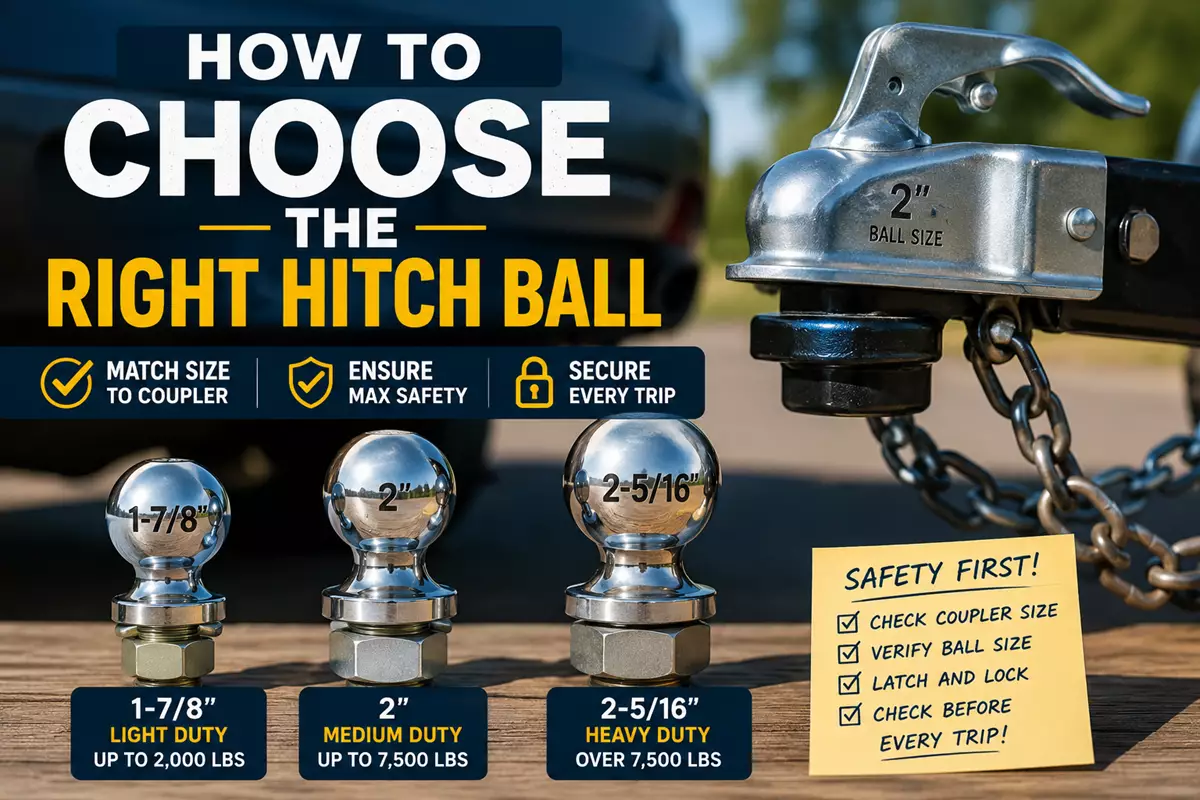
For nearly all consumer and rental trailers, only three hitch ball sizes are in widespread use. Knowing them by sight (and by stamp) covers more than 95 percent of rental scenarios.
1-7/8 Inch
The smallest of the three common sizes. Found on light-duty trailers: small utility trailers, jet ski trailers, small boat trailers, and some lawn and garden equipment trailers. Typical gross trailer weight rating up to 2,000 pounds. Less common on rental marketplaces because most rental trailers fall into the next size up, but worth recognizing if you are renting a smaller utility model.
2 Inch
The most common hitch ball size by a wide margin. The default for medium-duty trailers including most cargo, utility, and flatbed trailers under about 7,500 pounds gross weight. The majority of rental trailers on peer-to-peer platforms use a 2-inch coupler. If you have to guess (which you should not), 2 inch is the most likely answer.
2-5/16 Inch
The size for heavy-duty trailers: large flatbeds, equipment haulers, larger enclosed trailers, gooseneck couplers, and any trailer with a gross weight above roughly 7,500 pounds. Slightly larger than the 2-inch ball and obviously different by feel, but visually similar enough that an inexperienced eye can mistake one for the other. The mistake is dangerous because a 2-inch ball under a 2-5/16-inch coupler produces exactly the loose-fit failure described above.
How to Identify Your Trailer's Required Ball Size
The trailer's coupler is stamped with the required ball size. Every legitimate trailer coupler shows the size either on the top of the coupler casting, on the side near the latch, or on a separate metal tag attached to the coupler. Look for stamped numbers that read "1-7/8," "2," or "2-5/16," usually preceded or followed by an inch mark. The stamp is the authoritative source. If the coupler is stamped 2, the trailer needs a 2-inch ball. If it is stamped 2-5/16, the trailer needs a 2-5/16-inch ball. There are no exceptions and no judgment calls.
If the stamp has worn off or the coupler is rusty enough to be unreadable, ask the host directly. The host will know the trailer's spec because they bought it. Do not guess based on size alone, because the visual difference between 2 inch and 2-5/16 inch is genuinely small (about a sixteenth of an inch) and easy to misjudge.
How to Identify the Ball on Your Hitch
Hitch balls are also stamped with their size, usually on the top of the ball where it meets the threaded shank. Common stampings include "1-7/8," "2," and "2-5/16," matching the coupler stamps. Some balls also show the weight rating (the gross weight the ball is rated to handle), which appears as a larger number like "3,500 lbs" or "7,500 lbs."
If the ball is stamped, read the stamp and verify it matches the trailer's coupler. If the ball is unstamped (older or budget balls sometimes are), measure the diameter at the widest point with a caliper or precision ruler. Do not eyeball the measurement. A 2-inch ball measures 2.000 inches at the equator; a 2-5/16-inch ball measures 2.3125 inches. The difference is real but not large.
The Three Standard Hitch Ball Sizes
The size stamped on the coupler is the only authoritative source.
Other Sizes You May Encounter
Beyond the three common sizes, two others occasionally appear in specialty situations. A 3-inch ball is used for some commercial and agricultural trailers above 15,000 pounds gross weight; you will not encounter it in typical consumer rentals. A 1-1/4-inch ball exists historically for some very small trailers but is rare in the modern market. If a trailer requires either of these sizes, the host will tell you in advance because the matching ball is not in most renters' toolboxes.
Ball Mount Compatibility and Shank Diameter
The hitch ball threads into a ball mount (the metal piece that slides into the tow vehicle's receiver). The ball's threaded shank has to match the hole in the ball mount. Two shank diameters are common: 3/4 inch and 1 inch. A 1-inch shank ball will not fit through a 3/4-inch ball mount hole, and a 3/4-inch shank ball will wobble in a 1-inch hole.
For 1-7/8-inch balls, the shank is usually 3/4 inch. For 2-inch balls, both shank sizes exist depending on the ball's weight rating. For 2-5/16-inch balls, the shank is usually 1 inch or larger. When buying or matching a ball, the shank size matters as much as the ball size, and the ball mount's hole diameter determines what fits. The ball mount itself comes in different drop and rise configurations to level the trailer at the correct towing height. If you're not sure how much drop or rise your combination needs, our Hitch Drop & Rise calculator works out the difference between your receiver height and the trailer's coupler height.
Class Ratings: Why Bigger Is Not Better
Hitch balls are also rated by weight capacity, which corresponds roughly to the trailer hitch class system. Class I and II hitches typically use 1-7/8 or smaller 2-inch balls. Class III and IV use 2-inch balls in higher weight ratings. Class V uses 2-5/16-inch balls for the heaviest applications.
The temptation, when in doubt, is to use a larger or higher-rated ball. Resist it. The ball size must match the coupler exactly. A 2-5/16-inch ball with a 10,000-pound rating will not fit a 2-inch coupler, no matter how strong it is. Match the size first, then verify the weight rating is at least equal to the trailer's gross weight. A ball rated for 7,500 pounds pulling a 5,000-pound trailer is fine; a ball rated for 3,500 pounds pulling a 5,000-pound trailer is overloaded and dangerous. If you're unsure which hitch class your tow vehicle and trailer combination requires, our Hitch Class calculator matches vehicle GVWR to the correct class in seconds.
Installing the Ball Properly
The ball threads through the hole in the ball mount and is secured underneath with a lock washer and nut. A few details separate a properly installed ball from a problem waiting to happen.
Torque to Specification
The nut should be torqued to the manufacturer's specification, which varies by ball size. Typical values are around 100 foot-pounds for 1-7/8 and 2-inch balls with 3/4-inch shanks, and 150 foot-pounds or higher for 2-5/16-inch balls with 1-inch shanks. The exact torque is usually printed on the ball's packaging or stamped on the ball itself. Snug is not enough. A properly torqued ball does not loosen during use; a hand-tightened ball can work itself loose and become a fall-off hazard.
Lock Washer Required
Always use a lock washer between the nut and the underside of the ball mount. The lock washer prevents the nut from backing off under vibration. Skipping it is one of the most common installation errors and one of the most consequential.
Re-Torque After First Use
The first tow after installing a new ball seats the threads and compresses the lock washer slightly. Re-check the torque after the first trip and adjust if needed. After that, an annual check is typically sufficient.
Common Hitch Ball Mistakes
The same handful of errors show up repeatedly in real-world hitch failures. Each is preventable with a thirty-second check before towing. Our guide on how to hook up a trailer covers the full latch verification sequence that catches most of these.
| Mistake | Why It Is Dangerous | The Fix |
|---|---|---|
| Trusting a closed latch without verifying size | A wrong-size ball can close a coupler in a way that looks correct but lacks the proper underhook | Always verify the ball stamp matches the coupler stamp before considering the hookup complete |
| Eyeballing the difference between 2 and 2-5/16 | The visual difference is small enough that experienced drivers misjudge it | Read the stamp; if unreadable, measure with a caliper or ask the host |
| Reusing a worn ball with visible flat spots or scoring | A worn ball may measure smaller than its nominal size and produce a loose fit | Replace at the first sign of significant wear; balls are inexpensive |
| Skipping the lock washer under the nut | The nut can back off under vibration and the ball can work loose | Always install a lock washer; it is a 50-cent component |
| Mismatched shank diameter in the ball mount | A 3/4-inch shank in a 1-inch hole wobbles and loosens with every mile | Match the shank size to the ball mount hole exactly |
| Hand-tightening the nut instead of torquing it | An undertightened ball can loosen during use and become a fall-off hazard | Torque to spec (typically 100 ft-lbs for 2-inch, 150+ for 2-5/16) |
The Pre-Tow Visual Check
Before every trip, take ten seconds to confirm three things at the hitch: the ball size matches the coupler stamp, the coupler latch is fully closed and pinned, and the ball mount is fully seated in the receiver with the hitch pin in place. This three-point check catches almost every avoidable hitch failure. If you are renting frequently, build the check into a habit; if you are a first-time renter, do it consciously and slowly the first few times until it becomes automatic. Our ultimate towing safety guide covers the rest of the pre-trip checks that round out a complete safety review.
What to Do If the Ball Sizes Do Not Match
If you arrive at pickup and discover the ball on your tow vehicle does not match the trailer's coupler, do not attempt to tow. The fix is straightforward but not optional. Most auto parts stores carry all three common sizes for around $15 to $30, and the swap takes about ten minutes with a wrench. Some hosts also keep spare balls in the correct size and will swap one in for you if asked; this is worth confirming when you book.
Multi-ball mounts (a single ball mount with two or three balls of different sizes already attached on a rotating or interchangeable mechanism) are a popular solution for renters who tow trailers of different sizes regularly. If you anticipate renting a mix of trailer sizes over time, a multi-ball mount is a one-time $80 to $150 investment that eliminates the size-matching problem permanently.
The Bottom Line
Hitch balls come in three standard sizes (1-7/8, 2, and 2-5/16 inches) and the size on your tow vehicle has to match the size stamped on your trailer's coupler exactly. The check takes thirty seconds, the consequences of getting it wrong are severe, and there is no good reason to skip it. Match the stamp. Verify the latch closes properly. Pin the latch. Confirm the ball mount is seated and pinned in the receiver. Five seconds each, every single tow. The renter who does this is the renter whose trailer stays attached to the tow vehicle through every mile of every trip.
Ready to put it into practice? Browse trailers on Neighbors Trailer and check the listing for the coupler size before you book; most hosts include the spec in their listing or are happy to share it on request. Bring the matching ball, verify the fit at pickup, and the rest of the trip is the easy part.