

How to Back Up a Trailer for Beginners
 Neighbors Trailer
Jun 12, 2026 465 12 min read
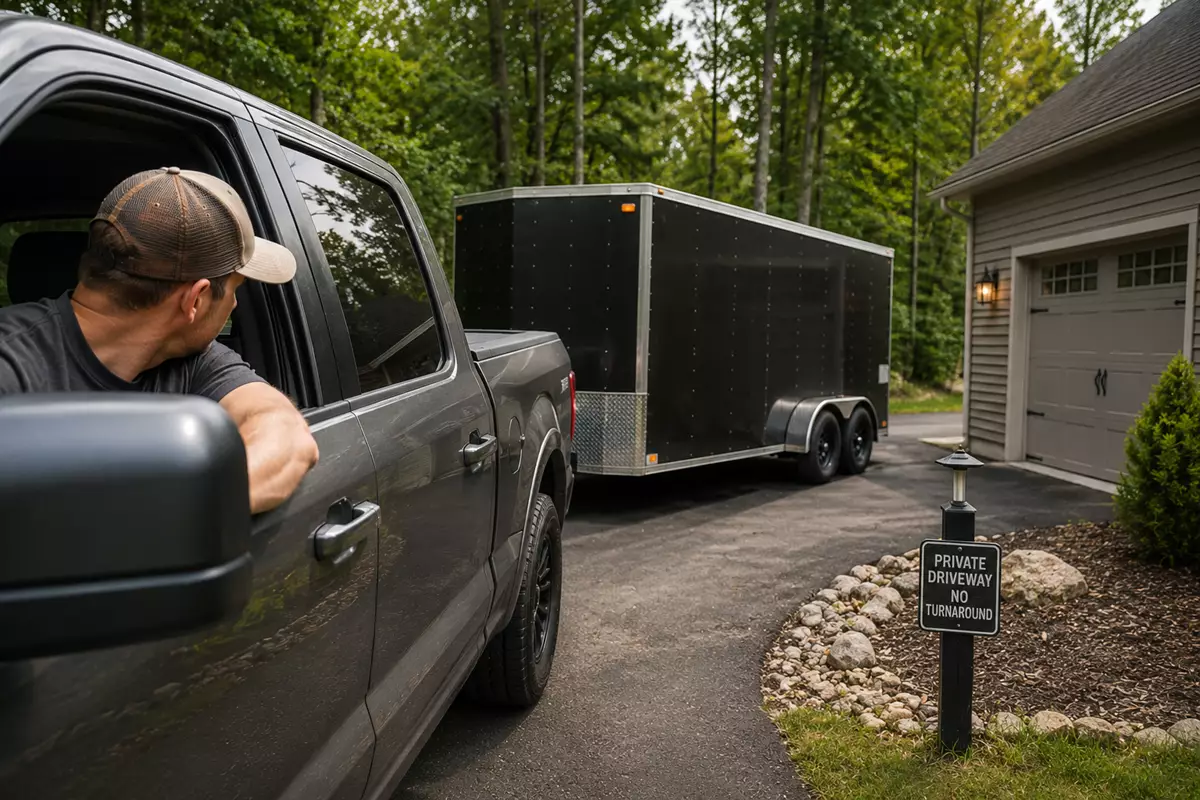
Backing up a trailer is the single skill that intimidates first-time renters more than any other part of towing. The forward driving is easy enough. Once the trailer is hitched, the truck pulls it along just like any heavy load. The hookup itself is a quick walk-through that most people learn in five minutes. But the moment a renter has to back the trailer into a campsite or a parking spot, the steering wheel suddenly feels like it is connected to the wrong wheels. The trailer moves the opposite direction of what feels natural, the angles compound on themselves, and the renter who was confident on the highway is now sweating in the rearview. This guide walks through exactly how to back up a trailer the way experienced drivers do it, the single trick that makes the counterintuitive part feel obvious, and the rules that keep a first-time backup from becoming a body-damage claim. Not sure which trailer type or size fits your project? The What Trailer Do I Need? calculator walks through the decision in about a minute.
Why Backing Up a Trailer Feels Wrong at First
The reason backing up feels counterintuitive is simple physics. When you drive forward, the truck pulls the trailer, so the trailer follows the truck. Turn the steering wheel left and the trailer eventually swings left behind you. Easy.
In reverse, the relationship inverts. The truck is now pushing the trailer rather than pulling it, and a trailer being pushed pivots around its own axle, not the truck's hitch. When you turn the steering wheel to the left while reversing, the back of the truck swings left, which shoves the trailer's tongue left, which makes the back of the trailer swing right. The trailer moves opposite to your steering input. Most first-time renters spend the first sixty seconds making the trailer go the wrong way, then over-correcting in the opposite direction, then over-correcting back, until the trailer is jack-knifed at an awkward angle and they have to pull forward and start over. There is nothing wrong with your reflexes; the geometry is just genuinely backwards from what feels right.
The Hand-on-the-Bottom-of-the-Wheel Trick
Every experienced trailer driver eventually learns the same trick to deal with the inverted geometry. It is the single most useful piece of advice for new backup drivers, and it makes the rest of this guide feel obvious once you start using it.
Put One Hand at the Bottom of the Wheel
Before you start backing, place one hand at the six o'clock position on the steering wheel. The bottom of the wheel. Either hand works, but most drivers find that whichever hand they normally use for steering corrections is most comfortable.
Move Your Hand the Direction You Want the Trailer to Go
Now the rule becomes simple. If you want the back of the trailer to go left, move your hand left. If you want the trailer to go right, move your hand right. Because your hand is at the bottom of the wheel, moving it left actually turns the wheel right (the top of the wheel rotates the other way), which is exactly the steering input you need for the trailer to go left. The trick is just a mental hack that re-maps your intuition from "where do I want the truck to go" to "where do I want the trailer to go." The hand at the bottom is the trailer.
This sounds almost too simple, and people tend to be skeptical until they try it. In practice, the first time you back up using this method, the trailer goes exactly where you point it. The counterintuitive part disappears almost completely. It is the difference between hours of struggle and the kind of confidence that lets a first-time renter back into a tight campsite on the first try.
The One Rule That Makes Backing Up Click
Hand at 6 o'clock, move LEFT
Trailer goes LEFT
Hand at 6 o'clock, move RIGHT
Trailer goes RIGHT
The hand at the bottom of the wheel is the trailer.
Set Yourself Up to Succeed Before You Touch the Wheel
The best backup is the one that requires the least skill, and most of the setup work happens before you put the truck in reverse.
Walk the Path First
Before you start backing, get out of the truck and walk the full path the trailer needs to take. Look for low obstacles you cannot see from the driver's seat: tree stumps, fire pit edges, electrical hookups at campsites, low fences, parked vehicles you forgot were there. A two-minute walk catches almost every obstacle that would otherwise become a damage claim. This step alone separates the renters who finish with a clean trailer from the ones who do not.
Adjust Both Side Mirrors All the Way Out
For backing up, you want both side mirrors angled wider than your normal driving position, so you can see the entire side of the trailer all the way to the back wheels. The rearview mirror inside the cab is almost useless for trailer backing because the trailer blocks most of the view. Side mirrors do all the work. If your truck has towing mirrors that extend outward, use them in the extended position.
Use a Spotter If You Have One
A second person standing outside the vehicle, visible in one of the side mirrors, is the most reliable backup aid there is. Agree on hand signals before you start: a fist for stop, a palm for slow down, a wave in the direction the trailer needs to move. The spotter's only job is to watch the trailer's back corners and warn the driver before they hit anything. A good spotter prevents almost every avoidable backing incident.
Confirm the Hookup Before You Start
If you are backing a trailer you just hooked up, take one more look at the coupler latch and safety chains before you put it in reverse. A trailer that disconnects during a backup gets damaged in ways that hitched trailers do not. Our guide on how to hook up a trailer covers the latch verification that catches the few percent of hookups that look right but are not.
The Five Rules of Trailer Backing
Once you are set up and using the hand-on-bottom trick, five rules cover everything else. Memorize them, and the rest is just practice.
Small Inputs, Then Wait to See the Effect
The single biggest first-timer mistake is over-steering. New drivers turn the wheel too much, the trailer starts going wrong, they over-correct, the trailer goes wrong the other way, and they lose control entirely. The fix is to make small steering adjustments and then wait two or three seconds for the trailer to actually respond. Trailers have lag. A small input now becomes a noticeable movement two seconds later. If you keep turning the wheel while waiting for the trailer to respond, you have already over-corrected by the time it does.
Drive Slowly
Every problem in trailer backing gets worse with speed. The lag becomes harder to manage, the angles compound faster, and you run out of room to recover before you hit something. Idle speed is plenty. There is no prize for backing in quickly, and there is a real cost to backing in fast and missing.
Use Mirrors, Not the Rearview
The trailer blocks your view through the back of the cab. Trust the side mirrors. Look at the bottom of the trailer in each side mirror and use the gap between the trailer and the obstacles you walked earlier as your guide. The mirror on the side the trailer is swinging toward is the one to watch most carefully; that is where contact will happen first.
Pull Forward to Reset
When the trailer gets at an awkward angle and you cannot figure out which way to steer to recover, do not keep trying to fix it in reverse. Stop, pull forward six or eight feet to straighten the truck and trailer back into a line, and start the backup again. Pulling forward to reset is not failure. It is what experienced drivers do too. The only failure is continuing to back up in a bad situation until something gets damaged.
Stop and Walk When in Doubt
If you lose your sense of where the trailer corners are or how much space you have left, stop, put the truck in park, get out, and walk around. Look at the trailer from outside, reassess the path, and get back in with a clearer picture. The thirty seconds it takes is a small price compared to what an unseen obstacle costs.
Common Scenarios and How to Approach Them
Most real-world trailer backing falls into a handful of recognizable scenarios. Knowing what to expect makes each one easier.
| Scenario | Difficulty | Key Technique |
|---|---|---|
| Empty parking lot, straight back | Easy | Small steering corrections to stay straight; use lane lines as a reference |
| Straight back into a driveway | Easy | Walk the path first; pull forward at any odd angle to reset |
| Back into a parking spot at an angle | Medium | Start with the truck angled toward the spot, then back along the angle |
| Campsite or marked back-in spot | Medium | A spotter helps enormously; watch for fire pits and hookup posts |
| Loading dock or tight commercial space | Hard | Expect to pull forward and reset several times; do not rush |
| Backing around a corner | Hardest | Avoid this if possible by finding a different approach; otherwise, very slow |
Practice Before You Need It
The single most underrated piece of advice for new trailer drivers is to practice somewhere with no consequences before practicing somewhere with real consequences. After you pick up your rental, find an empty parking lot near the pickup location. Spend ten or fifteen minutes practicing the hand-on-bottom trick in a wide-open space. Try backing in straight lines, then try gentle curves. Set up traffic cones or use parking lines as makeshift targets, and practice backing into them as if they were a campsite or a driveway.
Ten minutes of intentional practice in a parking lot teaches more than two hours of struggling on a real backup in a tight space. The muscle memory you build in low-stakes practice carries directly over to the real scenario, and you arrive at the campsite confident instead of nervous.
When You Should Not Back Up
Sometimes the best trailer backup is the one you avoid entirely. A few situations are worth identifying so you can plan around them.
Pull-Through Options Are Available
Many campsites, parking lots, and loading areas have both back-in and pull-through spots. Pull-through is always easier with a trailer because you never have to reverse with the trailer attached. If you have a choice, pick pull-through even if it costs a few dollars more or means a slightly longer walk. The time and stress savings are real.
Steep Hills or Inclines
Backing a trailer downhill is significantly harder than backing on flat ground. The grade adds momentum to the rear of the trailer, the brakes feel different, and any error compounds faster. If you can find a flat approach, take it.
Tight Spaces with Multiple Obstacles
If the backup path requires threading the trailer between obstacles on both sides with only a foot or two of clearance, find another option if you can. Take a longer route, find a different spot, or ask the owner for a different drop point. The risk of damage in a very tight backup is high enough that avoidance is usually the right call.
What to Do If Something Starts to Go Wrong
Even with the right technique, the occasional backup starts to go sideways. Knowing how to recover prevents the small problem from becoming a damage incident.
If the trailer starts to jackknife (the trailer angle relative to the truck gets sharper and sharper), stop. Do not try to steer your way out of a jackknife in reverse. The geometry only gets worse. Put the truck in drive, pull forward until the trailer and truck are back in a roughly straight line, and start the backup over with a different approach.
If you hear or feel anything unusual (a scrape, a thump, a sudden resistance), stop immediately and get out to look. Most backup damage gets worse if you keep backing after the first contact. Stopping early often turns a damage claim into a story about a close call. For the broader set of safety practices that apply to towing in general, our ultimate towing safety guide covers braking, hill technique, and emergency responses in more detail.
The Bottom Line
Trailer backing intimidates first-timers more than any other part of renting. The good news is that the intimidation is almost entirely psychological. Once you put your hand at the bottom of the wheel and start thinking of that hand as the trailer, the counterintuitive geometry becomes intuitive within minutes. Combine the trick with the five rules (small inputs, slow speed, mirrors, pull forward to reset, stop and walk when in doubt), and you have everything you need to back into any reasonable space on the first or second try. Ten minutes of practice in an empty parking lot before your first real backup is the difference between a stressful first trip and a confident one.
Ready to put it into practice? Browse trailers on Neighbors Trailer and look for pull-through-friendly spots at your destination if you want an easier first trip. If you are going somewhere that requires backing in, find an empty parking lot near pickup and give yourself ten minutes of muscle-memory practice before the real thing. That small investment pays off the first time you successfully back into a tight campsite on the first try.