How Summer Heat Changes Trailer Towing
 Neighbors Trailer
Jul 10, 2026 286 14 min read
Every summer, roadside assistance calls involving trailers spike sharply between mid-July and late August. The cause is not usually the trailers themselves. It is heat. Ambient temperatures in the 90s and above change almost every aspect of towing, from the pressure inside your tires to the effective braking distance on a long downhill grade. First-time renters often plan a summer trip the same way they would plan a spring or fall one, and discover somewhere along the highway that the rules have quietly shifted. Experienced haulers know to adjust in advance. This guide walks through what actually changes when temperatures climb, why each shift matters, and the specific pre-trip checks and driving habits that keep a hot-weather trip uneventful.
Why Summer Towing Is Different
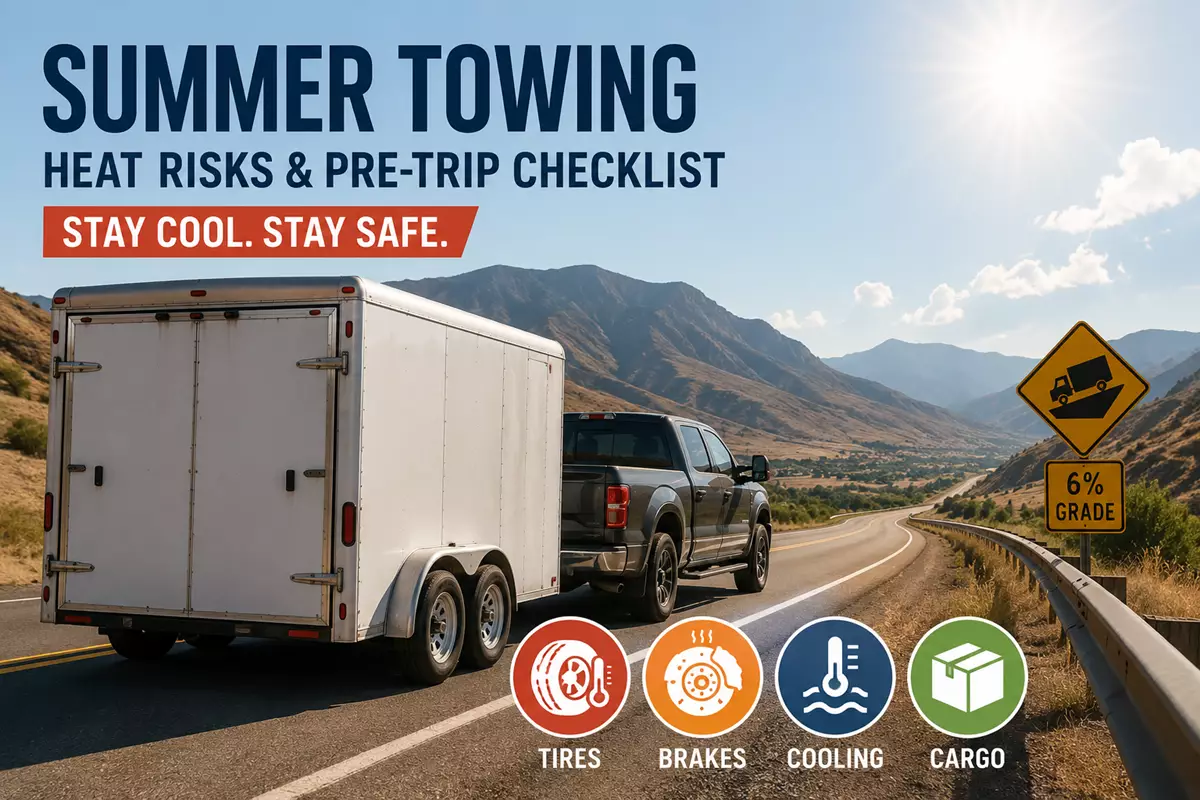
Four systems on a tow vehicle and trailer respond dramatically to heat: tires, brakes, engine cooling, and cargo. Each has a slightly different failure threshold, and each becomes more likely to fail when ambient temperatures climb into the 90s and beyond. The important thing to understand is that these are not independent risks. They compound. A hot day that pushes tire pressure higher also stresses the brakes harder because the same cooling airflow that would normally shed heat is now moving hotter air. The same road grade that would normally test a tow vehicle's cooling system now tests it against a higher baseline temperature. What is a manageable risk at 70 degrees becomes a real problem at 100.
The good news is that all four systems can be managed with a small set of adjustments. Some are pre-trip checks. Some are driving habits. All of them are easy once you know what to look for.
Tires: The Biggest Heat Risk
Tires are the single most common cause of heat-related trailer failures. The reason is simple: heat directly increases the pressure of the air inside the tire, and trailer tires are typically inflated close to their maximum sidewall rating already. Small pressure increases can push them over the safe limit.
Pressure Rises With Temperature
The rule of thumb is that tire pressure increases by roughly one PSI for every 10 degrees Fahrenheit of temperature rise. A tire that was inflated to 65 PSI in a cool morning garage will read closer to 70 PSI by mid-afternoon on a hot highway. Add the additional heat generated by the tire itself as it flexes at 65 miles per hour, and the internal pressure can climb another 5 to 10 PSI. A tire that started the day at its max sidewall rating can easily be significantly over that rating by afternoon.
The Blowout Threshold
Overinflation causes the tire to run at reduced contact area, which concentrates the load on the center of the tread, generates additional heat through flexing, and eventually leads to a sudden sidewall failure. Underinflation is the more famous cause of blowouts, but summer overinflation is nearly as common and easier to overlook because most renters assume more pressure is safer. It is not. Sidewall maximums exist for a reason, and running above them for hours at a time is the single most common cause of trailer tire blowouts in July and August.
The Cold Pressure Rule in Summer
Always inflate trailer tires cold, first thing in the morning before any sun exposure, before any driving. Set the pressure to the sidewall maximum stamped on the tire, not above. Do not top up a tire that is already warm from driving; the reading will be artificially high, and the tire will be underinflated when it cools. Our trailer tire pressure guide covers the cold-versus-hot pressure distinction and the DOT age code reading that also matters more in heat. If you're near the trailer's payload limit and want to verify the tires are rated for the load, the Tire Load calculator works out the required rating per tire from your loaded weight and axle count.
Watch for Sidewall Cracks Before You Leave
Heat accelerates the aging of rubber. Tires with existing small sidewall cracks or dry rot may look serviceable in cooler weather but fail rapidly in heat. Before any summer trip, walk around each tire and look for spider-web patterns in the sidewall, small radial cracks near the tread edge, or any visible degradation. Age also matters: a tire older than five to seven years old is more likely to fail in heat regardless of tread depth. Ask the host about tire age at pickup; the DOT code on the sidewall tells you the manufacturing week and year.
Brake Fade on Long Downhills
The second failure mode that heat unlocks is brake fade. Trailer brakes and tow vehicle brakes both generate heat when used, and heat degrades their effectiveness. In summer conditions, this can produce a scary situation on any long downhill grade.
Why Brake Fade Happens
Every time you press the brake pedal, the friction between the brake pads and the rotor converts kinetic energy into heat. On a short stop, the heat dissipates quickly through airflow. On a long downhill where the brakes are engaged continuously for miles, the heat accumulates faster than it can dissipate. The rotors get hot, the pads get hot, and eventually the brake fluid itself begins to overheat. Hot brake fluid produces a spongy pedal, longer stopping distances, and in extreme cases, near-total loss of braking effect. This is brake fade.
Add summer ambient heat to this cycle and the problem gets worse. Cooling airflow is hotter to begin with, brake components start each descent already warm, and the margin between working brakes and faded brakes shrinks. To get a sense of how much longer a fully loaded trailer takes to stop at highway speeds, our Stopping Distance calculator factors in tow vehicle weight, trailer weight, brake type, and speed to return an estimated distance in feet.
The Warning Signs
Fade rarely happens all at once. Warning signs include a brake pedal that feels softer than usual, a burning smell (like hot metal or scorched fabric), longer stopping distances than expected, and in extreme cases, smoke visible around the wheels. If any of these appear on a long downhill, pull over at the next safe spot and let the brakes cool for at least 20 minutes before continuing.
How to Prevent Fade
The most effective preventive measure is downshifting into a lower gear on long downhills so that engine braking (or transmission drag) does the primary slowing. This lets the brakes work in short pulses to control speed rather than continuously to hold speed. The gear you want is roughly the same one you would use to climb the grade in the opposite direction. Do not ride the brakes down the hill; use them in firm, brief applications to keep speed within a safe range, then let them cool between applications.
For trailers with electric brakes, verify the brake controller is set to the correct gain at pickup. An undergained controller does not do its share of the work, forcing the tow vehicle's brakes to absorb the full load; an overgained controller can cause the trailer wheels to lock up during hard braking.
Engine Cooling Under Summer Load
The tow vehicle's cooling system works harder in summer for two reasons: the ambient air used for cooling is itself hotter, and the trailer adds significant load to the engine. On a hot day on a long grade with a fully loaded trailer, the cooling system operates near its maximum capacity for extended periods.
Watch the Temperature Gauge on Climbs
The single most important habit for summer towing is to watch the tow vehicle's temperature gauge, especially on long uphill grades. A gauge that starts creeping toward the red is a warning that needs immediate attention. Slow down (higher speed means more airflow but also more heat generation, and above about 55 mph the balance shifts against you), turn the air conditioning off (which reduces the cooling system's parasitic load), and if needed, pull over and let the engine idle in park for a few minutes to catch up. Continuing to climb with an overheating engine is how head gaskets fail.
Transmission Fluid Deserves Special Attention
Automatic transmissions generate significant heat under towing loads, and transmission fluid degrades much faster in heat than engine oil does. Many tow vehicles have a separate transmission temperature gauge. If yours does, watch it as closely as the engine gauge. Transmission fluid above about 240 degrees Fahrenheit begins to break down; sustained temperatures at that level shorten transmission life dramatically.
Reduce Load Before You Go
The simplest way to reduce cooling-system stress is to reduce the load. If your trip is near the limit of what your tow vehicle can handle, summer is not the time to test that limit. Rent a lighter trailer, split the trip, or consider whether the tow vehicle is actually the right one for the job. Cooling systems have less margin in heat, and a tow that is comfortable in October may be dangerous in July.
Asphalt Softens Under Heavy Static Load
Something that rarely comes up in cooler weather but genuinely matters in extreme heat: asphalt softens at high temperatures. At ambient temperatures above about 95 degrees, the surface of an asphalt driveway or parking lot can become soft enough that concentrated static loads sink into it. This has practical consequences for trailer owners and renters.
The Static Load Problem
A trailer jack, especially a tongue jack with a small foot, concentrates hundreds of pounds of weight on a few square inches of surface. On cool asphalt, this is fine. On hot asphalt, the jack foot can slowly sink into the surface over hours or days, leaving a permanent indentation. A trailer parked on soft asphalt with a fully loaded cargo compartment can leave four tire-shaped depressions. Jack stands used to level a trailer for loading can push through the top layer of asphalt entirely.
Use a Jack Pad or Move to Concrete
The simple fix is to place a wooden block, a jack pad, or any wide surface under any jack foot on hot pavement. This spreads the load across a larger area and prevents the sink-in effect. For extended parking in extreme heat, concrete is dramatically better than asphalt for this reason. If you are picking up or dropping off a trailer at a host's driveway on a hot day, use a jack pad as a matter of habit.
Cargo That Cannot Handle Enclosed Trailer Heat
The interior of an enclosed trailer parked in the sun can reach temperatures 30 to 50 degrees hotter than the ambient outside temperature. On a 95-degree day, the interior can easily exceed 140 degrees. This has implications for what can safely be hauled.
Heat-Sensitive Cargo to Avoid
Aerosol cans (spray paint, propellants) can rupture at high internal temperatures. Lithium-ion batteries (power tools, e-bikes, electronics) become unstable and can catch fire well below their normal thermal limits when preheated by cabin temperatures. Medications, especially insulin and biologics, are typically ruined by exposure above 86 degrees for extended periods. Food items (grocery hauls, catering trips) spoil quickly. Musical instruments (guitars, wood instruments) can warp or crack. Paint, adhesives, and some chemicals can degrade or become dangerous.
If you are hauling anything heat-sensitive in summer, either use an open-deck trailer (which stays close to ambient temperature) or plan for cabin temperatures well above what you might expect. Cold packs help only briefly against sustained heat inside an enclosed trailer.
Living Cargo Is a Hard No
Never haul living animals in an enclosed trailer in summer heat. The interior temperatures reach lethal levels within minutes on a hot day, even with ventilation. Pets, livestock, and any living cargo need dedicated trailers with active ventilation or air conditioning, or need to travel in the tow vehicle's cabin. This is a safety issue with no acceptable workaround.
The Driver Factor
Heat affects the driver, and the driver's condition affects the safety of the whole trip. Two habits change what a hot-weather tow feels like.
Fatigue Accelerates in Heat
Concentration and reaction time both degrade faster in hot conditions, especially if the tow vehicle's air conditioning is being cycled off to reduce cooling-system load. Plan more frequent breaks than you would in cooler weather. A 15-minute stop with air conditioning on and a cold drink resets fatigue meaningfully. Skipping breaks to save time is the worst-case tradeoff, because a fatigued driver in heavy traffic with a loaded trailer is exactly the combination that produces accidents.
Hydration Matters More Than It Feels Like
Dehydration reduces reaction time and situational awareness before you notice it. Drink water consistently throughout the trip, not just when you feel thirsty. Avoid the temptation to caffeinate through a hot-weather tow; caffeine accelerates dehydration and produces alertness that fades faster than it feels like it should.
Time the Trip Around Peak Heat
If flexibility exists, plan to drive during the cooler hours: early morning (5 to 9 AM) or evening (after 6 PM). Midday driving between noon and 4 PM in summer combines every heat risk covered above at peak intensity. A trip that would be routine at 8 AM can be genuinely challenging at 2 PM. Adjusting the schedule is usually easier than adjusting the vehicle.
The Pre-Trip Summer Heat Check
Before any summer trip, add four items to the standard pre-trip checklist. Each takes under a minute and can prevent the failures covered above.
| System | What to Check | Heat-Specific Failure |
|---|---|---|
| Tire pressure and age | Cold pressure at sidewall max; sidewall for cracks; DOT date under 7 years | Blowout from overinflation or heat-accelerated aging |
| Coolant level and condition | Reservoir at full mark; coolant clear, not rusty or oily | Engine overheating on grades; cooling system failure |
| Transmission fluid | Level correct with engine warm and running; fluid pink or red, not brown | Transmission overheating; premature transmission failure |
| Belts and hoses | No visible cracks, fraying, bulges, or soft spots | Belt failure disables water pump; hose burst dumps coolant |
| Battery terminals | Clean, tight, no corrosion; battery under 5 years old ideally | Heat kills weak batteries; roadside failure on hot day |
| Brake controller gain | Set to appropriate level for trailer weight; test at low speed | Undergained controller forces tow vehicle brakes to fade first |
| Trailer brake components | Ask host about last brake service; test with manual override before highway | Fade compounds on hot downhills |
| Emergency water for the driver | At least two liters accessible in the cab | Dehydration accelerates fatigue during roadside issues |
What to Do If Something Goes Wrong
Even with careful preparation, summer conditions occasionally produce roadside situations. The right response depends on which system is signaling.
If a tire blows out, do not slam the brakes. Grip the steering wheel firmly, ease off the accelerator gradually, and coast to a safe shoulder. Sudden braking with a blown trailer tire can induce sway that becomes uncontrollable. Once stopped, do not attempt a tire change on a busy highway shoulder unless you are safely behind a barrier; call for roadside assistance.
If the engine temperature climbs into the red zone, pull over immediately, put the transmission in park, turn the air conditioning off, turn the heat on high (which pulls heat out of the engine and into the cabin), and let the engine idle. Do not turn the engine off immediately in the red zone; idling with the fan running is often the fastest way to cool it down. Once the gauge drops, either continue at reduced speed or wait for the engine to fully cool before attempting to add coolant.
Our ultimate towing safety guide covers the broader set of emergency responses that apply year-round, most of which become more likely to be needed in summer conditions.
The Bottom Line
Summer towing is not fundamentally different from towing at any other time of year, but the margin between comfortable and dangerous is smaller. Tires that would be fine at 70 degrees can blow out at 100. Brakes that would work at moderate temperatures can fade on long descents. Engine cooling systems that have plenty of margin in October have almost none in July. The renters who tow safely in summer are not doing anything dramatic; they are just paying more attention to the specific systems that heat stresses, checking them more carefully before the trip, and driving more conservatively when the thermometer climbs.
Ready to tow safely through peak season? Browse trailers on Neighbors Trailer, pick one appropriately sized for your load and your tow vehicle's capacity, and plan the trip during cooler hours if you can. The small adjustments covered above turn a challenging hot-weather tow into a routine one.