

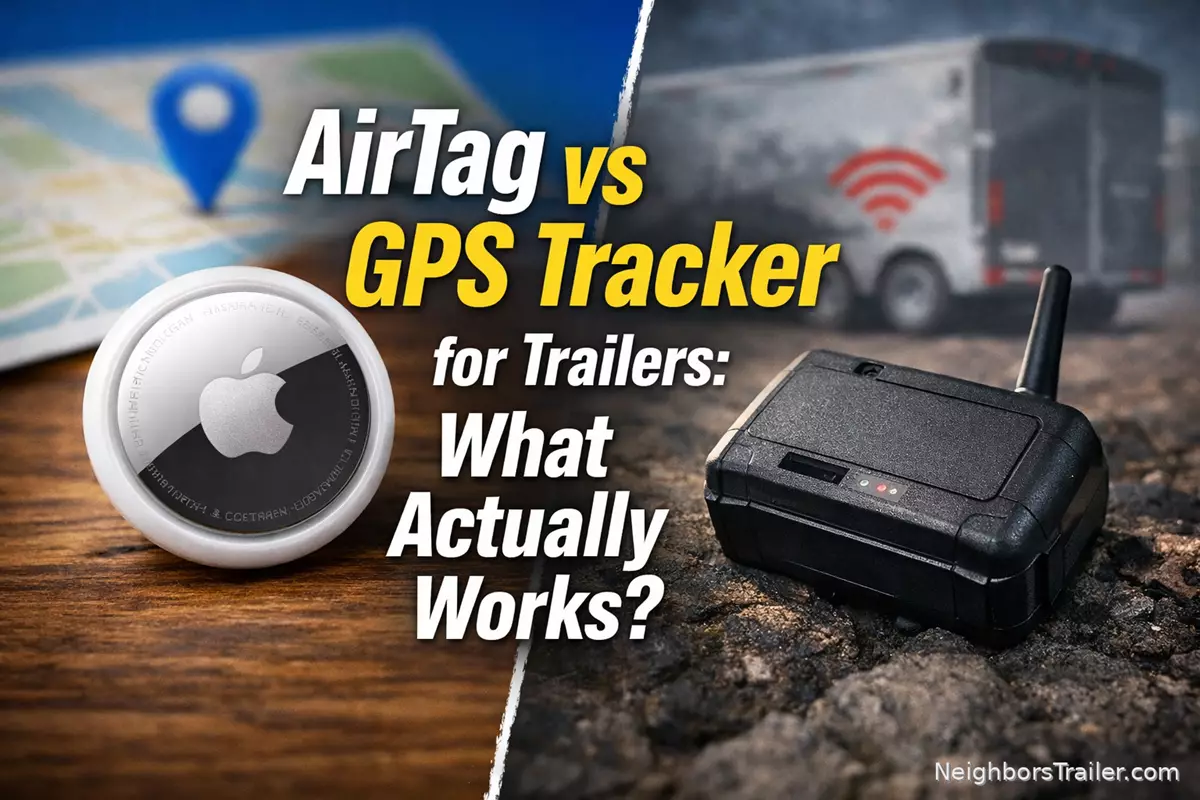
AirTag vs GPS Tracker for Trailers: What Actually Works?
 Neighbors Trailer
Apr 3, 2026 634 11 min read AirTag vs GPS tracker, trailer GPS tracker, trailer theft prevention, track sto
If your goal is theft prevention and recovery, a GPS tracker is significantly more reliable than an AirTag for protecting your trailer. AirTags rely on nearby Apple devices to update their location, while GPS trackers use satellites and cellular networks to provide real-time tracking anywhere, whether your trailer is parked in a busy neighborhood or sitting on a rural property miles from the nearest iPhone. With over 100,000 utility trailers stolen each year in the United States and recovery rates for untracked trailers often falling into the single-digit range, picking the right tracking technology is not just a nice-to-have. It is a decision that could mean the difference between getting your trailer back and losing it for good.
How Each Technology Actually Works
Before comparing results, it helps to understand what is happening under the hood. These two devices solve the same problem in fundamentally different ways, and those differences matter the moment your trailer leaves your property without permission.
How AirTags Track Location
An AirTag is a Bluetooth-based device that piggybacks on Apple's "Find My" network. It does not have its own GPS chip or cellular connection. Instead, it sends out a Bluetooth signal that nearby iPhones and iPads detect passively. Those Apple devices then relay the AirTag's location back to you through iCloud. The key word here is "nearby." If there are no Apple devices within Bluetooth range (roughly 30 to 50 feet), the AirTag simply cannot update its position. It sits silently, waiting to be discovered.
How GPS Trackers Work
A GPS tracker operates independently. It connects directly to satellites overhead to determine its exact coordinates, then transmits that data to you through a built-in cellular modem, the same type of network your phone uses. This means a GPS tracker works in open fields, on highways, in storage yards, and anywhere else that has even minimal cell service. It does not need another person's device to function. It reports continuously, on its own, whether someone is nearby or not.
The simplest way to think about it: an AirTag waits to be discovered. A GPS tracker reports continuously.
Range and Coverage: Where the Gap Gets Real
This is where the practical difference between these two technologies becomes impossible to ignore, especially for trailer owners.
An AirTag performs well in dense urban environments where iPhones are everywhere. Walking through downtown Dallas or a crowded shopping center, an AirTag updates quickly and accurately because there are hundreds of Apple devices within range at any given moment. But trailers are not typically kept in city centers. They sit in driveways, storage lots, rural properties, and job sites where foot traffic is minimal and iPhone density is low.
A GPS tracker does not care about foot traffic. It works anywhere with cellular signal coverage, which in the United States covers roughly 99% of the population. Updates arrive in real time, whether your trailer is parked at a construction site in rural Oklahoma or moving down I-35 at highway speed. If your trailer leaves a populated area, an AirTag can effectively "go dark," sometimes for hours. A GPS tracker keeps reporting every 15 to 60 seconds regardless.
Theft Scenarios: AirTag vs GPS in the Real World
Numbers and specs only tell part of the story. What really matters is how each device performs when someone hooks up to your trailer at 2 AM and drives off. Let us walk through the scenarios that trailer owners actually face.
Scenario: Trailer Stolen Overnight from Your Driveway
With an AirTag, the device may not update for hours, especially in a suburban or rural neighborhood where few people are walking around with iPhones after midnight. You might wake up to a location ping from six hours ago that shows your trailer was last seen near your street, but nothing since. With a GPS tracker, you receive an instant movement alert on your phone the moment the trailer starts rolling. You can watch the live tracking path as it moves and relay precise coordinates to law enforcement in real time.
Scenario: Trailer Moved Across State Lines
With an AirTag, you get delayed, inconsistent pings as the trailer passes through areas with varying iPhone density. Long stretches of highway through rural counties may produce zero updates for 30 minutes or more. By the time a ping comes in, the trailer has already moved far from that location. With a GPS tracker, you see a continuous breadcrumb trail on a live map, updated every minute or less. Police can set up an intercept based on current, real-time position data instead of chasing a stale location.
Scenario: Trailer Parked at a Remote Chop Site
This is the worst case, and it is more common than most owners think. A thief moves your trailer to a secluded property, a rural barn, or an industrial lot with no foot traffic. An AirTag becomes completely blind here because there are zero Apple devices to relay its signal. It could sit there for days without a single update. A GPS tracker continues reporting its exact location regardless, giving law enforcement a pinpoint address to investigate.
The Anti-Stalking Problem Thieves Exploit
Apple built anti-stalking features into AirTags to prevent people from being tracked without their knowledge. That is a good thing for personal safety, but it creates a serious vulnerability for theft prevention. If an unknown AirTag is traveling with someone, Apple's system sends an alert to their iPhone, sometimes as quickly as 30 minutes after the tag separates from its owner. On Android devices, periodic detection scans can also flag unknown AirTags nearby.
For trailer theft, this means the person who just stole your trailer can receive a notification on their phone telling them an AirTag is traveling with them. From there, finding and removing a small, battery-powered disc takes seconds. They twist out the CR2032 battery, and your tracking goes permanently silent with no notification sent back to you. GPS trackers designed for vehicles and trailers are built to stay hidden. They do not broadcast their presence to nearby phones. Many are hardwired or magnetically mounted in concealed locations, making them far harder to detect and remove.
Trailer Recovery Rates: The Numbers That Matter
The data on trailer theft recovery tells a clear story, and it strongly favors active GPS tracking over passive Bluetooth solutions. The chart below shows estimated recovery rates based on the type of tracking technology in use.
Stolen Trailer Recovery Rates by Tracking Method 80% 60% 40% 20% 0% 7% No Tracking ~18% AirTag Only ~55% GPS Tracker ~75% GPS + Locks Sources: NICB, NER, and industry recovery data. AirTag estimate based on urban/suburban scenarios.
The takeaway is stark. Trailers with no tracking device are recovered less than 7% of the time. Adding an AirTag improves your odds slightly in urban settings, but still leaves you relying on chance. A dedicated GPS tracker pushes recovery rates dramatically higher because it gives law enforcement something they can actually work with: a live, real-time location. Combine that with physical deterrents like coupler locks and wheel locks, and your odds of getting your trailer back climb above 75%.
Recovery Rate Data
The following chart illustrates estimated trailer recovery rates based on tracking method, compiled from law enforcement reports and insurance industry data.
NeighborsTrailer.com
Side-by-Side Comparison: AirTag vs GPS Tracker for Trailers
| Feature | Apple AirTag | GPS Tracker |
| Tracking method | Bluetooth (Apple Find My) | GPS + cellular network |
| Real-time tracking | No, depends on nearby iPhones | Yes, updates every 15-60 sec |
| Rural/remote performance | Poor, may go dark for hours | Strong anywhere with cell signal |
| Movement alerts | No instant theft alert | Yes, geofence + motion alerts |
| Anti-stalking alert to thief | Yes, alerts nearby phones | No, hidden and silent |
| Upfront cost | $29 | $15 to $100 |
| Monthly subscription | None | $7 to $20 per month |
| Battery life | About 1 year (CR2032) | Weeks to 5+ years by model |
| Best use case | Keys, bags, secondary backup | Trailers, vehicles, equipment |
When an AirTag Might Still Be Useful
Being honest here: AirTags are not useless. They are just not the right primary solution for trailer security. An AirTag can work well as a secondary, low-cost backup tucked inside a storage compartment or toolbox on your trailer. In dense urban areas with heavy foot traffic, it may provide occasional location updates that supplement your GPS data. And at $29 with no subscription, the barrier to entry is as low as it gets.
The key distinction is this: an AirTag is a convenient locator for everyday items like keys, wallets, and luggage. It was never designed to be an anti-theft device for high-value assets that move on highways and get parked in remote locations. Using it as your only line of defense for a trailer worth thousands of dollars is a gamble that the data does not support.
The Best Security Setup for Trailer Owners
The most effective approach to trailer safety layers multiple deterrents together. No single product stops every thief, but combining physical and digital security makes your trailer a much harder target.
Physical Deterrents
Start with a quality coupler lock that prevents anyone from hooking your trailer to their vehicle. Add a wheel lock or boot for extra visibility. These do not stop a determined thief with an angle grinder, but they slow the process down and make your trailer less attractive compared to an unlocked one down the street. A simple hitch pin lock is another inexpensive layer that takes five seconds to install and can prevent opportunistic theft.
Digital Tracking
Install a GPS tracker in a concealed location on your trailer. Hardwired models that tap into the trailer's electrical system offer unlimited battery life. For trailers without a power source, battery-operated GPS units with multi-year battery life are available from companies like Trak-4, LandAirSea, and Lonestar Tracking, with monthly plans starting around $7 to $10. Configure geofence alerts so you receive a notification the instant your trailer moves outside a defined zone. Some newer options also offer multi-year battery life with no monthly subscription, which can be a strong fit for trailer owners who want long-term tracking without ongoing fees. See our GPS trailer guide for trailer owners → GPS tracker guide for trailer owners.
Optional: AirTag as a Backup
Some owners choose to add an AirTag as a secondary backup alongside their GPS tracker. Hide it in a different location than your GPS unit. If a thief somehow finds and removes the GPS device, the AirTag may still provide intermittent location data, especially if the trailer ends up in a populated area. At $29, it is cheap insurance on top of your primary system.
Protecting Your Investment Beyond Hardware
Tracking technology is one piece of the puzzle, but protecting your trailer also means having the right coverage in place. If you rent your trailer out through a peer-to-peer platform like Neighbors Trailer, rental insurance adds another layer of financial protection. NT Protect coverage, available for just a few dollars per day during active rentals, helps cover damage and incidents that happen while someone else is using your trailer. Between smart hardware, physical locks, and proper rental coverage, you give yourself the best possible chance of keeping your trailer safe and recovering it quickly if the worst happens.
What to Do If Your Trailer Gets Stolen
Even with the best precautions, theft can still happen. If it does, your response in the first 30 minutes matters more than anything else. Call law enforcement immediately and provide them with your GPS tracker's live location data. Do not attempt to recover the trailer yourself. Give police the real-time coordinates, the direction of travel, and any identifying information about the trailer including its VIN, registration, and photos. If you have a GPS tracker with movement history, share the full route log so investigators can see where the trailer has been and where it is headed. This level of detail is exactly what separates a successful recovery from a cold case.
The Bottom Line
AirTags are clever, affordable, and genuinely useful for tracking everyday items. But for a trailer sitting in your driveway, parked at a job site, or listed on a rental platform, they are not built for the job. GPS trackers cost more upfront and carry a small monthly fee, but they deliver the one thing that actually matters when your trailer disappears: real-time location data that works everywhere, does not alert the thief, and gives law enforcement a live trail to follow. In a theft situation, minutes matter, and only GPS gives you live tracking. Protect your trailer the way it deserves to be protected.