

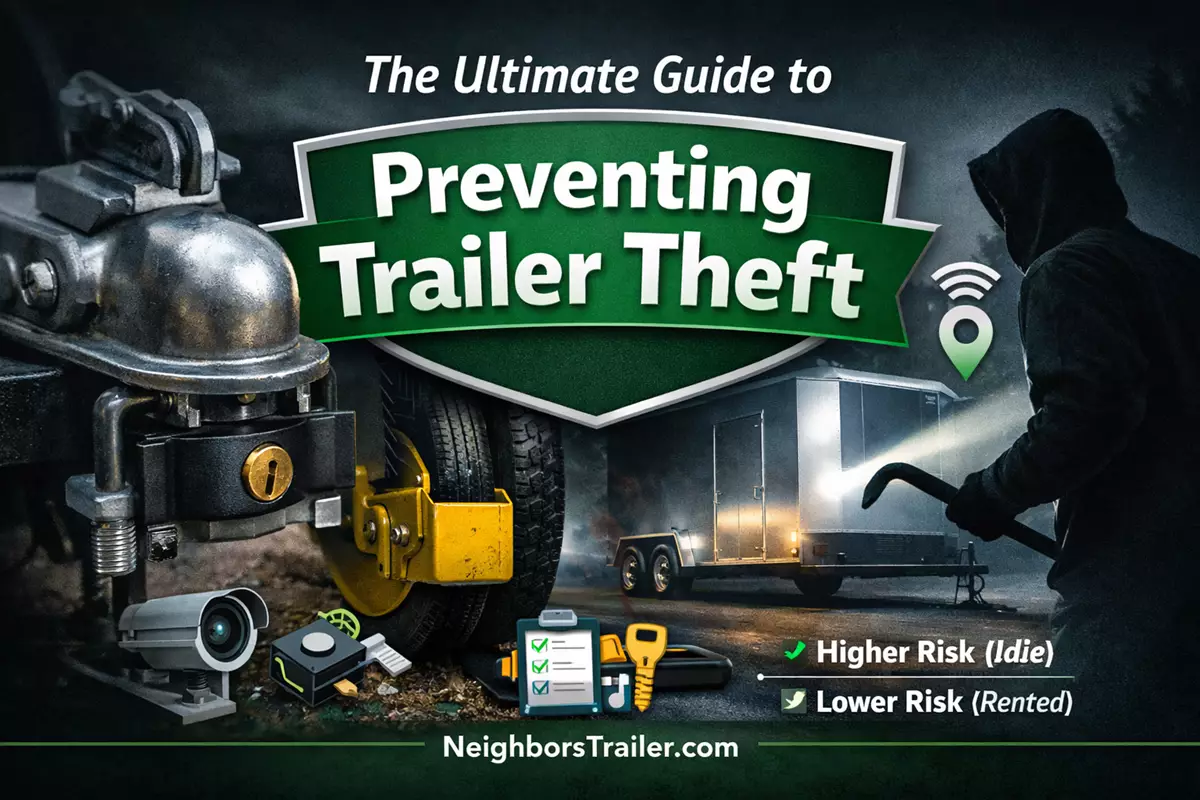
Trailer Theft Prevention: The Complete Guide (2026)
 Neighbors Trailer
Mar 24, 2026 553 11 min read trailer theft prevention, trailer security, GPS tracking, coupler lock
Every year, tens of thousands of trailers vanish from driveways, job sites, and parking lots across the United States. According to CargoNet, cargo theft activity increased by more than 27% in 2024, reflecting a broader rise in trailer and equipment theft nationwide. Meanwhile, industry estimates suggest that fewer than 20% of stolen trailers are ever recovered. If you own a trailer, whether it sits in your driveway between weekend projects or earns you rental income on Neighbors Trailer, theft prevention is not optional—it is essential.
How Trailer Theft Actually Happens
Before you can prevent theft, it helps to understand how thieves operate. The vast majority of trailer thefts follow a predictable pattern. A thief drives through neighborhoods or commercial areas looking for trailers parked in the open. They check whether the coupler is locked. If it isn't, they back up their truck, hitch the trailer, and drive away. The entire process takes under 90 seconds. More organized operations involve trailers stolen from storage yards, rest stops, and rural properties. These thieves may bring bolt cutters, angle grinders, or battery-powered cutting tools to defeat basic security. Some even use stolen trucks to pull trailers so that witnesses see a "normal" tow vehicle and don't think twice. The peak times for trailer theft are Friday evenings, overnight hours between 1 AM and 5 AM, and holiday weekends when owners are away from home. Understanding these patterns helps you plan when your trailer needs the most protection.
The Most Common Mistakes Trailer Owners Make
Leaving the Coupler Unlocked
This is by far the most common security failure. An unlocked coupler is an open invitation. It takes a thief less than 30 seconds to hitch an unsecured trailer and disappear.
Parking in Dark, Unmonitored Areas
Visibility is your friend. Trailers parked behind buildings, in unlit side yards, or at the far end of a commercial lot are prime targets. If nobody can see your trailer, nobody will notice it leaving.
Relying on a Single Security Measure
One lock is not enough. Professional thieves carry tools designed to defeat specific lock types. The goal is to stack multiple deterrents so that defeating one still leaves several more between the thief and your trailer.
Skipping Registration and Documentation
Many trailer owners never record their VIN, take photos of their trailer, or keep registration documents accessible. Without this information, recovering a stolen trailer becomes nearly impossible, and insurance claims get complicated.
The Best Physical Security for Your Trailer (Ranked)
Physical security remains your first and most important line of defense. Not all security devices are equal. Here’s how the most effective options compare in real-world conditions:
| Security Device | Protection Level | Cost Range | Estimated Defeat Time | Best Use Case | Visibility (Deterrence) |
| Coupler Lock | High | $25–$80 | 3–10 min (power tools) | Baseline protection for all trailers | Medium |
| Hitch Pin Lock | Moderate | $15–$40 | 1–5 min | Preventing theft while hitched | Low |
| Wheel Boot / Lock | Very High | $50–$150 | 5–15 min | Long-term storage | High |
| Enclosed Tongue Lock | Very High | $60–$120 | 5–12 min | Blocking full coupler access | Medium |
| Chain + Padlock (Hardened) | Moderate–High | $30–$80 | 2–8 min | Anchoring to fixed object | Medium |
Coupler Locks: Your Non-Negotiable Baseline
A coupler lock fits over or inside your trailer's coupler mechanism and prevents it from being placed onto a hitch ball. This is the single most cost-effective theft deterrent available. If you do nothing else on this list, install a coupler lock every time your trailer is unhitched. Look for hardened steel construction, a lock cylinder that resists picking, and a design that fully encloses the coupler. Cheap cast aluminum locks can be smashed with a hammer. Invest in quality here.
Wheel Boots: The Visible Deterrent That Works
A wheel boot clamps onto one of your trailer's tires and physically prevents the wheel from rotating. Even if a thief defeats your coupler lock, they cannot tow the trailer without dragging a locked wheel, which creates noise, sparks, and attention. Wheel boots are especially effective for long-term storage. The bright color (usually yellow or orange) also serves as a visual deterrent. Thieves looking for a quick steal will move on the moment they see a boot.
The Layered Defense Method
The most effective security protocol in 2026 combines multiple physical barriers. Pair a high-security coupler lock with a wheel boot and a heavy-duty chain anchoring the trailer to a fixed object like a ground anchor or concrete post. This combination forces a thief to defeat three separate systems, each requiring different tools and adding minutes to the clock. Most opportunistic thieves will not invest that kind of time and risk.
GPS Tracking: What Actually Works (and What Doesn't)
GPS tracking has become an essential second layer of trailer security. If physical locks fail, a hidden GPS tracker becomes your best chance of recovering your trailer.
The 5-Layer Trailer Security System
The most effective trailer security isn’t a single device—it’s a layered system. Each layer adds time, complexity, and risk for a thief.
Layer 1: Physical Locks (Foundation)
- Coupler lock
- Wheel boot
Layer 2: Anchoring
- Chain + ground anchor
Layer 3: Visibility
- Motion lighting
- Security cameras
Layer 4: Tracking
- GPS with real-time alerts and geofencing
Layer 5: Financial Protection
- Insurance or NT Protect coverage
The goal is simple: make your trailer take longer, louder, and riskier to steal than the one next to it.
(Visual: 5-Layer Trailer Security System Diagram)
Want a simple way to implement this system? Use the 10-step checklist below to secure your trailer in minutes.
What to Look for in a Trailer GPS Tracker
The most effective GPS trackers for trailers offer real-time location updates (not just periodic check-ins), geofencing alerts that notify you instantly when your trailer moves outside a set boundary, long battery life or hardwired power options, weatherproof construction rated for outdoor mounting, and cellular connectivity that works without a Wi-Fi network. Avoid cheap Bluetooth trackers marketed for keys and wallets. (See our full GPS tracker guide for trailer owners → ) Their range is limited to about 30 feet, and they rely on other users' phones to relay location, making them nearly useless for trailer recovery.
Where to Mount Your GPS Tracker
Hide your tracker where a thief won't think to look. Inside the trailer frame rail, behind a license plate light housing, under a fender, or inside a sealed compartment are all strong options. Avoid mounting it in obvious locations like the tongue or coupler area, which experienced thieves check first. Owners on Neighbors Trailer can purchase GPS devices directly through the app by going to More, then Shop, then tapping Shop Now on the GPS Tracker banner or go to https://neighborstrailer.com/home/gps-tracker. Having a tracker on your listed trailer adds an extra layer of confidence when renting to new users.
Where You Park Matters More Than You Think
Your trailer's parking location is arguably the single biggest factor in theft risk. A well-lit, visible, high-traffic area cuts your risk dramatically, while a dark, secluded spot invites trouble.
At Home
Park your trailer in a locked garage or fenced backyard whenever possible. If it must sit in the driveway, position it so that a thief would need to maneuver around your vehicles to reach it. Motion-activated floodlights and a visible security camera (even a dummy camera) add deterrent value. Consider a driveway alarm that alerts you when someone enters the area at night.
At Job Sites and Storage Yards
Choose storage facilities with gated access, security cameras, and on-site staff. If you store at an open lot, chain your trailer to a ground anchor and use a wheel boot. Avoid leaving your trailer at a job site overnight unless the site has active security.
While Traveling
When stopping at hotels, rest stops, or restaurants, park your hitched trailer where you can see it from inside. Use a hitch lock even when the trailer is attached to your vehicle, as thieves can disconnect a trailer from a hitch in under a minute if the pin is unsecured. Well-lit parking spots near building entrances are always your best option.
Insurance and Liability: What Most People Miss
Physical security and technology are your first and second layers of defense, but insurance is your financial safety net when everything else fails. Most homeowner's insurance policies provide limited coverage for trailers, often with low caps that don't reflect the trailer's actual value. Dedicated trailer insurance or an inland marine policy typically provides better coverage for theft, damage, and liability. If you list your trailer on Neighbors Trailer, NT Protect is available for just a few dollars per day. It covers damage to the trailer during the rental period, and the $500 deductible means both you and your renter have financial protection without the burden of full replacement cost. For owners who rent frequently, this coverage becomes a core part of your risk management strategy. Regardless of your insurance choice, always keep an updated record that includes your trailer's VIN, photos from multiple angles, receipts for aftermarket upgrades (locks, GPS, toolboxes), and your registration and title documents. These records accelerate both insurance claims and law enforcement recovery efforts.
Rental vs. Ownership: The Hidden Risk Comparison
One factor many trailer owners overlook is how usage patterns affect theft risk. A trailer that sits idle in the same location for weeks or months can become a predictable target. Thieves often observe neighborhoods and job sites, noting which trailers rarely move.
By contrast, trailers that are used regularly—whether for personal projects or rentals—tend to benefit from more frequent inspections, repositioning, and visibility. This alone can reduce the likelihood of being targeted.
For owners who choose to rent their trailers through platforms like Neighbors Trailer, there can be additional layers of protection, including renter verification and optional coverage such as NT Protect. While no system eliminates risk entirely, increased usage, visibility, and structured protections can help reduce exposure compared to long-term idle storage.

Your 10-Step Trailer Security Checklist
Whether you use your trailer daily or rent it on weekends, these ten steps form a complete security system:
These ten steps form a complete security system:
- Install a hardened steel coupler lock every time the trailer is unhitched
- Add a wheel boot for overnight storage
- Chain the trailer to a fixed anchor point
- Mount a hidden GPS tracker
- Park in well-lit, high-visibility areas
- Install motion-activated lights and a security camera
- Record your VIN and take photos
- Review your insurance coverage annually
- Add NT Protect when listing your trailer
- Report any theft immediately
What to Do Immediately If Your Trailer Is Stolen
If your trailer disappears, the first 24 hours are critical for recovery. Start by calling law enforcement and filing a police report with your trailer's VIN, license plate number, make, model, year, color, and any distinguishing features. Provide photos and GPS tracker data if available. Next, contact your insurance company to initiate a claim. Having your documentation ready (the records you created in step seven above) will speed this process significantly. Check your GPS tracker app for the trailer's last known location and share that data with police. Post the theft on local social media groups, community boards, and stolen trailer registries. Many trailers are recovered because a neighbor or fellow owner recognized one parked in an unusual location. If the trailer was rented through Neighbors Trailer at the time of theft, contact the platform's support team immediately. The rental agreement, renter identification, and any insurance coverage through NT Protect will all factor into the resolution process.
Protect Your Investment Starting Today
Trailer theft is a real and growing threat, but it is also one of the most preventable property crimes. The combination of physical locks, GPS tracking, smart parking habits, and proper insurance coverage creates a security system that makes your trailer a hard target. You don't need to implement everything at once. Start with a coupler lock and a GPS tracker, then add layers over time. If your trailer earns you rental income on Neighbors Trailer, every dollar you spend on security protects both your asset and your earning potential. Take ten minutes today to assess your current setup against the checklist above. The small investment in prevention is nothing compared to the cost, stress, and lost income of a stolen trailer.