

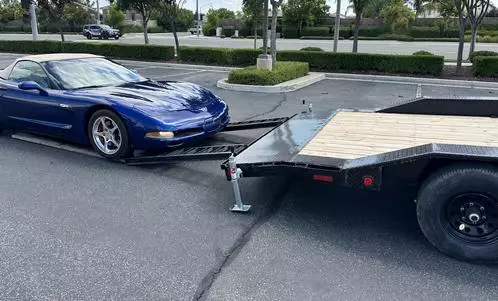
Learn How to Load a Low-Profile Car on a Car Trailer
 Neighbors Trailer
Oct 3, 2023 2801 8 min read
Loading a low-profile sports car, classic, or exotic onto a standard car trailer is one of the highest-stakes moments in any DIY auto transport. The same low ride height that makes the car look fantastic also makes the angle from ground to ramp painful, sometimes literally. Get the loading process wrong and you can scrape the front splitter, crack a fiberglass air dam, or rip off a $1,500 carbon lip in a single second. Get it right and the car rolls on smoothly with zero damage.
This guide walks through everything that matters when you put a low-profile car on a car trailer. By the time you reach the end you will know what trailer to choose, how to set up the ramps, the loading order that protects the front bumper, and the tie-down pattern that keeps the car planted for the whole drive.
Why Low-Profile Cars Are Tricky to Load
The challenge is geometry. A standard open car hauler typically has 16 to 20 inches of deck height plus a five-foot ramp, which produces a ramp angle around 16 to 18 degrees. Most daily drivers have nine to ten inches of front overhang ground clearance and shrug off that angle without thinking. A lowered or factory-low car often has only three to five inches of clearance at the splitter, and that geometry will not survive a steep ramp.
The fix is not to push harder, drive faster, or hope the splitter holds. The fix is to change the loading geometry, by either lowering the ramp angle, raising the car as it goes up, or both. The right car trailer rental makes that easy. The wrong one makes it impossible.
Before you commit to a trailer, verify whether your specific car will actually clear its ramp. Our Car Loading Clearance calculator takes your car's ground clearance, wheelbase, and front overhang along with the trailer's deck height and ramp length, then runs the break-over geometry and returns a clear verdict: clears, marginal, or scrapes. If it scrapes, it tells you exactly how much to raise the tongue to fix it. It is the fastest way to avoid the exact splitter-damage scenario this post is about.
Pick the Right Trailer Before You Pick Up the Car
For low-profile loading, you have three trailer options that actually work:
| Trailer Type | Effective Ramp Angle | Best For | Daily Rate Range |
| Open low-profile car hauler | 9 to 11 degrees | Most lowered street cars | $120 to $185 |
| Hydraulic tilt deck | 5 to 8 degrees | Slammed cars and exotics | $175 to $325 |
| Enclosed lift-gate trailer | 0 degrees (level lift) | Show cars and concours vehicles | $225 to $400 |
A standard open hauler with stock ramps simply will not work for anything below about five inches of clearance. Trying to make it work with two-by-fours or makeshift extensions is how splitters get destroyed. Spend the extra $30 to $80 per day on the right unit. Reading our overview of when a car trailer rental makes sense can also help you understand the cost trade-offs.
Step-by-Step Loading Process
1. Park on Level, Solid Ground
Choose a flat parking lot, paved driveway, or dry hard-pack surface. Avoid grass, gravel, or any slope. Even a small grade adds two to three degrees to the ramp angle, which is enough to scrape on a 4-inch-clearance car.
2. Block the Tow Vehicle and Trailer Wheels
Engage the parking brake on the tow vehicle, leave it in gear or park, and place wheel chocks in front of and behind both trailer wheels. The trailer should not move at all during loading. A trailer that walks forward by even six inches as you drive on can drop the splitter onto the ramp.
3. Reduce the Ramp Angle
If the trailer has hydraulic tilt, lower the deck fully. If it has standard ramps, place a pair of 2x10 boards at the base of each ramp to extend the ramp foot 12 to 18 inches forward. This drops the effective angle by roughly two to four degrees, which is often enough to clear a low splitter.
4. Spot the Car Carefully
Have a second person stand to the side, not in front, and watch the gap between splitter and ramp as the car approaches. Drive at a slow walking pace, no faster than 2 to 3 mph. Keep the steering wheel straight; turning while on the ramp shifts weight onto a single wheel and can scrape one corner of the splitter.
5. Stop at the Right Spot
The front axle should sit slightly ahead of the trailer's center of gravity, with about 60 percent of the vehicle's weight on or just forward of the trailer axles. This produces the right tongue weight (10 to 15 percent of total weight) and prevents trailer sway on the highway.
Tie-Down Pattern That Actually Works
Once the car is positioned, set the parking brake firmly and put the transmission in park or first gear. Now the straps. The right pattern uses four wheel-net or axle straps, not body or chassis straps, anchored at the wheels in a crossing pattern.
Front straps run from the trailer's front anchor points back and outward to the front wheels. Rear straps run from the back anchors forward and outward to the rear wheels. The crossing pattern keeps the car planted both forward and laterally. Tighten each strap until the suspension compresses about half an inch, then check again after one mile of driving and re-tighten if needed. If you are using an enclosed trailer, our complete tie-down guide covers the patterns in more detail.
NeighborsTrailer.com
What to Do When the Car Cannot Drive On
If the car is non-running, has a blown transmission, or has so little clearance that no ramp angle will clear it, you have two options. The first is a winch-equipped trailer; many tilt and enclosed units include a 9,000-pound winch on the front bulkhead that pulls the car up at a controlled rate. The second is a tow truck with a flatbed and approach plates, but at that point the per-mile cost usually exceeds renting a tilt or enclosed trailer for the day.
Cost and Coverage
For a typical 200-mile round trip with a tilt-deck trailer, expect roughly $200 in rental, $80 in fuel, and a few dollars per day in NT Protect coverage built into your booking. The same trip booked through a national chain often runs $350 or more, and the chain rarely has a tilt deck on the lot when you need it. NT Protect is mandatory on every Neighbors Trailer rental, charged automatically at the time of booking, and gives both renter and owner real coverage for the full duration of the rental. There is no add-on to choose, no policy to read, and no separate purchase.
Frequently Asked Questions
What ground clearance is too low for a standard car trailer?
Anything under five inches of front splitter clearance should not be loaded on a standard ramp hauler. At four inches or less you are almost guaranteed to scrape unless you use a tilt deck or lift-gate trailer.
Can I add my own ramp extensions to a regular trailer?
Lumber extensions can drop ramp angle by a few degrees in a pinch, but they shift weight unpredictably and are not rated for vehicle loading. For an expensive low car, the cost of damage from a slipped 2x10 dwarfs the cost of renting the right trailer.
Should I drive on forward or backward?
For most low-profile cars, forward is best because the front splitter is the lowest point, and driving forward gives you maximum control and visibility. Driving backward up a ramp puts the rear bumper at risk and reduces visibility, which is the wrong trade-off on a tight ramp.
How much will I damage by getting it wrong?
A scraped fiberglass splitter on a sports car is typically a $400 to $1,500 repair. A cracked carbon lip on an exotic is $2,000 to $6,000. A bent oil pan from grounding out is far worse. Treat the trailer choice and ramp angle as the most important decision of the trip.
Is NT Protect required if I am only moving the car a few miles?
Yes. NT Protect is mandatory on every booking on Neighbors Trailer regardless of trip length. It is charged automatically at checkout for a few dollars per day and there is no version of the booking flow that allows it to be skipped.
The Bottom Line
Loading a low-profile car on a car trailer is a solved problem when you pick the right trailer and follow the right process. Match the trailer type to your car's clearance, set up on a flat surface, drop the ramp angle as much as possible, and use the four-corner crossing strap pattern to keep the car planted. The same process that protects a brand-new exotic also protects a 30-year-old project car, and on Neighbors Trailer the right trailer is usually within a few miles of home. If the car is heading to an autocross, track day, or car show, our Car Events hub lists upcoming SCCA and motorsport events in your area alongside available enclosed trailers and car haulers for the trip.
Related Articles
- Hydraulic Tilt Flatbed Trailer for Rent in Denver, CO
- A Beginner's Guide to Choosing the Right Car Trailer Rental
- How to Choose the Right Car Trailer Rental for Your Needs
- A Complete Guide to Tiedowns to Secure Your Cargo in an Enclosed Trailer Rental
Content updated April 2026