

Best Trailer Type for Each Job: A Quick Picker
 Neighbors Trailer
May 12, 2026 297 8 min read
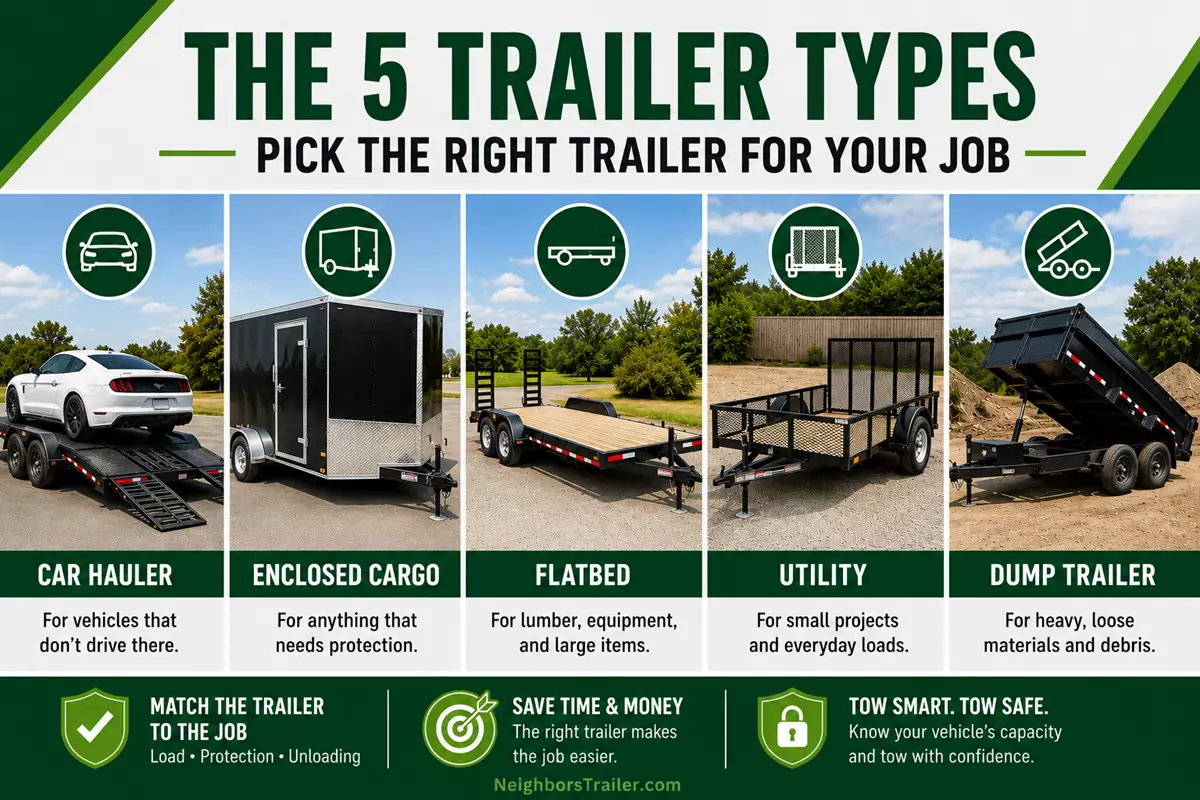
The right trailer depends on what you're hauling, where you're going, and whether the load needs protection from weather. For vehicles, choose a car hauler. For lumber, equipment, or anything you can strap down, a flatbed works. For furniture, tools, or anything weather-sensitive, an enclosed cargo trailer is the answer. For small home and yard projects, a utility trailer is the most flexible. For loose materials like gravel, soil, or debris, a dump trailer saves serious unloading time.
How to Pick a Trailer in Under a Minute
The question most first-time renters ask is some version of "what kind of trailer do I need?" — and the honest answer is that it depends less on personal preference than on three specific things about the job:
- What you're hauling (size, shape, weight)
- Whether it needs protection from weather and theft
- How you'll load and unload it
Match those three to the right trailer type and you're done. The five trailer types below cover roughly 95% of all rental jobs. Each section tells you when it's the right answer, when it isn't, and what to budget.
1. Car Hauler — For Vehicles
Use it when: You need to move a car, motorcycle, ATV, golf cart, lawn tractor, or any vehicle that doesn't drive itself there.

Common jobs:
- Buying a non-running project car at auction
- Moving a classic or collector car to a show
- Hauling a track-day car to and from the circuit
- Moving an inoperable vehicle to a mechanic
- Cross-country relocation with a second car in tow
What to look for: Most car haulers are open-deck with steel rails, ramps that fold down for loading, and tie-down points along the deck. Length matters — full-size cars need 18'+ decks; compact cars and motorcycles fit on 14–16' decks.
Daily rate range: $75–$150
When it's not the right answer: If you're moving a high-value collector car, a covered enclosed car hauler protects against road debris and weather. Worth the premium if the car is worth six figures.
2. Enclosed Cargo Trailer — For Anything That Needs Protection
Use it when: Your load needs to stay dry, stay clean, or stay out of sight.

Common jobs:
- Moving furniture, mattresses, electronics
- Hauling tools and equipment to a job site daily
- Race car transport (closed deck)
- Long-distance moves with valuables
- Trade show booth and inventory transport
- Anything you don't want visible from the road
What to look for: Look for ramp doors (better for loading wheeled items) or barn doors (better for forklift loading). Internal tie-down rings matter for securing loads. Interior lights are a small detail that matters a lot if you'll be loading at dusk.
Daily rate range: $60–$120
When it's not the right answer: For overhead-load items (anything taller than ~7') or for hauling loose materials that don't need protection (gravel, mulch, soil), enclosed is overkill. Use a flatbed or dump trailer instead.
3. Flatbed (Utility/Equipment) — The Workhorse
Use it when: Your load is large, oddly shaped, or easier to strap down than to lift over a wall.

Common jobs:
- Hauling lumber, plywood, or building materials
- Moving riding mowers, ATVs, skid steers, or small construction equipment
- Hauling pallets of bricks, pavers, or sod
- Picking up a piece of furniture too big for an enclosed trailer
- Construction job site material runs
What to look for: A solid wood or metal deck, tie-down points along all four sides, and ramps if you're loading equipment. Deck length matters — 12' handles most homeowner jobs; 16–20' is common for equipment.
Daily rate range: $50–$120 (utility flatbed); $75–$150 (heavier equipment trailer)
When it's not the right answer: Weather-sensitive loads (electronics, furniture, antiques) belong in an enclosed cargo trailer. And for loose materials (gravel, mulch, dirt), a flatbed is harder to unload than a dump trailer.
4. Utility Trailer — Best for Small Projects
Use it when: You're hauling a single-load, mid-weight job that doesn't need a full-size trailer.

Common jobs:
- Mulch, soil, or gravel for spring yard work (covered in detail in our Spring Yard Work guide)
- Hauling yard waste or branches
- Moving a few large items (a sectional sofa, an appliance, a piano)
- Quick lumber runs
- Single-pallet pickups
What to look for: Open-deck with low walls (6"–18") so loading is easy. A rear gate or fold-down ramp helps for wheeled items. Most homeowner jobs work great in a 6'x12' utility trailer with a 2,500 lb payload.
Daily rate range: $25–$75
When it's not the right answer: For loads heavier than ~3,000 lbs, a heavier-duty flatbed is safer. For weather-sensitive items, go enclosed.
5. Dump Trailer — When Unloading Matters
Use it when: What you're hauling is heavy, loose, and would be miserable to shovel out by hand.

Common jobs:
- Gravel, sand, or decorative stone
- Construction debris removal
- Bulk soil, mulch, or compost (loads over 1 cubic yard)
- Concrete demolition cleanup
- Roofing tear-off debris
- Tree removal cleanup (large branches and stumps)
What to look for: Hydraulic lift capacity (most dump trailers handle 5,000–14,000 lbs), gate options (split tailgate is more flexible than full-swing), and power source (battery vs. tow vehicle).
Daily rate range: $90–$180
When it's not the right answer: For light loads (yard waste, light landscaping debris), a utility trailer is cheaper and easier to back into a driveway. Dump trailers are also typically heavier and require a more capable tow vehicle.
Quick Decision Table
| If you're hauling... | Pick this trailer |
|---|---|
| A car, motorcycle, ATV | Car Hauler |
| Furniture, electronics, valuables | Enclosed Cargo |
| Lumber, equipment, large items | Flatbed |
| Mulch, soil, a few large items | Utility |
| Gravel, debris, anything heavy and loose | Dump |
| A collector car worth $50K+ | Enclosed Car Hauler |
| A trade show booth | Enclosed Cargo |
| Roofing tear-off | Dump |
| A riding mower or ATV | Flatbed or Utility |
| Spring yard work | Utility (small jobs) or Dump (bulk soil/gravel) |
Three Questions That Resolve 90% of Picks
If you're still not sure, three questions almost always settle it:
1. Will the load fit through a 6-foot-wide opening?
If yes, most utility trailers handle it. If no, you need a flatbed.
2. Does the load need to stay dry?
If yes, enclosed. If no, anything open-deck works.
3. Will you load and unload by hand, by ramp, or by crane?
- By hand → utility or flatbed with low walls
- By ramp → car hauler, flatbed with ramps, or enclosed with ramp door
- By tipping (dumping) → dump trailer
A Quick Note on Tow Vehicle Capacity
Whatever trailer you pick, your tow vehicle has to be rated to pull it. A trailer rated to carry 7,000 lbs is useless if your SUV is only rated to tow 5,000.
The basic check:
- Find your vehicle's maximum tow rating in the owner's manual
- Add the trailer's empty weight plus your cargo weight
- The combined number must be under your vehicle's max tow rating
For deeper coverage on this — including how GVWR, payload, and tongue weight all interact — see our Renting vs. Buying a Trailer guide. The owner's manual is the source of truth for your specific vehicle.
Frequently Asked Questions
What's the most popular type of rental trailer?
Car haulers and enclosed cargo trailers are the two most-rented categories on peer-to-peer trailer platforms. Together they typically account for more than half of all rental bookings.
Can I move a car on a flatbed trailer?
You can, but a dedicated car hauler is safer and easier. Car haulers have lower decks, integrated ramps, and tie-down points positioned for vehicles. Flatbeds work in a pinch but don't have the same vehicle-specific features.
What's the difference between a utility trailer and a flatbed?
Utility trailers are smaller, lighter, and have low walls (6"–18" tall) to keep loose materials from rolling off. Flatbeds are larger, heavier, have a completely flat deck, and are designed for strapping down equipment or large objects.
Do I need a special license to rent any of these trailers?
For most consumer-size trailers (under 10,000 lbs GVWR), a standard driver's license is sufficient. Larger commercial trailers may have state-specific requirements. Check your state's DMV rules and our Texas Trailer Towing Laws (2026 Guide) for one example.
How much does it cost to rent each type?
Typical 2026 daily rates: utility ($25–$75), flatbed ($50–$150), enclosed ($60–$120), car hauler ($75–$150), dump ($90–$180). Rates vary by region and platform. See our Renting vs. Buying a Trailer cost analysis for more detail.
Further Reading
- Renting vs. Buying a Trailer: A 2026 Cost Comparison
- Spring Yard Work: 5 Trailer Loads That Save You a Trip
- Trailer Theft Is Up: How to Protect Your Trailer in 2026
- Texas Trailer Towing Laws (2026 Guide)
Ready to find the right trailer?
- Browse by type: See utility, flatbed, enclosed, car hauler, and dump trailers near you
- Have a trailer to share? List it on Neighbors Trailer and earn from your idle equipment