

Spring Yard Work: 5 Trailer Loads That Save You a Trip
 Neighbors Trailer
May 9, 2026 523 7 min read
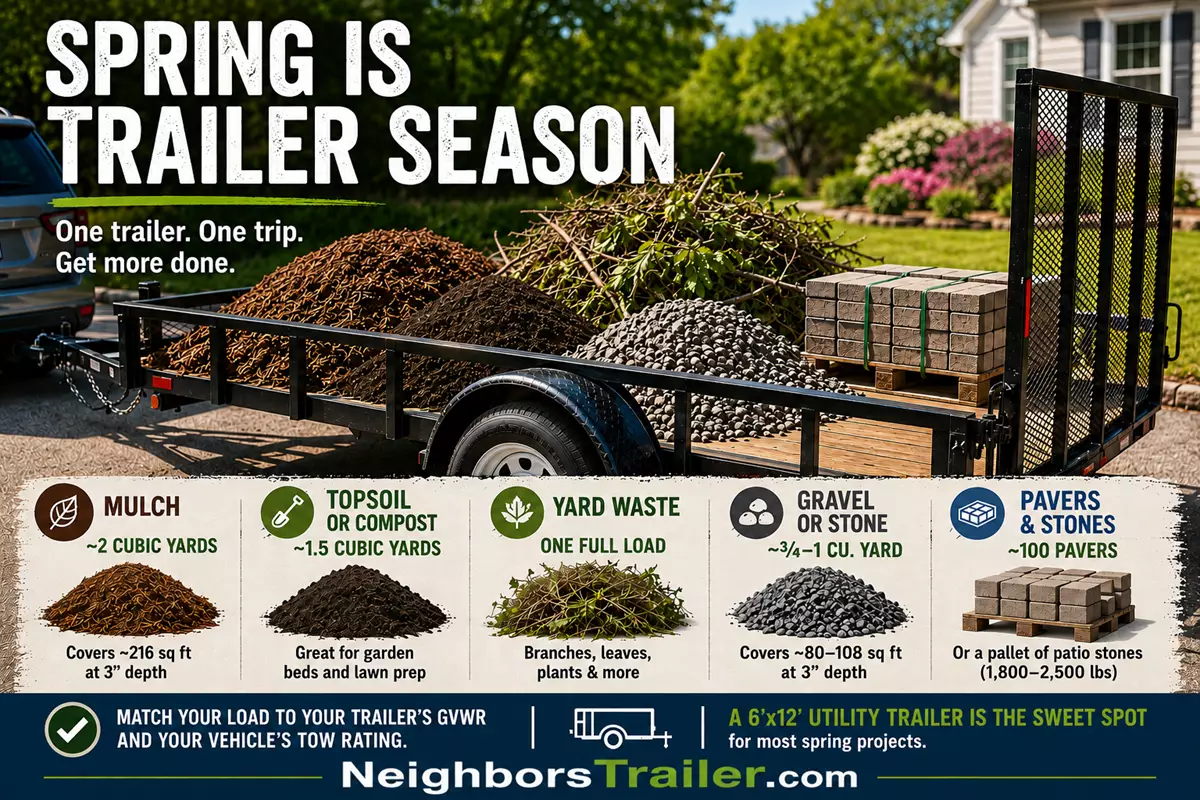
A 6'x12' utility trailer can typically haul about 2 cubic yards of mulch, a half-ton of topsoil or compost, a full season's pile of yard waste, half a ton of gravel, or roughly 100 standard pavers in a single trip — saving multiple back-and-forth runs in a passenger vehicle. Match the load to the trailer's GVWR and the vehicle's tow rating.
Spring Is Trailer Season
Every spring, the same thing happens. You drive to the garden center. You buy mulch. You fit eight bags in your trunk. You go back. You buy more mulch. You drive back. You realize you didn't buy enough. You go back a third time.
A trailer turns three trips into one.
For most homeowners, spring is when a trailer earns its rental fee. The yard work projects that pile up in May — mulching beds, prepping a new garden, hauling away winter brush, laying a small patio — are exactly the loads that fit comfortably in a mid-size utility trailer. Below are the five most common spring hauls, what each one looks like in real-world quantities, and what size trailer makes each one a one-trip job. Juggling several of these in one weekend? The Weekend Project Planner helps you map out the whole to-do list.
1. Mulch (The Spring Classic)
The single most common spring trailer load. Bagged mulch from a garden center costs more per cubic yard than bulk mulch from a landscape supplier, and the difference is usually 2-3x. A trailer load of bulk mulch pays for itself the first time you use it. Not sure how many yards you need? The Landscape Material Calculator turns your bed size into cubic yards and weight.
What fits:
| Trailer Size | Mulch Capacity | Covers (at 3" depth) |
|---|---|---|
| 4'x8' utility | ~1 cubic yard | ~108 sq ft of beds |
| 5'x10' utility | ~1.5 cubic yards | ~162 sq ft |
| 6'x12' utility | ~2 cubic yards | ~216 sq ft |
| 7'x14' utility | ~2.5–3 cubic yards | ~270–325 sq ft |
Tip: Most landscape suppliers will load mulch directly into your trailer with a skid-steer. Bring a tarp to cover the load on the drive home — wet mulch is heavier and harder to unload than dry.
2. Topsoil, Compost, or Garden Soil
Heavier than mulch — about 1 ton per cubic yard for moist topsoil, vs. ~600 lbs/cubic yard for mulch. Pay attention to your trailer's GVWR (gross vehicle weight rating) and your vehicle's tow capacity here. A 6'x12' trailer with 2,000 lbs payload can handle about 1 cubic yard of topsoil; loading 2 cubic yards is too much.
What fits (at safe payload limits):
| Trailer Size | Topsoil Capacity | Use Case |
|---|---|---|
| 4'x8' (1,500 lb payload) | ~½ cubic yard | Small bed prep, raised garden |
| 5'x10' (2,000 lb payload) | ~1 cubic yard | Medium garden install |
| 6'x12' (2,500–3,500 lb payload) | ~1.5 cubic yards | Lawn renovation |
| 7'x14' (3,500–7,000 lb payload) | ~2–3 cubic yards | New sod prep, full bed install |
Tip: Don't fill the trailer level with the sides. Dense materials concentrate weight on the axle, and an overfull load can exceed your tow rating even if there's still room in the bed.
3. Yard Waste and Spring Cleanup
Branches, leaves, dead plants, broken-down winter cover. The bulky stuff that's hard to fit in a sedan and impossible to bag without filling thirty paper sacks.
A typical 6'x12' trailer holds the equivalent of 20–30 yard waste bags in one load. For homes with mature trees or a large yard, that's the difference between one trailer trip and a whole afternoon of stuffing bags.
What you can typically fit:
- A season's worth of pruned branches from 4–6 mature shrubs
- All the leaves you raked but didn't bag last fall
- Spent tomato plants, old garden bed material, root balls from removed plants
- An entire dead Christmas tree (if you forgot to deal with it)
Tip: Most municipalities have free or low-cost yard waste drop-off in spring. Many landscape suppliers also accept clean organic matter for compost. Check your city's bulk-waste schedule before you load.
4. Gravel, Stone, or Decorative Rock
Weight is the constraint here. Gravel runs roughly 2,800 lbs per cubic yard — denser than topsoil. A small 4'x8' trailer can only handle about a third of a cubic yard before exceeding its payload rating.
Realistic loads (within payload limits):
| Trailer Size | Gravel Capacity | Covers (at 3" depth) |
|---|---|---|
| 4'x8' utility | ~⅓ cubic yard | ~36 sq ft |
| 5'x10' utility | ~½ cubic yard | ~54 sq ft |
| 6'x12' utility | ~¾–1 cubic yard | ~80–108 sq ft |
| 7'x14' utility | ~1.5 cubic yards | ~160 sq ft |
Tip: This is the load category where dump trailers genuinely earn their keep. If you're hauling more than a yard of stone, a dump trailer's hydraulic lift saves the back-breaking shovel-out at the other end. Same applies for sand and bulk soil.
5. Pavers, Stepping Stones, or Patio Materials
The "I want a small patio this summer" project. Standard concrete pavers weigh 8–12 lbs each, so the limit is usually weight, not floor space.
What typically fits in a 6'x12' utility trailer:
- About 100 standard pavers (12"x12", 11 lbs each) = 1,100 lbs
- Or a pallet of patio stones (typically 1,800–2,500 lbs delivered)
- Or 40 retaining wall blocks (50–60 lbs each)
For a project bigger than that — building a 200-square-foot paver patio, for example — you're often better off having the materials delivered by the supplier. But for a small fire pit, a path, or a few stepping stones, a single trailer trip handles it.
Tip: Distribute pavers evenly across the trailer floor, not stacked in one corner. Concentrated load points can damage trailer decking and put uneven stress on the axle.
How to Pick the Right Trailer Size
For most homeowners doing typical spring projects, a 6'x12' utility trailer with ~2,500 lbs payload capacity handles 80% of seasonal yard work. It's small enough to back into a driveway, large enough to make multiple trips unnecessary.
A few quick rules:
- For mulch and yard waste: size the trailer to volume (cubic yards). Both materials are bulky but light.
- For soil, gravel, and pavers: size the trailer to weight (payload). Volume isn't the constraint; the trailer's GVWR is.
- Always check your tow vehicle's rating. A trailer rated for 3,500 lbs is useless if your SUV is only rated to tow 2,000.
Frequently Asked Questions
How much mulch fits in a typical utility trailer?
A 6'x12' utility trailer typically holds about 2 cubic yards of mulch — enough to cover roughly 216 square feet of garden beds at 3" depth. Smaller 4'x8' trailers hold about 1 cubic yard.
Can I haul a yard of topsoil in a small trailer?
Yes, most 5'x10' utility trailers with a 2,000-lb payload rating can handle one cubic yard of moist topsoil (about 2,000 lbs). Smaller trailers max out at half a yard.
Is a dump trailer worth renting for spring yard work?
For loads of gravel, sand, or bulk soil over one cubic yard, yes — the hydraulic lift saves significant unloading time. For mulch and yard waste, a standard utility trailer is usually fine.
Do I need a special license to rent a utility trailer in 2026?
For most consumer-size utility trailers (under 10,000 lbs GVWR), a standard driver's license is sufficient. Larger trailers may have state-specific requirements — see our Texas Trailer Towing Laws (2026 Guide) for one example of state rules.
What if I don't own a trailer for spring projects?
Peer-to-peer rental marketplaces let you rent a utility trailer from a local owner for a single project — typically $25–$75/day depending on size and location. See Renting vs. Buying a Trailer for the full math on which makes sense for your use frequency.
Further Reading
- Renting vs. Buying a Trailer: A 2026 Cost Comparison
- Trailer Rental Safety: Complete Guide for Renters and Owners (2026)
- Texas Trailer Towing Laws (2026 Guide)
Ready to tackle your spring projects?
- Need a trailer for one weekend? Browse trailers in your area — find utility, dump, and equipment trailers from local owners.
- Have a trailer that sits idle most weekends? List it on Neighbors Trailer — turn spring rental demand into income.