

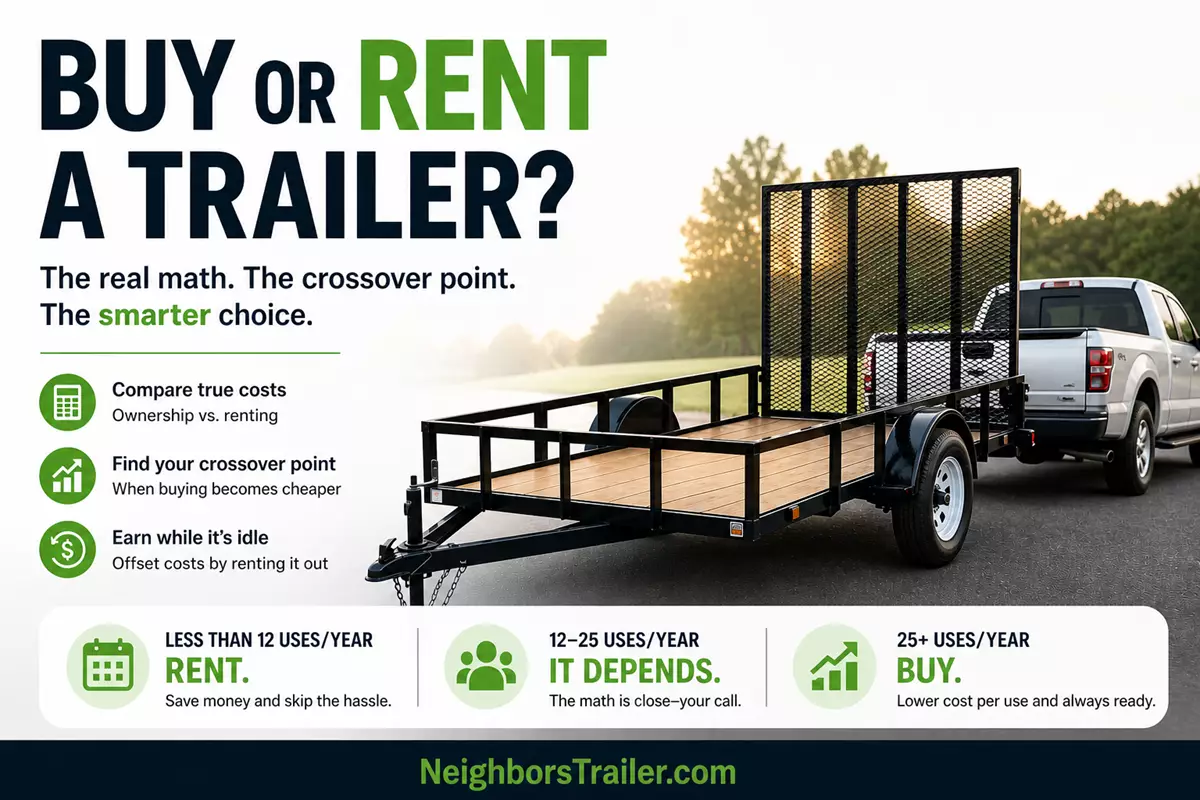
Renting vs. Buying a Trailer: A 2026 Cost Comparison
 Neighbors Trailer
May 5, 2026 759 15 min read
Owning a trailer makes financial sense at roughly 12–15+ uses per year for utility trailers, and at lower thresholds for higher-cost specialty trailers (dump, equipment, enclosed cargo). Below those frequencies, renting is typically cheaper once the full cost of ownership — purchase price, registration, storage, insurance, maintenance, and depreciation — is accounted for. The crossover point varies by trailer type, local rental rates, and storage costs. For occasional users (1–8 uses per year), renting wins decisively. For frequent users (15+ per year), owning wins. For users in the middle, the math depends on specifics covered below.
Key Takeaways
- Purchase price is only one cost — total cost of ownership also includes registration, storage, insurance, maintenance, and depreciation
- Utility trailers (the most common type) typically cost $1,500–$3,500 new and depreciate at 10–15% per year
- Annual carrying costs for an owned trailer typically run $400–$1,500/year depending on storage and use intensity
- Daily rental rates for a comparable utility trailer typically run $25–$80/day depending on location and platform
- The crossover point — where ownership becomes cheaper than renting — typically falls at 12–15+ rentals per year for basic utility trailers, sooner for higher-value specialty trailers
- There's a third path: owners who rent out their trailers when not in use can offset ownership costs significantly, shifting the math entirely
Why This Math Matters
Most "should I buy or rent" advice on the internet is generic. Either it pushes ownership ("a trailer is an investment, you'll always have it when you need it") or it pushes renting ("why pay for storage and depreciation when you can just rent"). Both are right sometimes. Neither is right always.
The actual answer depends on six variables, in order of importance:
- How often you'll use it per year
- What type of trailer you need
- What it costs to store one where you live
- What rental rates look like in your local market
- Whether you'd be willing to rent out the trailer when not in use (which changes the math significantly)
- Your tax situation if used for business
This post walks through the real costs on both sides, gives you a use-frequency framework to find your crossover point, and addresses the hybrid path most renters don't realize is available.
The Real Cost of Owning a Trailer
The purchase price is the most visible cost but rarely the largest one over a 5–10 year ownership window. Here's the full picture using a typical mid-size utility trailer ($2,500 purchase price) as the example, with notes on how the math shifts for other types.
Upfront Costs
| Cost | Range | Notes |
|---|---|---|
| Purchase price (utility trailer, new) | $1,500–$3,500 | Used trailers typically 25–50% cheaper |
| Purchase price (dump trailer) | $6,000–$15,000+ | |
| Purchase price (enclosed cargo) | $4,000–$12,000 | |
| Purchase price (equipment/car hauler) | $3,500–$9,000 | |
| Sales tax (varies by state) | 0–10% of purchase | TX: 6.25%, CA: 7.25%+, FL: 6%, OR: 0% |
| Title and registration (one-time + annual) | $25–$200/year | Varies dramatically by state — 12 states require no registration for small utility trailers |
| Initial setup (lock, hitch, jack, etc.) | $100–$500 |
For a typical utility trailer, plan on $1,800–$4,200 out the door when you account for tax, registration, and setup.
Annual Carrying Costs
These are the costs you pay every year you own the trailer, whether you use it once or fifty times.
| Annual Cost | Range | Notes |
|---|---|---|
| Insurance | $50–$500/year | Personal use is cheapest; commercial use $300–$1,000+ |
| Storage | $0–$2,400/year | Free if you have driveway/garage; $30–$200/month for paid storage |
| Routine maintenance | $50–$300/year | Bearing service, tire pressure, lights — light-use averages |
| Major maintenance reserves | $100–$400/year | Tire replacement, brake service, deck boards (averaged across multi-year cycles) |
| Registration renewal | $25–$100/year | Where required |
| Total typical annual carrying | $225–$3,700/year | Wide range driven mostly by storage and insurance |
For a typical utility trailer with home storage and personal-use insurance, expect $400–$800/year in carrying costs. With paid storage in a high-cost area, that figure can reach $1,500–$2,000/year.
Depreciation: The Cost Most Owners Underestimate
Depreciation is the silent cost. You don't write a check for it, but it's real money — it's the gap between what you paid and what the trailer will sell for when you're done with it.
Typical depreciation rates by trailer type (industry data, exponential model — year-over-year on remaining value):
| Trailer Type | First-Year Drop | Subsequent Years | After 5 Years (typical) |
|---|---|---|---|
| Utility | ~15% | 8–10%/year | Worth ~55–60% of original |
| Enclosed Cargo | ~20% | 10–12%/year | Worth ~45–50% |
| Flatbed/Equipment | ~12% | 7–9%/year | Worth ~60–65% |
| Dump | ~15% | 10–12%/year | Worth ~50% |
| Travel/Camper | ~25% | 10–15%/year | Worth ~40% |
A $2,500 utility trailer owned for 5 years will typically be worth around $1,400–$1,500 at resale — a depreciation cost of roughly $1,000–$1,100, or $200–$220 per year spread across the ownership period.
A $10,000 dump trailer owned for 5 years will typically depreciate to around $5,000 — meaning $1,000/year in depreciation, often the largest single component of ownership cost.
Total Cost of Ownership Over 5 Years (Utility Trailer Example)
Putting it together for a $2,500 utility trailer with home storage and personal-use insurance:
| Component | 5-Year Total |
|---|---|
| Purchase + tax + setup | ~$2,800 |
| Annual carrying costs ($600/year) | $3,000 |
| Depreciation (sold at $1,400) | $1,100 |
| Total cost of ownership | ~$6,900 |
| Implied cost per year | ~$1,380 |
That's the number to compare against rental costs. Not the purchase price. The annualized total.
The Real Cost of Renting
Rental costs are simpler to calculate but easier to misunderstand. The key question isn't "what's the daily rate?" — it's "what's the all-in cost of getting a trailer for the day, including pickup, return, and any platform fees?"
Typical Rental Rates by Trailer Type
Across major P2P trailer rental marketplaces and traditional rental yards in 2026:
| Trailer Type | Daily Rate Range | Weekly Rate Range |
|---|---|---|
| Small utility (4'x8' to 5'x10') | $25–$50 | $125–$250 |
| Mid-size utility (6'x12' to 7'x14') | $40–$75 | $200–$400 |
| Enclosed cargo | $60–$120 | $300–$600 |
| Equipment / car hauler | $75–$150 | $375–$750 |
| Dump trailer | $90–$180 | $450–$900 |
| Specialty (gooseneck, livestock, etc.) | $100–$250 | $500–$1,200 |
These are typical 2026 ranges. Local market conditions matter — urban areas typically run higher, rural areas lower. Holiday weekends and peak seasons add a premium.
What "Rental Cost" Includes That Ownership Doesn't
When you rent, the daily rate generally covers:
- The trailer itself, with current registration
- Maintenance and tire condition (the rental owner's responsibility)
- Insurance/protection coverage during your rental window (varies by platform)
- Depreciation (you pay nothing for value loss — the owner absorbs it)
- Storage between uses (you pay only when using)
That's why a $50/day rental can be cheaper than a $2,500 purchase even after dozens of uses. The renter is paying for only the time they need the trailer.
Annual Rental Cost at Various Use Frequencies (Mid-Size Utility Trailer at $50/day)
| Uses per Year | Daily Rentals | Annual Cost |
|---|---|---|
| 1 (occasional moving) | 1 day | $50 |
| 4 (quarterly project) | 4 days | $200 |
| 8 (~monthly) | 8 days | $400 |
| 12 (monthly + extras) | 12 days | $600 |
| 20 (weekend regular) | 20 days | $1,000 |
| 30 (weekly) | 30 days | $1,500 |
| 50+ (heavy use) | 50+ days | $2,500+ |
Comparing to the ~$1,380/year annualized cost of owning the same type of trailer: the crossover point is around 26–28 uses per year for a typical home-stored utility trailer. Below that, renting wins. Above that, owning wins.
That number changes with the variables. Higher rental rates push the crossover lower. Higher storage costs push it higher. Specialty trailers with steeper depreciation push it higher. We'll address the variations next.
The Crossover Point: When Ownership Wins
Different trailer types have different crossover points because their cost structures differ. Here's a rough guide to where ownership starts winning, using the typical 5-year annualized total cost on the ownership side and typical 2026 daily rental rates on the rental side.
| Trailer Type | Annualized Ownership Cost | Daily Rental Rate | Approx. Crossover (uses/year) |
|---|---|---|---|
| Small utility | ~$900 | ~$35 | ~25 days/year |
| Mid-size utility | ~$1,380 | ~$50 | ~28 days/year |
| Enclosed cargo | ~$2,500 | ~$90 | ~28 days/year |
| Equipment / car hauler | ~$2,200 | ~$110 | ~20 days/year |
| Dump trailer | ~$3,500 | ~$135 | ~26 days/year |
The pattern: for most trailer types, the crossover sits in the range of 20–30 uses per year. Below that, the math favors renting. Above that, ownership wins on per-use cost.
A simpler heuristic: if you'll use the trailer less than once a month, rent. If you'll use it two-plus times a month, consider buying. If you're somewhere between (1–2 times a month), the answer depends on your specific storage costs and whether you'd consider listing the trailer for rent when not in use.
Use Cases: What Actually Wins for Different People
The Weekend Hobbyist (1–4 uses per year)
Profile: A homeowner who hauls mulch in the spring, picks up something from IKEA twice a year, and helps a neighbor move once.
The math: 4 rental days at $50 = $200/year vs. ~$1,380/year ownership cost.
Verdict: Rent. Saves $1,000+/year. Avoids storage, registration, insurance hassle.
The Monthly User (8–12 uses per year)
Profile: A small landscaper or home renovator who needs a trailer about once a month for projects.
The math: 12 rental days at $50 = $600/year vs. ~$1,380/year ownership cost.
Verdict: Still rent. Saves around $700/year, and rental gives flexibility to upgrade trailer type as the project demands.
The Weekly User (40+ uses per year)
Profile: A working contractor, full-time landscaper, or active equipment hauler.
The math: 50 rental days at $50 = $2,500/year vs. ~$1,380/year ownership cost.
Verdict: Buy. The math flips clearly. At this use intensity, also explore commercial-grade build quality and consider business-use tax depreciation (consult a CPA).
The Specialty User
Profile: Someone who needs a specific type of trailer (dump, enclosed cargo, gooseneck) for a project that lasts a few weeks or months — rebuilding a deck, moving across state, hauling a vehicle.
The math: 14 days of dump trailer rental at $135 = $1,890 vs. $10,000+ to buy.
Verdict: Rent. The specialty trailer would sit unused after the project. Renting is the obvious choice. For a rental that runs that long, Trailer Bid lets you post the need once and compare one complete total from each supplier near you rather than pricing it week by week.
The "I'd Rent It Out" Owner
Profile: An owner who'd be willing to list their trailer for rent on a peer-to-peer marketplace when they're not personally using it.
The math: A trailer rented out 30 days/year at typical owner-take-home rates ($25–$50/day after platform fees) generates $750–$1,500/year. This effectively offsets the entire annual carrying cost of ownership for most utility trailers.
Verdict: Ownership becomes meaningfully cheaper, sometimes net-zero. We'll cover this path in the next section because it changes the framing of the whole decision.
The Hybrid Path: Owning and Renting Out
There's a third option most "rent vs. buy" guides skip. If you own a trailer, peer-to-peer marketplaces let you list it for rent during the days you don't personally need it. The same trailer that costs you $1,380/year to keep can also generate income while it's parked.
The math becomes:
Annualized cost of ownership − rental income from listing = net annual cost
For a typical utility trailer that rents out 20–30 days/year:
- Income: 25 days × $30 net/day = ~$750/year
- Net ownership cost: $1,380 − $750 = ~$630/year
That's competitive with — sometimes cheaper than — renting one when you need it, because the trailer is available the days you actually need it (you control the calendar) and earns income the rest of the time.
This isn't a fit for everyone. Listing requires verifying renters, handling pickups, addressing maintenance, and accepting some platform fees. Marketplaces like Neighbors Trailer handle the verification, payment processing, and protection coverage parts; the owner handles the physical handoff and the listing setup.
For owners who already have the trailer, listing is essentially free upside — turning an idle asset into income. For prospective buyers on the fence, the option to list afterward shifts the buy/rent math meaningfully toward buying.
A deeper look at how peer-to-peer marketplaces handle the verification, screening, payment, and protection layers is in our recent piece on how peer-to-peer marketplaces verify users.
Tax Considerations for Business Owners
A trailer used for business unlocks tax treatments that don't apply to personal-use ownership. The two relevant frameworks:
Section 179 deduction: Allows businesses to deduct the full purchase price of qualifying equipment in the year it's placed in service, subject to annual limits ($2,500,000 maximum deduction in 2025, with phase-out thresholds). A trailer used 100% for business typically qualifies.
MACRS depreciation: For trailers, the IRS classifies them as 5-year property with specific year-by-year depreciation percentages (20% / 32% / 19.2% / 11.52% / 11.52% / 5.76% under the standard half-year convention).
Mixed use: A trailer used 70% for business and 30% personally allows depreciation of only 70% of the cost.
These are general descriptions of widely-used tax treatments — not tax advice. Specific eligibility, limits, and phase-outs change year-to-year. Consult a CPA before making purchase or depreciation decisions for business use.
When to Lean Renting
You're probably better off renting if:
- You'll use a trailer fewer than ~12 times per year
- You don't have free storage available (paid storage tilts the math sharply against ownership)
- You need different trailer types for different jobs (hauling lumber, then a car, then mulch)
- You don't want to deal with maintenance, registration, or seasonal tire pressure checks
- You live in an HOA or area that restricts trailer parking
- The project is finite (a 6-week renovation, a one-time move)
When to Lean Owning
You're probably better off owning if:
- You'll use a trailer 25+ times per year
- You have free outdoor or covered storage available
- The same trailer type works for nearly all your hauling needs
- You'd be willing to list the trailer for rent on the days you're not using it
- You're using the trailer for a business and can take advantage of Section 179 or MACRS depreciation
- Trailer availability matters more to you than price (you need it on your schedule, not when a rental is available)
When the Math Is Genuinely Close
For 12–25 uses per year with home storage and personal use, the numbers are within a few hundred dollars either way. At that point, the decision often turns on non-financial factors: do you want the convenience of having a trailer ready, or the flexibility of not maintaining one? Either is defensible. If you want to put your own numbers against it, the trailer cost-of-ownership comparison breaks down what owning actually costs per year, depreciation, insurance, registration, maintenance, and storage, so you can set that against what the same use would cost you renting.
Frequently Asked Questions
How much does it cost to own a trailer per year?
A typical mid-size utility trailer costs roughly $400–$1,500/year in carrying costs (insurance, storage, maintenance, registration), plus depreciation that averages another $200–$400/year over a 5-year ownership window. Total typical annualized cost runs $600–$1,900/year depending on storage and use intensity.
How much does it cost to rent a trailer in 2026?
Daily rental rates typically run $25–$50 for small utility trailers, $40–$75 for mid-size utility, $60–$120 for enclosed cargo, $75–$150 for equipment haulers, and $90–$180 for dump trailers. Local market rates vary; weekly rentals usually cost less per day.
At what use frequency does buying a trailer become cheaper than renting?
For typical utility trailers with home storage, the crossover is roughly 25–30 uses per year — below that, renting wins financially. Specialty trailers (dump, enclosed cargo, equipment) have similar crossover points around 20–28 uses per year. Above those frequencies, ownership wins on per-use cost.
Does a trailer really lose 10% of its value every year?
Depreciation rates vary by trailer type. Utility trailers typically depreciate 8–10% per year after a 15% first-year drop. Enclosed cargo and dump trailers depreciate slightly faster (10–12%/year). Travel trailers and campers depreciate fastest (10–15%/year). Well-maintained trailers in high-quality builds hold value better.
Can I offset the cost of owning a trailer by renting it out?
Yes, if you list it on a peer-to-peer rental marketplace. A trailer rented out 20–30 days/year typically generates $500–$1,500/year in net income to the owner, which can offset most or all of the annual carrying cost of ownership. This shifts the rent-vs-buy math meaningfully toward buying for owners willing to list.
Is it better to buy a new or used trailer?
Used trailers typically cost 25–50% less than new and have already absorbed the steepest first-year depreciation. For utility and equipment trailers (which are simple and durable), used is often the better financial choice. For trailers with complex systems (hydraulics on dump trailers, electrical on enclosed cargo), inspection quality matters more than new-vs-used.
Further Reading
- How Peer-to-Peer Marketplaces Vet Users — how P2P platforms handle identity verification, screening, and protection
- Trailer Theft Is Up: How to Protect Your Trailer in 2026 — security considerations for both owners and renters
- Texas Trailer Towing Laws (2026 Guide) — registration and licensing requirements, relevant to ownership cost
- Trailer Rental Safety: Complete Guide for Renters and Owners (2026)
Ready to make your decision?
- Renters: Browse trailers in your area — see real rental rates by type and location
- Owners: List your trailer — turn idle ownership cost into income
Legal Disclaimer
This article presents typical 2026 cost ranges based on publicly available pricing data, industry depreciation models, and general 2026 market conditions. Specific costs vary by region, trailer make and model, condition, local rental rates, storage availability, and individual use patterns. Tax treatment information is general and reflects publicly available IRS guidance as of 2026; specific eligibility for Section 179, MACRS, or other deductions requires consultation with a qualified CPA. This article is not financial, tax, or legal advice. Last reviewed: April 2026.