Renting Trailers for the Whole Job: A Contractor's Guide to Long-Term and Repeat Job-Site Rentals
 Neighbors Trailer
Nov 12, 2026 8 10 min read
A homeowner rents a trailer for an afternoon. A contractor needs one for the length of the job, and that is a completely different problem. A framing crew on a six-week build, a restoration company working a site for two months, a landscaper running the same dump trailer from job to job all season: none of them are served well by a one-day rental or by tying up capital in a trailer that sits idle between projects. The good news is there is a middle path built exactly for this, and it usually costs far less per day than contractors expect.
This guide is for the commercial side: how to rent a trailer for the whole job instead of the afternoon, why the daily rate drops sharply the longer you keep it, how to decide between renting and buying, and how to get one clear price for the entire project up front.
The Contractor's Real Problem: The Whole Job, Not the Afternoon
Most trailer rental advice assumes a short, one-time need. Contractors live in the opposite world. The need is measured in weeks or months, it repeats from job to job, and it has to be dependable, because a trailer that does not show up is a crew standing around on the clock.
That leaves three imperfect-looking options. Daily rentals add up fast over a multi-week job and mean a trip to the rental yard every time. Buying ties up cash, adds storage, maintenance, registration, and insurance, and leaves the trailer earning nothing between jobs. And borrowing whatever is available locally means taking whatever type and size happens to be on the lot. The fix is to rent for the actual length of the project, at a rate that reflects how long you are keeping it.
Why the Daily Rate Drops the Longer You Rent
The single most useful thing for a contractor to understand is that per-day pricing falls steeply with length. A trailer that rents for around $100 a day for a weekend is a very different number per day once you are keeping it for a month. The chart below shows the real pattern across Neighbors Trailer bookings.

Those are median daily rates across 8,555 bookings, not a quote for your job, but the shape is the point: the median daily rate drops roughly 60% from a weekend to a monthly rental. A two-day pickup and a thirty-day project are not priced on the same scale, and the gap is wide enough to change how you plan. For a contractor, that means the right question is not "what does a trailer cost per day" but "what does it cost for the length of my job," because committing to the whole project is what unlocks the lower rate. Our breakdown of monthly and long-term trailer rental cost walks through how that curve works.
The practical takeaway is to stop thinking in daily terms the moment a job runs past a week. If you find yourself renting the same trailer Monday after Monday, or extending a short booking again and again, you are paying short-rental prices for a long-rental need. Pricing the full length once almost always comes out lower per day, and it takes the weekly scramble off your plate. For a full breakdown of what a month-long rental actually costs, see how much it costs to rent a trailer for a month.
Rent, Buy, or Daily-Rent?
The decision comes down to how often and how long you actually use a trailer. Buying earns its place when you use the same trailer nearly every working day, year after year, and have somewhere to store and maintain it. Below that threshold, the economics usually favor renting, because you only pay when the trailer is working and you are not carrying it the rest of the year.
Daily rental is the right tool for a genuinely short, one-off need. But for a project that runs weeks or months, stacking up daily rentals is the most expensive way to solve the problem, and it is the most logistically painful. Renting for the length of the job sits in the middle: lower cost than buying for anything short of daily year-round use, and far less per day and far less hassle than repeated short rentals. It also lets you match the trailer to each job instead of forcing every job onto the one trailer you happened to buy.
Which Trailers Earn Their Keep on a Job Site
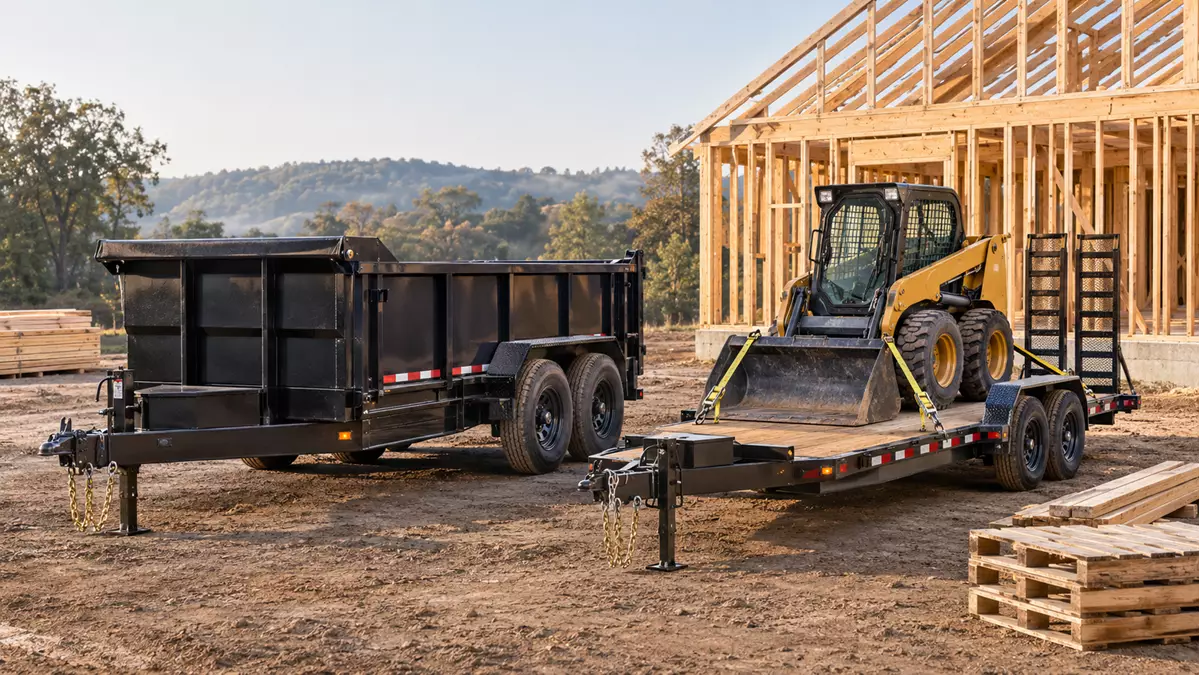
The workhorses on a commercial site are the dump trailer for demolition debris, dirt, and cleanup, the flatbed or equipment trailer for skid steers, mini excavators, and pallets of material, and the enclosed trailer for secure tool storage and a lockable rolling shop. Which one you want depends on the trade and the task, and plenty of jobs need more than one. For the full breakdown of which trailer type fits which job, our guide to trailer rentals for contractors covers each type in detail, so this post stays focused on the long-term rental side.
Price the Whole Project Once with Trailer Bid
The awkward part of a long rental has always been getting a straight price for it. Most of the market quotes a daily rate and leaves you to do the math, guess at delivery, and discover the rest at checkout. Trailer Bid, a Neighbors Trailer site built for long rentals, flips that around: you post the job once and suppliers near your site each quote one complete total for the whole thing.
Here is how it works for a contractor. You post what you need, the trailer type and size, the jobsite ZIP, the start date, how long you need it (up to a year), your delivery preference, and a maximum budget. Posting is free, takes about two minutes, and does not obligate you to accept anyone. Suppliers near the site each submit one landed total that covers the rental for the whole period, delivery to the site, collection at the end, and Neighbors Trailer fees. Tax is added at checkout where it applies, and the refundable security deposit is listed separately, so the number you compare is a real all-in price, not a starting rate. That one-total approach is the whole idea behind our explainer on why a complete invoice beats a vague quote.
Bids come back ranked by total, with each supplier's distance from your site shown, and you can send a read-only comparison link to whoever signs off on spend so they can review without being able to change anything. You choose the one you want, or none, within a set window before the bids expire. Booking and payment happen on Neighbors Trailer, with the same ID verification, protection, and support as any rental, and your site contact details are shared only with the supplier you choose, after you confirm. For a rental longer than a month, it runs as consecutive bookings about a month apart at the total you locked in, so the full-term price does not move on you partway through the job. Delivery is priced per mile for the round trip, which our delivery cost explainer breaks down with real rates.
Delivery to the Site, Priced In
For a crew, getting the trailer to the jobsite and back is part of the cost, not an afterthought, and it is worth knowing what delivery actually runs. Across Neighbors Trailer listings that offer it, delivery is priced per mile for the round trip. About six in ten listings offer delivery at all, the most common rate is $2.00 per mile, the median is $2.38, and the middle half of listings fall between $2.00 and $3.00 per mile, typically within roughly a 50-mile radius. Those are asking rates from listings, not a quote for your job, but they give you a realistic sense of the number before you post.
The reason this matters on a long rental is that delivery is a one-time cost spread across the whole project, not a repeated errand. Have it dropped at the start and collected at the end, and the per-day impact on a month-long job is small. Because a Trailer Bid total already folds delivery and collection in, you are comparing one landed number per supplier instead of trying to back out transport on your own.
To put the pieces together, picture a dump trailer for a 30-day cleanup. Using the medians above purely as an illustration and not a quote, the rental runs near the monthly end of the curve rather than the weekend rate, delivery and collection are a single round-trip charge rather than thirty daily trips, and Neighbors Trailer fees and any applicable tax round it out. Your actual total depends on the trailer, your location, and what suppliers near you quote, which is exactly why posting the job and letting them price it beats guessing.
Dependable Supply, Job After Job
Price is only half the problem. The other half is availability, and it is where a single rental yard's small fleet lets contractors down. Neighbors Trailer connects you with more than 22,000 trailer suppliers and more than 14,000 trailers across the US and Canada, so you are drawing on nearby inventory rather than hoping one lot has the right trailer free on your start date.
That depth matters most for the contractor who needs the same kind of trailer again and again. On most platforms, a long job means extending a short booking over and over, hoping it stays available each time. In Neighbors Trailer's own data, one renter extended a single booking eighteen separate times rather than lock in the length up front. Posting the whole job once, pricing it once, and locking it once removes that scramble, and it makes the next job easier to plan because you already know how the process works.
What to Have Ready Before You Post
You can post a job in about two minutes if you have these five things in hand. Pulling them together first makes the quotes you get back cleaner and easier to compare.
- Trailer type and size. Dump, flatbed or equipment, or enclosed, and the size the job actually needs.
- Jobsite ZIP and start date. Suppliers quote by distance to the site, so the location drives both price and delivery.
- How long you need it. The real project length, up to a year, since that is what sets the rate.
- Delivery preference. Whether you want it delivered and collected or will handle transport yourself.
- A maximum budget. The ceiling you want suppliers to quote under, which keeps the bids realistic.
Rent for the Length of the Job
Contractors do not lose money on the trailer itself. They lose it on the wrong rental structure: daily rates stacked across a long job, capital sunk into a trailer that sits idle, or a crew waiting because the one trailer in town was already out. Renting for the actual length of the project, at a rate that reflects that length, and getting one clear price for the whole thing up front is how you turn the trailer from a recurring headache into a line item you can plan around. Post your next job on Trailer Bid and let suppliers near your site quote it.