

What the Numbers Say About P2P Trailer Rental in 2026 (Preview)
 Neighbors Trailer
May 15, 2026 193 5 min read
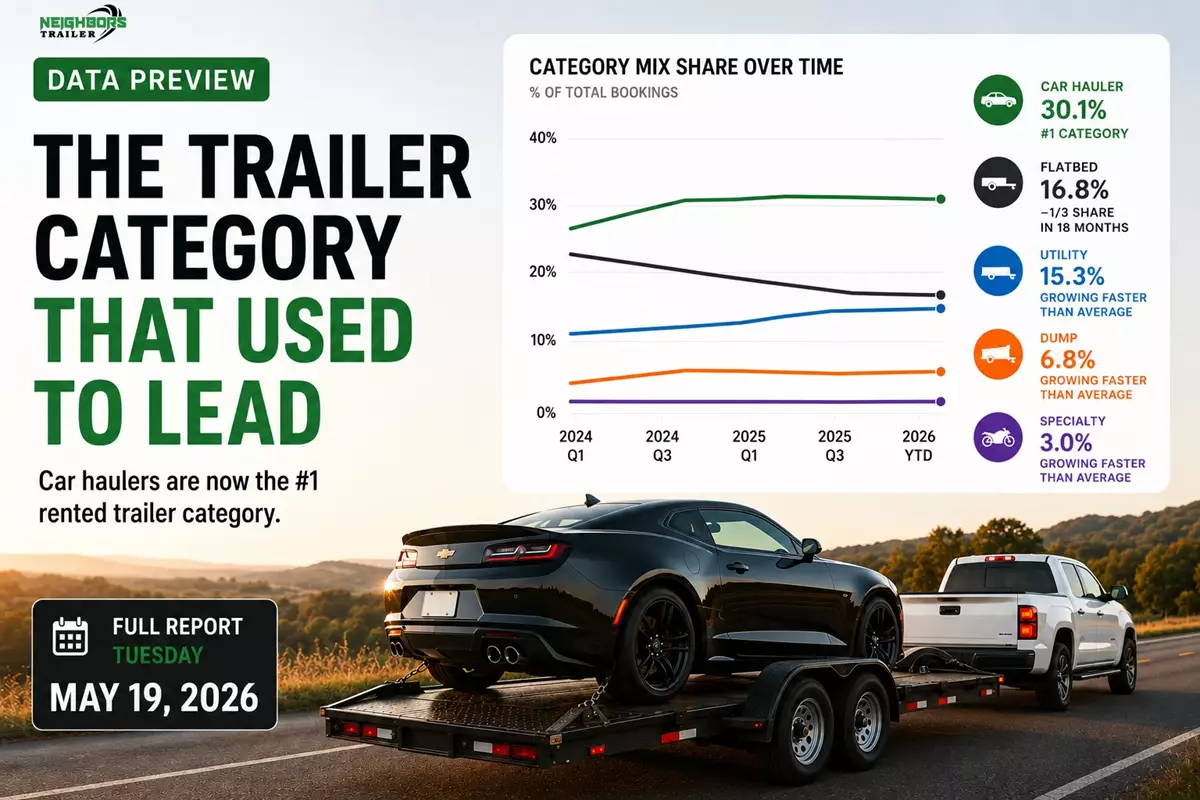
Peer-to-peer trailer rental is in early-stage rapid growth, but the demand mix is shifting underneath. Car haulers have become the dominant category. Flatbed trailers — tied for #1 just 18 months ago — have lost roughly a third of their mix share. Utility, dump, and specialty categories are growing faster than the platform average. The full breakdown of these trends, with three years of marketplace data, publishes Tuesday May 19.
The Trailer Category That Used to Lead
If you'd asked anyone in early 2024 which trailer type dominated peer-to-peer rentals, most would have guessed flatbed. They'd have been right at the time. Through Q1 and Q2 of 2024, flatbed trailers were the most-rented category on the Neighbors Trailer marketplace, accounting for roughly 27% of all bookings — essentially tied with car haulers as the platform's co-leader.
That's not the picture in 2026.
Flatbed's share has dropped sharply in 18 months. Car hauler bookings now meaningfully outpace flatbed bookings, and the gap is widening. Several categories that were marginal in 2024 — utility, dump, specialty trailers — have grown faster than the platform overall, pulling more share away from flatbed each quarter.
This isn't because flatbed rentals are disappearing. Flatbed bookings continue to grow in absolute terms. They're just being outrun. And the structural shift in what people are renting trailers for turns out to be one of the more interesting findings in a year's worth of marketplace data.
We're publishing the full breakdown Tuesday May 19, but here's the preview.
What Changed
The simplest way to describe what happened: renters are using P2P platforms for different jobs than they were two years ago.
Flatbed trailers are general-purpose workhorses. They serve construction, landscaping, equipment hauling, and a wide range of other use cases. They were the natural first choice for early P2P renters who weren't sure what they needed and gravitated to the most familiar trailer type.
Car haulers are different. Renting one means you have a specific job — usually moving a vehicle from point A to point B. Auction pickups. Track day transport. Inoperable vehicle moves. Collector car shows. Cross-country relocations with a second car in tow. The growth in car hauler rentals reflects a category of users who weren't using P2P platforms much in 2024 — people moving cars — and are now using them at scale.
The same pattern holds in the other categories that gained share:
- Utility trailer rentals have grown faster than the platform average. These are weekend homeowner jobs: mulch runs, yard waste, single-piece furniture moves.
- Dump trailer rentals have also grown faster than average. Dump trailers serve a working-user category — small contractors, landscapers, debris removal, working-class hauling jobs. Their growth signals the platform is being adopted by working professionals, not just hobbyists.
- Specialty and motorcycle trailer rentals have grown from very small bases by multiples each year. The "long tail" of trailer types — tow dollies, boat trailers, motorcycle haulers, livestock trailers — is being discovered.
What you don't see in this data is flatbed demand collapsing. You see the platform broadening. As more renters with more specific needs find P2P trailer rental, the share each category holds shifts to reflect what people actually want.
Why This Matters for the Category
Three things are worth pulling out, even before the full report.
1. Use-case diversity is the leading growth indicator.
The platforms that grow fastest in the sharing economy are usually the ones that capture more distinct use cases over time. Airbnb went from "couch sharing" to vacation rentals, business travel, monthly stays, and luxury rentals. The same pattern — one platform serving an expanding range of distinct jobs — appears to be playing out in P2P trailer rental.
2. The stereotype is wrong.
The default mental image of "trailer rental" is a homeowner hauling mulch on a Saturday. The data tells a different story. The single most-rented category — by a meaningful margin — is car haulers. The fastest-growing categories include trailers used by working professionals (dump trailers) and specialty users (motorcycle haulers, specialty trailers).
3. Category mix evolution may be more informative than total growth numbers.
Most industry growth headlines focus on total volume — bookings up X%, revenue up Y%. Those numbers matter. But for a category in early growth like this one, the shape of the growth — which use cases are gaining and which are stable — tells you more about where the market is going than the topline numbers alone.
What's in the Full Report Tuesday
The full 2026 industry report drops Tuesday May 19 and includes:
- Year-over-year revenue and booking volume figures for 2024 and 2025
- 2026 year-to-date pace data
- The complete category mix evolution across three years of platform data
- Geographic concentration analysis (top states, top cities)
- Seasonality patterns
- Conversion funnel analysis
- What the data signals about where the category is heading
We'll publish it as a standalone post under the title "The State of Peer-to-Peer Trailer Rental: 2026 Industry Snapshot."
If you're tracking the sharing economy, the trailer-rental category, or just curious how a young marketplace's demand mix evolves in its first three years, the full report is worth the wait.
Further Reading
- Best Trailer Type for Each Job: A Quick Picker
- Renting vs. Buying a Trailer: A 2026 Cost Comparison
- How Peer-to-Peer Marketplaces Vet Users
Ready to participate in the market?
- Renters: Browse trailers in your area — see which categories are listed near you
- Owners: List your trailer — put your idle equipment to work