Complete Guide to Installing E-Tracks on Your Cargo Trailer
 Neighbors Trailer
Jan 10, 2024 2875 7 min read cargo traile
E-tracks are the unsung hero of secure cargo hauling. Those slim aluminum rails bolted to the walls and floor of an enclosed cargo trailer turn an empty box into a fully adjustable tie-down system, capable of holding everything from a refrigerator to a stack of furniture pads to a motorcycle. If you have ever rented a cargo trailer and wondered why some interiors look like a parking garage of slotted rails, this guide is for you.
This complete guide walks through what e-tracks are, how they work, how to use them correctly, what hardware to pair with them, and how to choose a cargo trailer rental on the Neighbors Trailer marketplace that already has the e-track system you need. By the end, you should be able to walk into any e-track-equipped cargo trailer and tie down a load like a pro mover.
What Is an E-Track System?
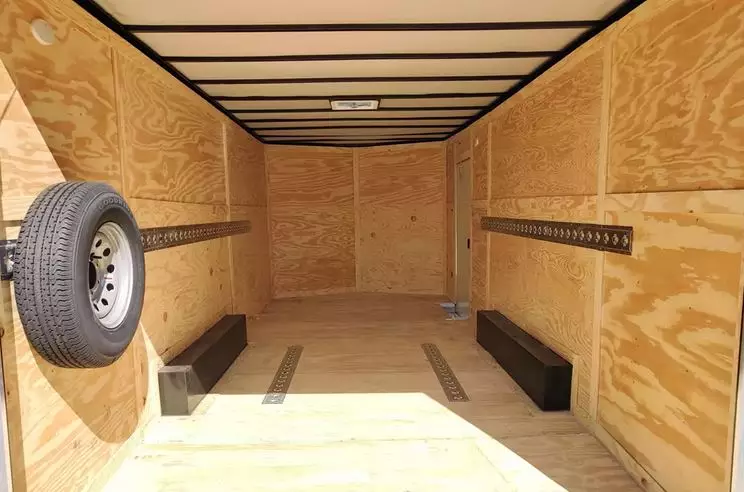
An e-track is a length of slotted metal rail, usually made from galvanized steel or aluminum, with evenly spaced rectangular openings. Each slot accepts a compatible fitting: a ring, a hook, a strap-end clip, or a bar end. The fittings lock into the slot with a quick downward push, then are held in place by tension when you crank the strap.
E-tracks come in two standard orientations. Horizontal e-track runs along the walls of the cargo trailer, typically at one or two heights, and is used for over-the-top tie-downs and side-load straps. Vertical e-track runs floor-to-ceiling in the corners, giving you anchor points you can use anywhere along the vertical axis. Some heavy-duty cargo trailers also include floor-mounted e-track, which is perfect for low-profile loads or motorcycle wheels.
Why E-Tracks Beat Static Tie-Down Rings
Old-school cargo trailers used a handful of welded-on tie-down rings, usually four total: one in each corner. That arrangement is fine for a single centered pallet, but it falls apart the moment your load is offset, oddly shaped, or stacked. E-track lets you place an anchor exactly where the load needs it, slide a second anchor over to balance the strap angle, and add a third for redundancy. The result is a load that does not shift, even on cross-country interstate runs.
| E-Track Fitting | Working Load Limit | Best Use | Compatible Strap |
| O-Ring Fitting | 1,200 to 2,000 lb | Universal anchor for any strap | Snap hook or carabiner |
| Spring-Loaded Ring | 1,500 lb | Quick attach and release | Snap hook ratchet straps |
| Strap-End Fitting | 1,200 to 1,700 lb | Permanent-feel strap anchor | Pre-attached ratchet straps |
| Wood Beam Socket | 1,000 lb each (pair) | Decking platforms, dividers | 2x4 or 2x6 lumber |
| D-Ring with Plate | 1,500 to 2,500 lb | Vehicle and equipment tie-down | Chain or heavy ratchet strap |
Choosing the Right Fittings for Your Load
The fitting you choose should match both the cargo and the strap you already own. If you have a set of ratchet straps with welded snap hooks, you want O-ring or spring-loaded ring fittings. If your straps end in a flat strap-end clip, get strap-end fittings instead. Mixing the two requires an adapter and adds slop you do not want under highway tension.
For wheeled cargo like motorcycles and ATVs, the wheel chock plus four ratchet straps to four e-track anchors is the gold standard. For appliances, two horizontal straps over the top, with a furniture pad to protect the finish, will lock a refrigerator or washer in place. For loose items like boxes, a load bar dropped into wood-beam sockets creates a horizontal divider that prevents forward shift under braking.
How Movers Actually Use E-Tracks
Professional moving crews load a cargo trailer in tiers. The chart below shows the typical distribution of e-track anchors used during a residential move, based on industry training data. Understanding the mix helps you pack the right hardware before you load up.
NeighborsTrailer.com
Loading Order That Maximizes E-Track Use
The biggest mistake renters make is loading first and tying down last. The right sequence is to load one tier of cargo, secure it with straps to e-track anchors before adding the next tier, then build up. This keeps the load square as it grows and gives every item its own dedicated anchor. If you only tie down the outer wall items after stacking, the items in the middle of the load have nothing holding them, and they will shift on the first hard brake.
Always strap heavy items first, low and against the front wall. Stack lighter items on top. Use load bars in wood-beam sockets to create horizontal dividers between tiers so weight does not collapse downward on bumpy roads. For deeper tie-down theory, see our complete guide to tie-downs in an enclosed trailer rental.
Compatible Straps and Tools
You do not need a giant toolkit to use an e-track system well, but a few essentials make every haul easier. Pack four to six ratchet straps in the 1,000 to 2,000 pound working load limit range, a pair of load bars, four corner protectors, and two moving pads. If you do not own these, most cargo trailer owners on Neighbors Trailer include a basic strap kit with the rental, and a few include load bars too. Check the listing notes before you book so you know what to bring.
Inspecting E-Tracks Before Each Haul
E-tracks take abuse. Before each rental, the owner should have already inspected them, but it is worth a 30-second walk-around. Look for cracked slots, missing screws, or rust pitting in the rail. A cracked slot can let a fitting unhook under tension, which is a fast way to lose your load. If anything looks compromised, photograph it, message the owner, and ask about a backup trailer.
Booking an E-Track-Equipped Cargo Trailer
Filter Neighbors Trailer listings by enclosed cargo trailer, then read the description for words like "e-track," "L-track," or "logistics track." Some owners include a full hardware kit, others charge a small fee for it. Message the owner to confirm e-track height, length, and the number of anchor points if your load has tight tie-down requirements. Renters must be at least 21 to book, and owners receive payouts through Stripe within two to three business days of the trailer's return.
Frequently Asked Questions
What is the difference between e-track and L-track?
E-track has rectangular slots and is the most common system in cargo trailers. L-track has narrower elongated slots and is more common on airline cargo and aluminum race trailers. The two systems are not cross-compatible without specific fittings.
How much weight can a single e-track anchor hold?
Most fittings carry a working load limit between 1,200 and 2,500 pounds. The rail itself is rated higher, but the limiting factor is always the fitting and the strap. Multiply by the number of anchors and divide cargo weight evenly across them.
Can I install e-track in a trailer I rent?
No. Renters cannot drill new anchors into a rental. If you need more anchor points than the listing offers, choose a different trailer that has the full e-track configuration already installed.
Do I need special straps for e-track?
Standard ratchet straps with snap hooks work with O-ring fittings. If your straps end in a flat strap-end clip, you need strap-end fittings. Match the fitting to the strap rather than the other way around.
The Bottom Line
E-track turns an enclosed cargo trailer into an adjustable, professional-grade tie-down platform. Choose the right fittings for your strap kit, build the load in tiers, secure each layer before adding the next, and inspect the rails before every haul. Browse Neighbors Trailer for e-track-equipped cargo trailers near you and book directly with the owner.
Related Articles
- Complete Guide to Tiedowns to Secure Your Cargo in an Enclosed Trailer Rental
- Cambuckle Ratchet Straps for Car Trailer Tie Downs
- How to Use Ratchet Straps on a Flatbed Trailer Rental
- Car Trailer Etracks Guide
Content updated May 2026