

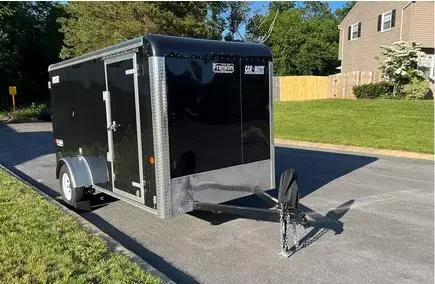
Top Box Trailer Weight Distribution Hitches for Smoother Drives
 Neighbors Trailer
Feb 9, 2024 371 6 min read box traile
A weight distribution hitch transforms how a box trailer handles, especially when the trailer crosses 4,000 pounds gross or the tongue weight pushes the rear of the tow vehicle down. By transferring tongue weight forward to the truck axle and rearward to the trailer axle, a properly tensioned weight distribution hitch keeps the truck level, the steering responsive, and the trailer pointing where you want it. This guide covers when you need one, what to look for when buying, how to set it up correctly, and which hitch styles work best for box trailers in the 5,000 to 14,000 pound range.
What a Weight Distribution Hitch Actually Does
A standard ball mount carries the entire tongue weight on the rear of the tow vehicle. Past about 500 pounds, that downward force squats the rear suspension, lifts the front wheels, lightens steering, and reduces braking on the front axle. A weight distribution hitch (WDH) uses spring bars or torsion arms to redistribute that load: roughly one-third stays on the rear axle, one-third moves to the front axle, and one-third transfers back to the trailer axle. The result is a level rig with full steering and braking authority on all axles.
When Box Trailers Need a Weight Distribution Hitch
Most truck manufacturers require a WDH once trailer gross weight exceeds 5,000 pounds. Below that, it is optional but improves handling on long hauls. The table below maps trailer weight ranges to recommended hitch class.
| Trailer Gross Weight | Tongue Weight Range | Hitch Class | WDH Spring Bar Rating |
| Under 3,500 lb | Up to 350 lb | Class II | WDH optional |
| 3,500 to 5,000 lb | 350 to 500 lb | Class III | WDH recommended, 600 lb bars |
| 5,000 to 8,000 lb | 500 to 800 lb | Class III or IV | WDH required, 800 to 1,000 lb bars |
| 8,000 to 12,000 lb | 800 to 1,200 lb | Class IV | WDH required, 1,200 lb bars |
| 12,000 to 14,000 lb | 1,200 to 1,400 lb | Class IV | WDH required, 1,400 lb bars |
Performance Difference With and Without a WDH
The chart below summarizes typical handling improvements for a 7,500-pound box trailer paired with a half-ton pickup. Sway reduction and steering response improve dramatically, while brake distance from 60 mph drops by 15 to 25 feet.
NeighborsTrailer.com
How to Pick the Right Weight Distribution Hitch
Match Spring Bar Rating to Loaded Tongue Weight
Tongue weight should be 10 to 15 percent of trailer gross weight. Pick spring bars rated within 100 pounds of your fully loaded tongue weight. Bars rated too heavy ride harshly when the trailer is empty; bars rated too light bottom out when loaded.
Decide: Spring Bar or Cam Sway Control
Basic round bar WDHs handle weight transfer only. Trunnion bar designs with built-in friction sway control add cornering and crosswind stability. For box trailers, which catch wind like a sail, prioritize a hitch with integrated sway control.
Match Receiver and Coupler
Confirm the WDH shank fits your truck's receiver opening (2-inch or 2.5-inch) and that the ball matches your trailer coupler (2 inch or 2-5/16 inch is most common on box trailers).
Quality Brands and Where to Buy
Equal-i-zer, Reese Strait-Line, Andersen No-Sway, and Husky Center Line are the most common quality choices. Expect to pay $400 to $900 for a complete kit. The adjustable hitch guide covers shank selection in detail.
How to Set Up a Weight Distribution Hitch Correctly
Step 1: Measure Truck Height Unloaded
With the truck empty (no trailer attached), measure the height of the front and rear wheel wells. Record both numbers.
Step 2: Hitch the Trailer
Couple the trailer ball, lock the latch, and attach the safety chains. Do not engage the spring bars yet.
Step 3: Measure Truck Height Loaded
Re-measure the front and rear wheel wells. The rear should be lower; the front may have lifted slightly.
Step 4: Engage the Spring Bars
Use the lift handle to lock the spring bars into the snap-up brackets. The truck should rise back toward level.
Step 5: Re-Measure and Adjust
Target: the front wheel well height is restored to within half an inch of the unloaded measurement. If the front is still too low, raise the head angle one tooth (more weight transfer). If too high, lower one tooth.
Step 6: Road Test
Drive a 5-mile loop with stops, lane changes, and a freeway entrance. The trailer should follow without sway. Brakes should engage all four corners on the truck. Re-tighten any clamp bolts after the first 100 miles.
Common Setup Mistakes
The most common mistake is undersizing the spring bars. The second is over-tensioning by setting the head angle too aggressive, which lifts the rear wheels too far off the ground and reduces traction. The third is forgetting to prep the tow vehicle with proper tire pressures and a working brake controller before attempting any heavy haul.
Frequently Asked Questions
Can I use a weight distribution hitch with surge brakes?
Yes, but the WDH must use chains or cams that do not interfere with the surge actuator's free movement. Some friction sway designs are not compatible with surge brakes; check the manufacturer specs.
Do I need to remove the WDH spring bars to back into a tight spot?
Older designs required removal. Most modern WDHs allow tight reverse maneuvers without removal, though sharp jackknife angles can damage the brackets. Slow down and watch the angle.
Can I use a WDH on a small SUV?
Only if the SUV manufacturer permits it and the receiver is rated for the load. Many crossovers have a Class II receiver that is not WDH-compatible. Check the owner's manual before adding spring bars.
How tight should the spring bars feel when engaged?
The lift handle should require firm effort but not maximum effort. If you cannot raise the bars without standing on the handle, the bars are oversized or the head angle is too aggressive. Adjust before towing.
Will a weight distribution hitch help with a tongue-heavy box trailer?
Yes. Tongue-heavy box trailers benefit most from a WDH. Without weight distribution, the truck rear sags so far that headlights point at the sky. A WDH restores level ride and proper headlight aim.
Closing Thoughts
A correctly sized weight distribution hitch is one of the highest-impact upgrades you can make to a box trailer towing setup. The right hitch keeps the rig level, restores braking and steering authority, and dramatically reduces sway. Match spring bar rating to loaded tongue weight, set the head angle to restore front-axle height, and re-check the bolts after the first 100 miles. Done correctly, the rig drives like the trailer is barely there.
Related Articles
- Enclosed Trailer Rental Hitch Guide
- Flatbed Trailer Rental Hitch Guide
- Cargo Trailer Rental Adjustable Hitches
- How to Prepare Your Truck to Tow Safely
Content updated May 2026