

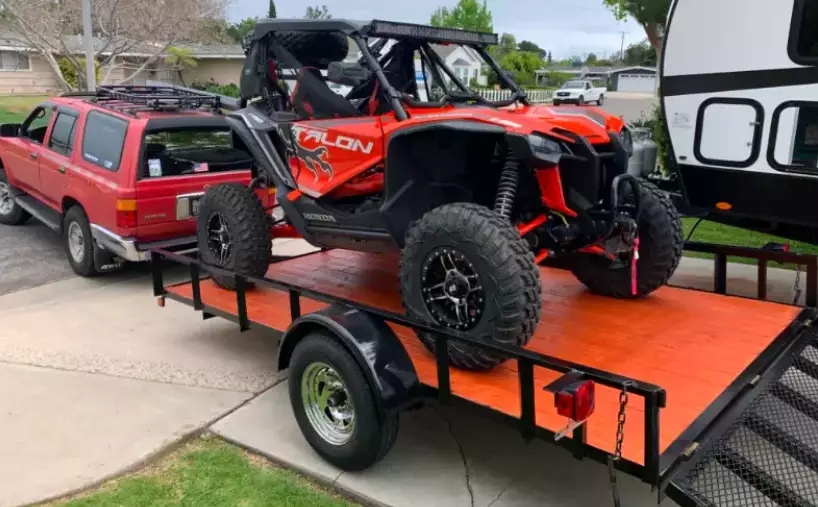
How to Safely Load ATVs and UTVs on Your Trailer: Complete Loading Guide
 Neighbors Trailer
Jan 11, 2023 945 8 min read
Content updated March 2026.
Loading an ATV or UTV onto a trailer is one of the more technical tasks in recreational towing — and one of the more dangerous if done incorrectly. These machines are heavy, high-centered, and easy to tip when transitioning from ramp to trailer deck. A loading mistake can result in a flipped vehicle, a damaged trailer, or serious injury to anyone standing nearby.
Whether you're loading for a weekend ride, a hunting trip, or a job site, these step-by-step tips will help you load ATVs and UTVs safely and securely onto your trailer rental from Neighbors Trailer.
1. Choose the Right Trailer for Your ATV or UTV
Before anything else, confirm that your trailer is rated for the weight and dimensions of your machine. Our ATV, UTV and motorcycle trailer calculator matches a deck size and weight rating to your specific machine. ATVs typically weigh 400–900 lbs, while UTVs can weigh 1,200–2,500 lbs or more. A tandem-axle flatbed or open utility trailer with an appropriate weight rating, full-width ramps, and adequate deck length is ideal for most ATV/UTV loading.
The trailer deck should be at least as wide as your machine's widest point (typically the handlebars for ATVs, the overall body width for UTVs). Ramps should be wide enough for your tires and rated for your vehicle's weight. Undersized ramps are a leading cause of ATV loading accidents.
2. Inspect the Ramps Before Loading
Before attempting any loading, inspect the ramps for cracks, bends, loose mounting hardware, or worn anti-slip surface. Ramps that aren't securely latched to the trailer can shift during loading — if a ramp slides sideways while you're driving an ATV up it, the machine will go with it.
Check that both ramps are set at the same height and angle. Mismatched ramps cause lateral tipping during loading. Spread the ramps to match your machine's track width exactly, and confirm they're locked in place before the engine starts.
3. Position the Trailer on Flat, Stable Ground
Never load an ATV or UTV on a slope, soft ground, or uneven surface. The loading process requires the trailer to remain stationary as the machine's weight transfers from ramp to deck — any trailer movement during this transition creates a tipping or sliding risk. Choose the flattest, hardest surface available.
Chock the trailer wheels before loading. Even on flat ground, the dynamic forces of a machine rolling up ramps can push a trailer forward. Wheel chocks keep the trailer stationary throughout the loading process.
4. Approach the Ramps Straight On
Always align your ATV or UTV directly in line with the ramps before starting the approach. Angled approaches to ramps are extremely dangerous — even a few degrees of misalignment can cause the machine to clip the ramp edge and tip sideways. Take the time to position the machine perfectly square before you begin.
Keep your speed slow and controlled during the approach. High speed up a ramp makes it impossible to react to problems and dramatically increases the forces acting on the machine when it transitions from ramp to deck. Slow, steady power — just enough to maintain momentum — is the correct technique.
5. Maintain Momentum Without Stopping on the Ramp
Stopping on the ramp is one of the most common causes of ATV loading accidents. A machine stopped on a steep ramp can roll backward unpredictably, and restarting on the incline creates a wheel-spin and jerk that can cause tipping. Apply enough throttle to maintain steady forward momentum from the beginning of the ramp to fully onto the trailer deck.
Practice the throttle application you'll need before you start — a light, consistent power input that doesn't exceed walking pace. If your machine stalls or stops on the ramp, do not attempt to restart. Have a helper push from behind if needed, or bring the machine back down and troubleshoot before attempting again.
6. Use a Spotter on Every Load
A spotter standing to the side — never behind — of the machine provides an extra set of eyes on alignment, ramp stability, and machine balance throughout the loading process. The spotter should watch the ramp contact points and watch for any lateral lean beginning to develop.
The spotter should have a clear sightline to the driver and be positioned to give hand signals rather than shouting — engine noise during loading makes verbal communication unreliable. Agree on signals (stop, go, straighten left/right) before beginning.
7. Drive to the Front of the Trailer Deck
Once your ATV or UTV is fully on the trailer deck, drive it as far forward as possible — ideally with the front bumper near the front rail or bulkhead. Front-loading positions the machine's weight over or ahead of the trailer axle(s), which optimizes tongue weight distribution and prevents trailer sway during towing. Our weight distribution planner helps you dial in that balance before you tow.
Center the machine side-to-side on the deck. An off-center machine creates uneven tongue weight and side loading on the trailer frame, which degrades handling and puts asymmetric stress on the tires and bearings.
8. Set the Parking Brake and Kill the Engine
As soon as the machine is positioned, set its parking brake and kill the engine before doing anything else. Never begin tie-down while the engine is running — an accidental engagement could move the machine while you're next to it. The parking brake provides a first layer of security while you prepare the tie-downs.
For UTVs with automatic transmissions, also place the selector in Park. For manual transmission machines, leave them in gear. Every mechanical holding mechanism you can engage gives you more security during the tie-down process.
9. Secure with Four Tie-Down Straps — One at Each Corner
Four tie-down straps, one at each corner of the machine, is the minimum for safe ATV/UTV transport. Attach straps to solid frame points — never to plastic body panels, suspension arms, or steering components. For ATVs, the most common secure anchor points are the front and rear frame tubes. For UTVs, use the cage/frame mounting points specifically designed for tie-downs.
Run straps straight down from the anchor point to the trailer D-ring at approximately 45 degrees — this angle provides both downward force (keeping the machine on the deck) and forward/rearward restraint. Ratchet all straps to firm tension, compressing the suspension slightly. The machine should not bounce or shift when you push against it with significant force. For complete guidance on tie-down techniques, see: Complete Guide to Tie-Downs: Securing Cargo in an Enclosed Trailer Rental.
10. Do a Final Check Before Moving
Before pulling away, do a complete walk-around: all four tie-down straps are tight and properly hooked, ramps are raised and secured, machine is centered, parking brake is set, and nothing is hanging loose. Check your trailer lights and confirm brake lights and turn signals are functioning on both the trailer and the tow vehicle.
Plan to stop within the first mile and re-check strap tension — machine weight and trailer vibration cause straps to seat and may reduce tension slightly. A quick stop to re-tighten is a small investment compared to losing a machine off the trailer at highway speed. For more on towing safety, see: Ultimate Trailer Towing Safety Guide.
ATV/UTV Loading Safety Checklist
Use this checklist before and after loading your machine:
| Step | Action Required | Status Check | Priority |
| Trailer selection | Verify weight rating and ramp width | Before loading | Critical |
| Ramp inspection | Check condition, latching, alignment | Before loading | Critical |
| Ground surface | Confirm flat, stable, hard surface | Before loading | Critical |
| Wheel chocks | Chock trailer before approach | Before loading | Critical |
| Straight approach | Align machine with ramps, square | During loading | Critical |
| Spotter positioned | Spotter to the side, signals agreed | During loading | High |
| Forward deck position | Machine to front, centered side-to-side | After loading | High |
| Parking brake and engine off | Set brake, kill engine before tie-down | After loading | Critical |
| 4-point tie-down | 4 straps at 45 degrees, firm tension | After loading | Critical |
| Pre-departure walk-around | Straps, lights, hitch, chocks removed | Before driving | Critical |
Loading Risk by Technique Error
This chart shows the relative risk introduced by each common loading mistake:
NeighborsTrailer.com
Load Right, Ride Safe
Loading an ATV or UTV is a skill that gets faster and more natural with practice, but it should never become casual. The risks of a poorly loaded machine — trailer sway, tipped vehicles, loose tie-downs at highway speed — are serious. Taking an extra 5–10 minutes to load correctly every time is always the right call.
Every trailer rental through Neighbors Trailer automatically includes NT Protect — built-in coverage at just a few dollars per day — so you can focus on the ride instead of the what-ifs. Explore more loading and towing guides: