

Using Winch Straps to Secure Your Load
 Neighbors Trailer
Nov 6, 2023 872 7 min read winch strap
A flatbed trailer rental is one of the most flexible pieces of hauling equipment available, and it earns its keep when you have heavy, awkward, or oversized cargo. The catch is that everything you load has to be locked down so well that it could take a hard stop at highway speed without shifting. That is where a thoughtful combination of winch line and tiedowns turns a flatbed into a safe, repeatable solution rather than a guess.
This guide walks through how to plan, install, and inspect winch tiedowns on a flatbed trailer rental, including the working load limits, hardware choices, and pre-trip checks that keep cargo where you put it.
Why Winch Tiedowns Matter on a Flatbed
Flatbed trailers ride high, expose cargo to wind, and offer no walls to absorb load shifts. A few seconds of inattention from another driver can force a sudden brake or evasive lane change, and the load needs to ride that out without breaking free. Federal cargo securement rules call for a minimum of one tiedown for every ten feet of cargo length, and the aggregate working load limit of all tiedowns must equal at least half the cargo weight. Winch-style tiedowns make hitting those numbers fast and consistent.
Choose the Right Winch Line and Tiedown Hardware
The line type you choose affects load rating, weight, and durability. The chart below summarizes typical working load limits for common winch lines and tiedown wire sizes. Always compare the working load limit, not the breaking strength, since working load is rated for repeated dynamic use.
NeighborsTrailer.com
Synthetic line is lighter, easier on the hands, and safer if it parts under load. Steel cable is more abrasion-resistant and better for dirty job sites. For most flatbed cargo work, a 3/8-inch synthetic winch line paired with 4-inch ratchet straps and Grade 70 chain segments covers the common load ranges.
Inspect the Anchor Points Before You Load
Winch tiedowns are only as strong as what they connect to. Before any load goes on the deck, walk the rails and inspect every anchor point.
- Stake pockets should be free of rust pitting that weakens the rim.
- Welded D-rings should show no cracks at the weld bead.
- Sliding winch tracks should run smoothly without binding.
- Floor decking around any anchor should be solid, not soft or rotted.
If anything looks weak, photograph it and message the trailer owner before you load. Owners on a peer-to-peer marketplace would rather swap a worn anchor before the trip than deal with a damage claim afterward.
Plan the Tiedown Layout
Effective tiedowns work in four directions: forward, rearward, side-to-side, and downward. Designing the layout before you load saves you from re-strapping later.
Direct Tiedowns
Direct tiedowns connect cargo anchor points to trailer anchor points and resist motion in the direction of the strap. Use direct tiedowns to keep heavy machines and vehicles from sliding forward under braking or rearward under acceleration.
Indirect Tiedowns
Indirect tiedowns pass over or around the cargo and apply downward force, increasing friction with the deck. They prevent shifting and bouncing rather than holding against a single direction.
Hybrid Layouts
Most loads need both. A skid steer, for example, gets four direct chains at the corners plus two indirect straps over the cab and bucket arm. The combination handles heavy loads, sudden braking, and road bumps as a system.
Working Load Limits to Plan Around
Match each tiedown to its expected share of the load. The table below shows quick reference numbers for common hardware on a flatbed rental.
| Hardware | Typical WLL (lbs) | Best Use |
| 2-inch ratchet strap | 1,000 to 1,667 | Light pallets, lumber, building materials |
| 3-inch ratchet strap | 3,333 | Mid-weight equipment, mid-load vehicles |
| 4-inch ratchet strap | 5,400 to 5,500 | Heavy equipment, machinery, large vehicles |
| Grade 70 transport chain 5/16 | 4,700 | Direct chain tiedowns, hooked to anchor points |
| Grade 70 transport chain 3/8 | 6,600 | Heavy equipment direct tiedowns |
| 3/8-inch synthetic winch line | 7,500 | Pulling and securing wheeled cargo |
Add up the WLL of all tiedowns securing a load and confirm the total is at least 50 percent of the cargo weight. Big loads often need more straps than you think, especially when using indirect tiedowns where the strap angle reduces effective hold.
Installing the Tiedown Sequence
Always install tiedowns in this order: chocks or wedges first, direct tiedowns next, indirect straps last, and final tension after a short test pull.
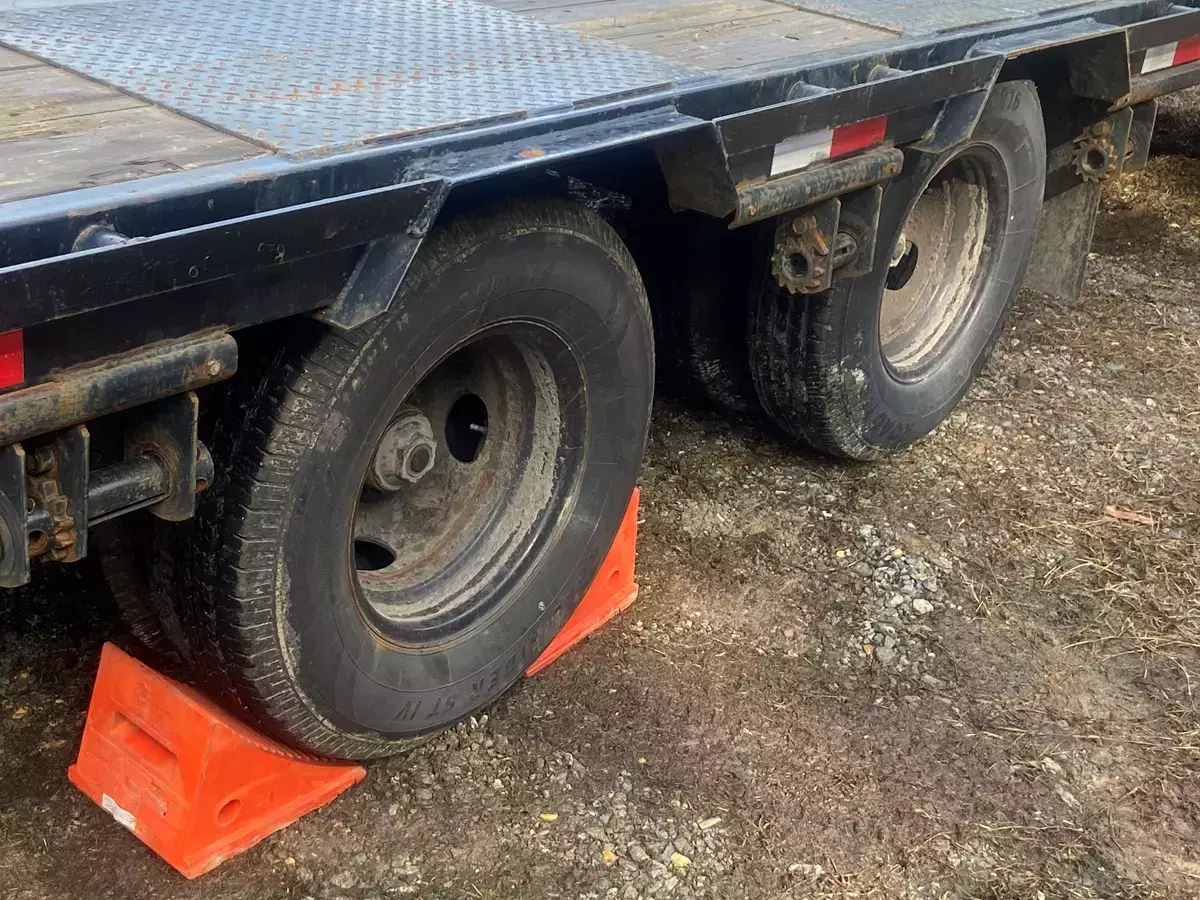
- Position the load on the deck and chock the tires or runners so it cannot roll.
- Attach direct tiedowns to fixed anchor points on the cargo and matching trailer anchor points. Set initial tension by hand.
- Pass indirect straps over the load to apply downward force. Tension after directs are set so the indirects do not redirect the cargo before the directs have a chance to seat.
- Drive the rig forward 100 feet on level ground, stop, and re-tension every strap. Vibration almost always loosens at least one connection during the first move.
- Recheck within the first 50 miles of highway driving and at every fuel stop after that.
The ratchet strap walkthrough on a flatbed trailer rental covers the strap-tensioning step in more detail.
Common Tiedown Mistakes to Avoid
Even careful operators slip up on tiedowns. Watch for these recurring issues:
- Crossing chains over sharp corners without edge protection. Sharp edges cut WLL by half.
- Using a single ratchet strap as the only restraint on a heavy item.
- Ignoring the angle of the tiedown; angles below 30 degrees lose holding power fast.
- Mixing chain and synthetic strap on the same load without confirming compatible WLL.
- Skipping the re-tension stop after the first 50 miles. Almost every load settles in.
For chain-specific guidance, see the flatbed trailer rental chain binder guide.
Frequently Asked Questions
How many tiedowns do I need on a flatbed trailer rental?
Federal rules require a minimum of one tiedown per ten feet of cargo length, with at least two tiedowns for any load. Total working load limit must equal half the cargo weight. Many loads need more than the minimum to balance forces in all directions.
Can I use a winch line as a tiedown?
A winch line can serve as one tiedown if it is rated for the load and the winch is mechanically locked under tension. Most flatbeds use the winch primarily for loading and add ratchet straps or chains as the dedicated tiedowns once the load is in place.
Do I need to use chains for vehicles?
Vehicles and heavy equipment generally call for Grade 70 transport chain at the four corners. Chain handles the dynamic loads of a vehicle better than straps and resists abrasion against suspension components.
How often should I inspect tiedowns?
Before every trip, after the first 50 miles of any haul, and at every fuel stop. A two-minute walk-around catches loose ratchets and shifted loads before they become roadside emergencies.
What if a strap or chain shows damage?
Retire it immediately. Cuts, frayed webbing, deformed hooks, and stretched chain links all reduce working load. Carry spares on every long trip so a damaged tiedown does not strand you.
Final Thoughts
Smart winch tiedown work on a flatbed trailer rental is the difference between a routine haul and a roadside emergency. Inspect anchors, choose hardware sized for the load, layer direct and indirect tiedowns, and re-tension after the first move. Done right, the cargo arrives where you sent it, every single trip.
Related Articles
- Learn How to Install a Winch on Your Flatbed Trailer Rental
- Learn How to Use Ratchet Straps on a Flatbed Trailer Rental
- Flatbed Trailer Rental Chain Binder Guide
- Complete Guide to Tiedowns for Securing Cargo
Content updated May 2026