

The 3 Best Drop Hitches Money Can Buy for a Cargo Trailer
 Neighbors Trailer
Jan 19, 2024 661 7 min read cargo traile
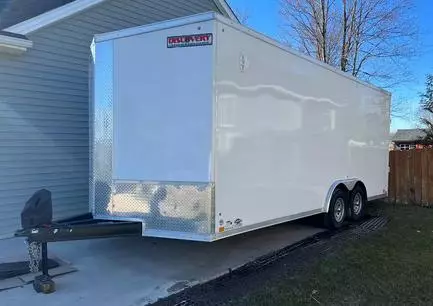
The drop hitch is the small piece of steel that decides whether your cargo trailer rides level or wags down the highway like a kite on a string. Pick the wrong drop, ball size, or shank length and you'll spend the trip fighting porpoising, brake squat, and tire wear. This guide walks through how to measure for the right drop, which hitch classes match common cargo trailers, the three categories of drop hitch worth your money, and the build details that separate a $40 drop ball mount from one that will last a decade.
What a Drop Hitch Actually Does
A drop hitch (also called a drop ball mount) slides into your tow vehicle's receiver and positions the trailer ball below the receiver opening. The drop, measured in inches from the bottom of the receiver to the top of the ball platform, exists to bring a tall truck or SUV's hitch height down to the trailer's coupler height. The goal is simple: the trailer frame should sit dead level when fully loaded, with the ball squarely under the coupler.
A level trailer puts weight on all axles evenly, keeps brake controllers calibrated correctly, and stops the trailer from pushing or pulling the back of the tow vehicle. A nose-high trailer overloads rear axles. A nose-low trailer overloads the front axle and lifts the rear, which kills steering response. There's no exception for cargo trailers; the same rule applies whether you're hauling 800 lbs of moving boxes or 7,000 lbs of equipment.
How to Measure for the Right Drop
Step 1: Measure receiver height
Park your tow vehicle on level ground, loaded as it will be when towing. Measure from the ground to the top of the inside opening of the receiver hitch. This is your receiver height (A).
Step 2: Measure coupler height
Park your trailer on the same level surface, fully loaded. Measure from the ground to the inside top of the coupler. This is your coupler height (B).
Step 3: Calculate the drop
Subtract: A minus B = required drop. If A is 22 inches and B is 18 inches, you need a 4 inch drop hitch. Always round to the nearest available drop (most hitches come in 2, 4, 6, 8, and 10 inch drops). For an in-depth refresher on prepping the rest of your towing system, see our cargo trailer towing checklist.
Hitch Class and Capacity
The drop hitch's weight rating must match or exceed both the receiver's class rating and the trailer's loaded weight (GVWR). Pairing a Class V receiver with a Class II drop hitch is a recipe for a failed shank. The chart below shows typical maximum trailer weights by receiver class.
NeighborsTrailer.com
The Three Drop Hitch Categories Worth Buying
1. Fixed Drop Ball Mount
A solid forged or cast steel shank with a fixed drop and a single ball welded or bolted to the platform. Cheapest, simplest, and effectively impossible to break if rated correctly. Best when you tow one trailer with one truck and the heights never change. Look for forged steel construction (not stamped) and a welded-on ball collar rather than a free-spinning ball.
2. Adjustable Drop Hitch (Pin-Style)
A vertical shank with bolt holes every 1 inch, paired with a removable ball platform that can be flipped to provide drop or rise. This is the right choice for most cargo trailer owners because you can fine-tune to within an inch of perfect level, and the same hitch handles multiple trailers. Look for chromoly steel shanks and a Grade 8 pin and clip combo. Our adjustable hitch buying guide covers the tradeoffs in more detail.
3. Multi-Ball Adjustable Hitch
The premium category. An adjustable shank with two or three balls (1-7/8, 2, and 2-5/16 inch) on a rotating or flippable platform. If you tow a small utility trailer one weekend and a 16 foot cargo box the next, this style eliminates the need to swap balls. Look for stainless or zinc-coated balls, a positive-lock pin system, and a Greaseable Bearing-style spinning ball that turns smoothly under load.
Drop Hitch Sizing Reference
Use the quick reference table below to narrow your selection. Always confirm the final fit on level ground with the trailer fully loaded.
| Tow Vehicle Receiver Height | Typical Cargo Trailer Coupler Height | Recommended Drop | Common Vehicle Match |
| 16 inches | 18 inches | 2 inch rise | Sedan, crossover |
| 18 inches | 18 inches | Level (no drop) | Half-ton, mid-size SUV |
| 20 inches | 18 inches | 2 inch drop | Half-ton lifted, full SUV |
| 22 inches | 18 inches | 4 inch drop | Three-quarter ton stock |
| 26 inches | 18 inches | 8 inch drop | One-ton dually, leveled |
Build Quality Markers to Look For
Drop hitches are one of the few towing components where overbuilding actually shows in the steel grade and finish. The hitches that survive a decade of cargo work share five traits: forged or cold-rolled steel construction, a hot-dip galvanized or zinc-plated finish, a minimum 2 inch ball platform thickness, Grade 8 hardware throughout, and a clearly stamped GTW (gross trailer weight) rating on the shank itself. Avoid any hitch with a paper sticker as the only rating label; that paper rating won't survive its first rainstorm.
Common Mistakes to Avoid
The most expensive drop hitch mistake is using a higher drop than needed "just in case." A 10 inch drop on a half-ton truck pulling a 14 foot cargo trailer puts huge leverage stress on the shank and receiver. Match the drop to your actual height difference. The second most common error is mismatching the ball size to the coupler. A 2 inch ball will appear to fit inside a 2-5/16 inch coupler but will rip out the first time the trailer hits a real bump. Always confirm the stamped coupler size and the stamped ball size match exactly. Finally, never reuse the hitch pin and clip. Replace both annually; the steel work-hardens and the clip springs lose retention strength.
Maintenance and Safety Checks
Once a season, pull the drop hitch out of the receiver, wire-brush the shank, and check for any visible cracks at the weld between platform and shank. Hose down the ball, dry it, and apply a light coat of marine grease. Inspect the hitch pin and clip; replace both if there's any visible bend or surface rust. Confirm the receiver tongue on your tow vehicle is also free of corrosion; a frozen receiver can hide a cracked weld until the worst possible moment.
Frequently Asked Questions
Can I use the same drop hitch on different trailers?
Yes, as long as each trailer's coupler size matches the ball on the hitch and the trailer's GVWR is at or below the hitch's stamped rating. An adjustable drop hitch with multiple ball sizes makes this swap easy.
What's the difference between a drop hitch and a weight distribution hitch?
A drop hitch repositions the ball vertically to keep the trailer level. A weight distribution hitch uses spring bars to transfer tongue weight forward onto the tow vehicle's front axle, which is a separate problem from height matching. Heavier cargo trailers often need both.
Is a steel drop hitch better than aluminum?
For cargo trailers, almost always yes. Aluminum drop hitches save weight but cannot match the shock load capacity of forged steel. Save aluminum for light utility hauling.
How tight should the hitch pin be?
Snug, with the clip fully seated through the back of the pin. If the shank rattles in the receiver, add an anti-rattle device or a tighter-tolerance pin; rattle accelerates wear on both the shank and the receiver tongue.
Final Thoughts
The best drop hitch is the one that matches your truck's receiver, your trailer's coupler, and your typical load. For most cargo trailer owners, that means an adjustable, pin-style drop hitch in chromoly steel with a Grade 8 pin set. Spend $80 to $180 once, and you'll keep the same hitch through three trucks. For more on adjusting hitches across multiple trailers, our adjustable hitch reference walks through specific model recommendations.
Related Articles
- Should You Buy an Adjustable Hitch?
- Safe Towing Tips for Cargo Trailer Rentals
- Cargo Trailer Rental Towing Checklist
- Cargo Trailer Adjustable Hitches
Content updated May 2026