20 Common Trailer Issues and How to Troubleshoot Them
 Neighbors Trailer .
Sep 5, 2024 1762 9 min read Basic Trailer troubleshootin
20 Common Trailer Issues and How to Troubleshoot Them
Every trailer eventually develops a problem. The good news is that 80 percent of the issues owners actually face fall into about 20 well-known patterns, and most of them are fixable in a driveway with basic tools. This troubleshooting guide walks through the 20 most common trailer issues, what causes each one, and the fastest fix that gets you back on the road.
Use it as a diagnostic checklist before you call a shop. Most of these problems can be ruled in or out within minutes, and many cost less than $50 to repair when caught early.
How Often Trailer Owners See Each Issue
NeighborsTrailer.com
Issue Severity at a Glance
| Issue | Safety Risk | Typical Fix Cost | DIY Friendly? |
| Tire blowout or sidewall failure | High | $120 to $400 | Yes |
| Wheel bearing failure | High | $40 to $250 | Yes |
| Electric brake malfunction | High | $80 to $300 | Sometimes |
| Wiring harness short or open | Medium | $15 to $150 | Yes |
| Brake controller mismatch | Medium | $90 to $300 | Yes |
| Bent or stuck coupler | High | $60 to $400 | Sometimes |
| Sway under load | High | $0 (load redistribution) | Yes |
| Frame rust or crack | High | $200 to $2,000 | No |
| Worn jack or tongue jack failure | Low | $50 to $150 | Yes |
| Lights out or flickering | Medium | $10 to $60 | Yes |
The 20 Most Common Trailer Issues
1. Tires Wearing Unevenly
Cupping, scalloping, or one-sided wear almost always points to one of three causes: incorrect inflation, misaligned axles, or worn bearings. Check pressure cold, then look for play in the wheel by jacking up the trailer and rocking the tire vertically and horizontally. For pressure and rotation guidance, see this guide to choosing the right tires for your trailer.
2. Tire Blowouts
Highway blowouts on trailer tires usually trace back to four things: under-inflation, overloading, age past 5 to 7 years, and heat from dragging brakes. Replace tires by date code, not tread depth, on any trailer that sits for months at a time.
3. Lights Not Working
Start at the connector at the tow vehicle. Use a $15 test light or a 4-pin tester to verify each pin. If the tow vehicle is delivering current, the problem is in the trailer harness, ground strap, or bulb. Ground straps are the single most common failure point.
4. Flickering or Dim Lights
Almost always a ground problem. Trailer lights ground through the coupler, which corrodes over time. Clean the coupler ball and the trailer's ground stud, then re-test. A dedicated ground wire bolted to the frame eliminates the issue permanently.
5. Brake Controller Will Not Detect Trailer
Check the blue wire at the controller and the brake magnet wires at each wheel. A broken blue wire is the most common cause. Use a multimeter to verify continuity between controller and wheel. This comparison of surge vs electric brakes covers the basic operating principles you need to understand the controller circuit.
6. Electric Brakes Pull to One Side
Imbalanced braking comes from differences in magnet wear, drum scoring, or a sticking wheel cylinder. Inspect both magnets for thickness, replace as a pair, and clean drum surfaces with brake parts cleaner before reassembly.
7. Surge Brakes Stick or Drag
The actuator on a surge brake trailer should retract freely when the tow vehicle moves forward. If brakes stay engaged, the actuator damper is failing or the brake fluid is contaminated. Bleed the line and replace the damper if it does not return smoothly.
8. Wheel Bearings Overheating
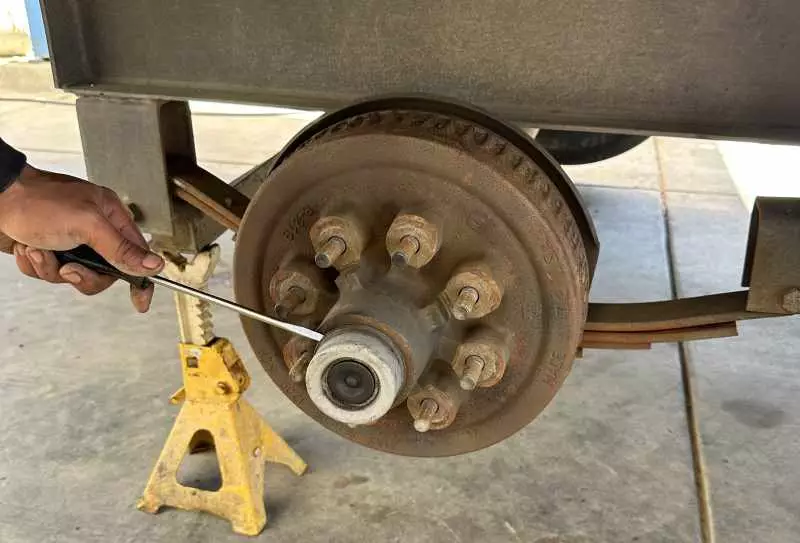
Hot bearings glow on a pre-trip thermal scan, melt grease, and eventually seize. Causes include over-tightened castle nuts, contaminated grease, or a failed seal allowing water in. Repack annually for trailers that store outdoors. For the full procedure and importance, this wheel bearing servicing guide walks through inspection and replacement.
9. Coupler Will Not Latch
The latch tongue inside the coupler is bent, the spring is broken, or there is debris in the throat. Clean the coupler interior, lubricate the moving parts, and inspect the latch tongue for wear. Replacement couplers are inexpensive and bolt or weld on.
10. Trailer Sways at Highway Speed
Sway has two main causes: incorrect tongue weight (under 10 percent of gross trailer weight) and overloaded rear of trailer. Move 60 percent of cargo weight forward of the axle. A weight distribution hitch with anti-sway is the second-line fix for travel trailers.
11. Tongue Jack Will Not Crank
Mechanical jacks suffer from stripped gears, bent shafts, or dry threads. Electric jacks fail at the motor or fuse. Lubricate the screw with white lithium grease annually and replace the unit when threads are stripped past safe operation.
12. Safety Chains Drag
Chains should cross under the coupler with just enough slack for full turning, never enough to drag on pavement. Shorten chains by adding a quick-link or replacing them with shorter rated chains. Dragging chains spark and lose links.
13. Brake Magnets Worn Out
A worn brake magnet has a measurably thinner face and weaker pull. Test with a multimeter for resistance (should read 3.2 ohms on most trailer brake magnets) and inspect the contact surface. Replace in pairs to maintain even braking.
14. Wheel Hub Won't Hold Grease
A leaking grease seal means the rear seal is shot, allowing grease to escape onto the brake shoes. Replace the inner seal as part of any bearing repack. Grease-contaminated brakes drag and lose stopping power.
15. Frame Rust at Welds
Surface rust is cosmetic. Rust that has pitted through a weld is structural and means a frame inspection before the next tow. Sand to bare metal, treat with a phosphoric-acid converter, and prime and paint immediately. Welded reinforcement is the only fix for cracks.
16. Trailer Pulls Crooked
A trailer that pulls off-center loaded is usually misaligned at the axle or has uneven tire pressures. Measure from the coupler to each axle end, both sides should be within 1/8 inch. If they are not, the axle is bent and needs replacement.
17. Wiring Connectors Corroded
Green corrosion inside the 7-way or 4-way connector kills electrical contact. Spray with electrical contact cleaner, scrub the pins with a brass brush, and apply dielectric grease before re-connecting. Severely corroded plugs should be cut off and replaced.
18. Trailer Won't Track Straight in Reverse
If the trailer jackknifes immediately even with small steering input, the wheelbase is short relative to the load, the trailer is overloaded behind the axle, or one wheel has more friction than the other. Practice small steering corrections, then verify load placement.
19. Deck Boards Rotting
Trailer decks see weather constantly. Replace cracked boards before they fail under load. Pressure-treated pine is standard, but composite and aluminum tread plate offer longer life. Bolt boards rather than nail them so they can be replaced individually.
20. Tail Light Lens Cracked or Cloudy
UV exposure cracks plastic lenses over years of storage. Cracked lenses let in water and short the bulb. Replacement LED tail-light assemblies cost $20 to $50 per pair and last far longer than incandescent originals.
The Pre-Tow Inspection That Catches Most of These
Before every trip, walk the trailer and check: tire pressure cold, lug nut torque, all lights with a helper, coupler latched and pinned, safety chains crossed, breakaway battery charged, brake controller responsive, jack fully retracted, ground strap intact, and cargo secured with 60 percent ahead of the axle. Five minutes of inspection prevents 90 percent of roadside breakdowns.
When to Stop and Call a Mechanic
Most of these issues are DIY-friendly with basic tools. Three exceptions warrant a professional: any frame crack or weld separation, hot bearings that have already smoked or seized, and brake fluid leaks in surge systems. Each of these can fail catastrophically in transit, and the repair complexity exceeds what most owners are equipped to handle in a driveway.
Frequently Asked Questions
How often should I service my trailer brakes?
Inspect electric brake magnets and drums annually or every 12,000 miles. Repack bearings at the same interval. Surge brakes need annual fluid bleeding and damper inspection.
What is the most common trailer breakdown?
Lighting and wiring failures, followed by tire issues. Both are caused mostly by corrosion and storage damage rather than highway use, which is why pre-trip checks matter.
Can I drive home with a partially failed brake?
Only if the failure is on one wheel and you significantly reduce speed and load. Total brake failure on a loaded trailer should be addressed before continuing the tow. Never rely on the tow vehicle's brakes alone for a trailer over 3,000 pounds.
How do I know if my axle is bent?
Measure from the coupler to each axle end on both sides. The numbers should be within 1/8 inch. A larger difference indicates a bent axle and means the trailer should not be towed at highway speed until repaired.
How long do trailer tires last?
Five to seven years from the manufacture date stamped on the sidewall, regardless of tread depth. Trailer tires age out before they wear out for most owners.
Bottom Line
Most trailer breakdowns trace back to maintenance that was skipped, not catastrophic mechanical failure. Run a five-minute pre-tow inspection every time, repack bearings annually, replace tires by date code, and clean grounds at the first hint of flickering lights. The cost of doing those four things adds up to a fraction of one tow truck call, and the trailer will outlast most of the trucks that pull it.
Related Articles
- Car Trailer Wiring Troubleshooting
- Cargo Trailer Brake Controller Issues
- Why Servicing Your Trailer's Wheel Bearings Matters
- Keep Trailer Tires in Excellent Condition
Content updated May 2026