

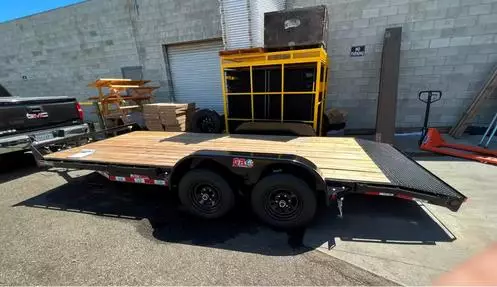
How to Back Up a Trailer
 Neighbors Trailer
Sep 7, 2023 496 8 min read
Pulling a flatbed trailer forward is rarely the hard part. Reversing is where most first-time renters lose their nerve, clip a curb, or jackknife in the driveway. The good news: backing a flatbed trailer is mostly muscle memory and a few mental habits. Once you understand why the trailer moves the way it does and know how to correct a drift early, reversing becomes one more predictable part of the drive.
This guide walks through how to reverse a flatbed trailer rental, from the physics of trailer steering to step-by-step technique for straight-line backing and turning into a tight space. If this is your first rental, skim it once at home and read it again at the pickup lot before the trailer is hooked up.
Why Reversing a Trailer Feels Counterintuitive
When you turn the steering wheel right in reverse, a solo truck swings right. With a flatbed hitched up, the trailer goes left. That mirror-image effect is what throws first-time drivers off. The trailer pivots at the hitch ball, so every input at the front wheels creates an opposite reaction at the trailer.
The longer the trailer, the slower it responds. A 20 foot flatbed needs bigger, earlier steering inputs than a 10 foot utility trailer. A shorter trailer, by contrast, turns instantly and can jackknife before you notice. Knowing which you are driving is half the battle.
Before You Put It In Reverse
Walk Around the Truck and Trailer
Check that safety chains are crossed under the tongue, the coupler is seated on the ball, the breakaway cable is attached, and the trailer lights are working. Confirm tire pressure and look for anything loose on the flatbed deck. A strap flapping off the side is easy to miss in the mirrors.
Pick a Reference Point on the Trailer
Before moving, find one feature on the flatbed (a stake pocket, a fender edge, a tie-down point) that you can see in the side mirror. That point becomes your steering reference. If it stays in the middle of the mirror, the trailer is tracking straight. If it drifts toward the mirror, the trailer is swinging that direction.
Adjust Both Side Mirrors Wide
Roll the side mirrors out until you can see the full length of the trailer down to the rear axle. You should not be using the rear-view mirror to back a flatbed; the deck will block your view. Side mirrors are the entire game in reverse.
The Bottom-of-the-Wheel Technique
There is one mental trick that makes backing a flatbed dramatically easier. Place your hand on the bottom of the steering wheel, not the top. In reverse, wherever your bottom hand moves is the direction the trailer will go. Push your bottom hand right and the trailer swings right. Push left and the trailer swings left.
This flips the counterintuitive steering into something intuitive. You no longer have to think "opposite of where I want to go." The wheel input matches the trailer movement.
Step-by-Step: Straight-Line Backing
Step 1: Set Up in a Straight Line
Pull the truck and trailer so both are aligned before reversing. A crooked start makes every correction harder. If you are backing into a driveway, pull past the entrance and line up square.
Step 2: Start Slow and Use Small Inputs
Ease off the brake without touching the gas. At idle speed, the truck moves just fast enough to steer. Big, fast steering corrections cause overcorrection and jackknifing. Small, early inputs keep the trailer tracking straight.
Step 3: Correct the Drift, Don't Chase It
If the trailer starts drifting left in the mirror, nudge your bottom hand slightly left. As soon as the drift stops, return the wheel straight. Chasing a drift by holding the wheel over too long creates a zig-zag that gets worse every correction.
Step 4: Stop and Pull Forward If You Lose the Line
Nothing resets the trailer faster than pulling forward a car length. If the trailer has drifted past where you can recover with small inputs, stop, pull forward to straighten, and start again. Most seasoned drivers pull forward multiple times when backing into a tight space. It is not a failure; it is the technique.
Turning Into a Spot: The "Palm Push" Method
Backing into a driveway or parking slot adds one more layer: you need the trailer to curve as it moves. Approach the spot from the opposite side so the trailer has room to swing. Place your bottom hand on the wheel and push toward the spot. Watch the mirror until the trailer starts to angle. Then slowly unwind the wheel so the truck follows the trailer into the spot.
The most common mistake is holding the turn too long. As soon as the trailer is angled correctly, return the wheel to straight and let the truck track in behind the trailer. Correct small drifts with short inputs, not sustained steering.
Reverse-Difficulty Benchmark by Flatbed Length
Not every flatbed rental reverses the same. Longer decks are more forgiving in the sense that they react slowly, but they need more practice to judge. Here is a rough benchmark for how long most first-time drivers take to feel comfortable with straight-line backing.
NeighborsTrailer.com
Quick Reference: Common Backing Problems and Fixes
| Problem | What You Are Seeing | Fix |
| Jackknife starting | Sharp angle between truck and trailer | Stop, pull forward, realign, try again with smaller steering input |
| Trailer drifting right | Trailer reference point moving into right mirror | Small left input on bottom of wheel, return to straight as soon as drift stops |
| Truck drifting but trailer straight | Trailer tracking well, truck angled | Counter-steer to bring truck back in line while trailer continues |
| Losing sight of trailer | Trailer disappearing from side mirror | Stop immediately, pull forward, reset mirrors wider |
| Overcorrection zig-zag | Trailer swinging left-right-left progressively | Stop, pull forward, start with neutral wheel, use smaller inputs |
Using a Spotter the Right Way
A spotter is the single fastest way to reverse safely in an unfamiliar spot. Position them where you can see them in the side mirror, not behind the trailer where you cannot. Agree on hand signals before you start. Keep the windows down so they can stop you with a voice call if a signal is missed. A good spotter watches the trailer path, not the truck.
Practicing Before the Real Job
Spend 15 to 30 minutes in an empty parking lot before your first reversing job. Set up two cones about twice the width of your trailer. Practice backing straight between them, then practice curving into a 90 degree "slot." That short rehearsal is worth more than reading ten guides. For a broader look at driving with a large trailer, there is a dedicated safety 101 post worth skimming.
Reversing a Flatbed Trailer FAQ
How slow should I go when backing a flatbed?
Idle speed is plenty. If you can comfortably walk beside the trailer, you are going a safe speed. Faster gives you less time to correct a drift.
Is a rear backup camera enough?
For short utility trailers, yes. For a flatbed over 14 feet, the deck blocks most of the camera view. Side mirrors remain the primary reference.
What is the tightest spot a long flatbed can reverse into?
It depends on truck wheelbase and deck length, but a useful rule is to leave roughly one trailer length of swing room on the approach side. Less than that and you will need to pull forward multiple times.
Does a weight distribution hitch change how the trailer backs up?
Not meaningfully. WD hitches spread the tongue load across both tow vehicle axles but do not change how the trailer pivots. Sway control friction bars, however, can add a small delay to trailer response in reverse.
Can I back a flatbed trailer with no load?
Yes, and an empty flatbed is actually a little squirrellier than a loaded one because it has no weight dampening small steering inputs. Practice empty, then practice loaded; the empty version is closer to worst case.
Put It All Together
Backing a flatbed trailer rental reduces to five habits: mirrors wide, hand on the bottom of the wheel, small inputs, correct early, and pull forward to reset. Those five habits get rehearsed in a parking lot in an afternoon and stick for life. If you are about to pick up your first flatbed, Neighbors Trailer's beginner towing tips pair well with this reversing guide.
Related Articles
- Trailer Safety 101: Driving With a Large Trailer
- Beginner Tips for Towing a Large Flatbed
- Essential Flatbed Safety Tips
- Towing Mistakes to Avoid With a Flatbed
Content updated April 2026