

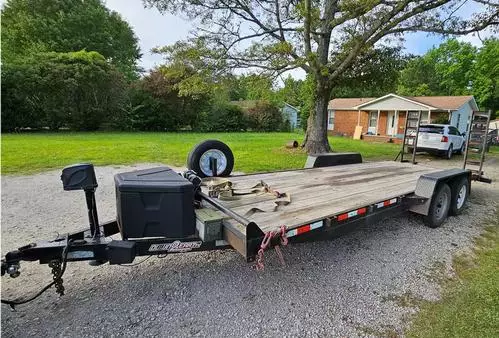
How to Select a Ball Mount for Your Flatbed Trailer Rental
 Neighbors Trailer
Sep 6, 2023 338 8 min read selecting trailer ball and moun
Hooking a flatbed trailer to a truck looks simple from the outside, but the one fitting that carries the full load of your haul is the ball mount. Choose the wrong one and the trailer sits too high or too low, the hitch ball wobbles in the coupler, and every bump on the road turns into a new worry. This guide walks through exactly how to pick a ball mount for a flatbed trailer rental so your first trip is smooth, level, and safe.
Whether you are hauling landscaping equipment, a pallet of materials, or a small piece of machinery, the ball mount is the link between your tow vehicle and the trailer. Get it right once and you can reuse the same setup across most of the flatbed rentals on Neighbors Trailer without a second guess.
What a Ball Mount Does (and Why the Right One Matters)
A ball mount is the metal arm that slides into the receiver tube on the back of your truck. One end locks into the receiver with a hitch pin. The other end carries the hitch ball, which drops into the trailer coupler. The ball mount decides three critical things: how high or low the coupler sits, how much weight the hitch can legally carry, and whether the hitch ball even matches the trailer coupler.
Get any of those three wrong and the trailer rides unlevel. An unlevel flatbed puts uneven pressure on tires and axles, shortens brake life, and can cause sway at highway speeds. A ball mount that is underrated for the load is even more dangerous because it can bend or separate from the receiver while towing.
Parts of a Ball Mount You Should Know
Before shopping, it helps to know the four parts you are actually comparing between products.
- Shank: The square bar that slides into the receiver tube. Sizes are standardized (see the table below).
- Drop or rise: The vertical offset from the shank to the hitch ball platform. A "2 inch drop" lowers the ball by 2 inches; a "2 inch rise" raises it.
- Ball platform: The flat pad where the hitch ball is bolted. This has a rated weight capacity.
- Hitch ball: The round ball that seats inside the trailer coupler. Most flatbed rentals use a 2 inch or 2-5/16 inch ball.
How to Pick the Right Ball Mount for a Flatbed Trailer Rental
Step 1: Measure the Hitch Drop or Rise
Park your truck and the trailer on the same flat surface. Measure from the ground to the top inside of your receiver tube opening. Then measure from the ground to the top of the trailer coupler. Subtract the two values. If the coupler sits lower than the receiver, you need a ball mount with a drop. If the coupler sits higher, you need a ball mount with a rise. The goal is a loaded trailer that rides level, not nose up or nose down.
Step 2: Match the Shank Size
The shank must match the receiver tube on your tow vehicle. A 2 inch shank will not fit a 1-1/4 inch receiver, and a 2 inch shank rattles in a 2-1/2 inch receiver. Check the decal on your receiver or your owner manual. If you absolutely must bridge a size gap, use a dedicated adapter sleeve rated for the load, not a washer stack.
Step 3: Check the Weight Rating
Every ball mount has two ratings stamped on the shank: Gross Trailer Weight (GTW) and Tongue Weight (TW). Tongue weight is usually about 10 to 15 percent of the loaded trailer weight. Your ball mount must be rated at or above the weight of the loaded flatbed, not the empty trailer. When in doubt, size up.
Step 4: Decide Between Fixed and Adjustable
A fixed ball mount has one hitch ball at one drop height. It is cheap, strong, and simple. An adjustable ball mount lets you change the drop height and sometimes swap between two ball sizes. If you rent different flatbed or utility trailers throughout the year, an adjustable mount usually pays for itself in the first season.
Step 5: Confirm Ball Diameter
The hitch ball has to match the trailer coupler exactly. Most flatbed rentals in the 5,000 to 10,000 lb range use a 2 inch ball. Heavier flatbeds often use a 2-5/16 inch ball. A 1-7/8 inch ball is common on small utility trailers. Mixing sizes seems harmless, but a smaller ball inside a larger coupler can pop out mid turn.
Ball Mount Shank and Class Quick Reference
Use this table to cross-check the shank size, rating class, and the kind of flatbed haul each one is built for.
| Shank Size | Hitch Class | Typical GTW | Typical Tongue Weight | Best For |
| 1-1/4 in | Class I / II | Up to 3,500 lb | Up to 350 lb | Small utility trailers, bike racks |
| 2 in | Class III | Up to 8,000 lb | Up to 800 lb | Single-axle flatbeds, landscaping loads |
| 2 in (heavy-duty) | Class IV | Up to 12,000 lb | Up to 1,200 lb | Tandem-axle flatbeds, equipment hauling |
| 2-1/2 in | Class V | Up to 18,000 lb | Up to 2,000 lb | Heavy commercial flatbed rentals |
Most Common Ball Mount Fit Issues on Flatbed Rentals
Looking across first-time flatbed renters, the fit problems that cause the most back-and-forth at pickup fall into a handful of categories. The chart below shows the share of reported issues by type, so you know what to check first.
NeighborsTrailer.com
The biggest category by far is an incorrect drop or rise. The fix is simple: take two minutes to measure before you leave the house. A close second is a shank that does not match the receiver, which is easy to verify with a tape measure on the receiver opening.
Mistakes to Avoid When Buying a Ball Mount
A few missteps show up again and again, even with experienced drivers. Skim this list before you buy.
- Buying by price alone. A $20 ball mount saves nothing if it bends under your load.
- Ignoring tongue weight. The trailer may be under 8,000 lb loaded, but the tongue could still exceed your hitch's TW rating.
- Reusing a rusty hitch ball. Pitting and wear can change the effective ball diameter, which lets the coupler rock in the socket.
- Skipping the hitch pin clip. The pin prevents the ball mount from working loose. Use the clip, every single time.
- Forgetting the truck side. Your receiver, crossmember, and tow vehicle prep all have to match the load before you roll.
Ball Mount Selection FAQ
Can I use the same ball mount for every flatbed rental?
Sometimes, but not always. If you rent flatbeds in a similar size class (for example, 6x12 and 6x14 tandem axles), one quality adjustable ball mount usually works. If you switch between a small utility trailer and a heavy flatbed, you likely need two mounts with different ratings and drops.
What happens if the trailer is not level?
An uneven trailer transfers too much weight to either the front or rear axle. Nose-down loading overworks the front trailer tires and can cause the tongue to dig in on speed bumps. Nose-up loading reduces weight on the tow vehicle's rear axle and causes sway at highway speeds.
Do I need a weight distribution hitch for a flatbed?
For most flatbed rentals under 6,000 lb loaded, no. Above that weight, or any time the tongue weight approaches your receiver's max, a weight distribution hitch is a smart upgrade. It spreads the load across both axles of the tow vehicle.
Is it safe to buy a used ball mount?
A used ball mount is fine as long as there is no visible bending, cracks in the shank, or heavy rust on the ball platform. Replace the hitch ball itself if you see pitting or flats worn into it.
How tight should the hitch ball be torqued?
Torque the nut under the ball platform to the spec printed on the ball or in its instructions, typically around 250 ft-lb for a 2 inch ball. A loose ball will slowly spin in the platform and eventually back itself off.
Final Check Before You Hit the Road
Once the ball mount is installed, take ninety seconds for a walk-around. Confirm the hitch pin and clip are in place, the coupler latch is fully engaged over the ball, the safety chains are crossed under the tongue, and the trailer sits level on the tow vehicle. Those four checks catch almost every ball mount related problem before you leave the driveway. For more on flatbed safety, Neighbors Trailer has a full tips guide worth reading before your first haul.
Picking the right ball mount is not complicated; it is careful. Measure, match, and check the ratings, and a flatbed trailer rental becomes a predictable, boring drive, which is exactly what you want.
Related Articles
- How to Choose the Right Flatbed Trailer Rental
- Essential Safety Tips for Flatbed Trailer Rentals
- Towing Mistakes to Avoid With a Flatbed Trailer
- Prepping a Flatbed Trailer for Safe Spring Towing
Content updated April 2026